It is not entirely clear what role tanks will play in a future great-power conflict, given the mauling Russian tanks have received at the hands of drones in Ukraine.
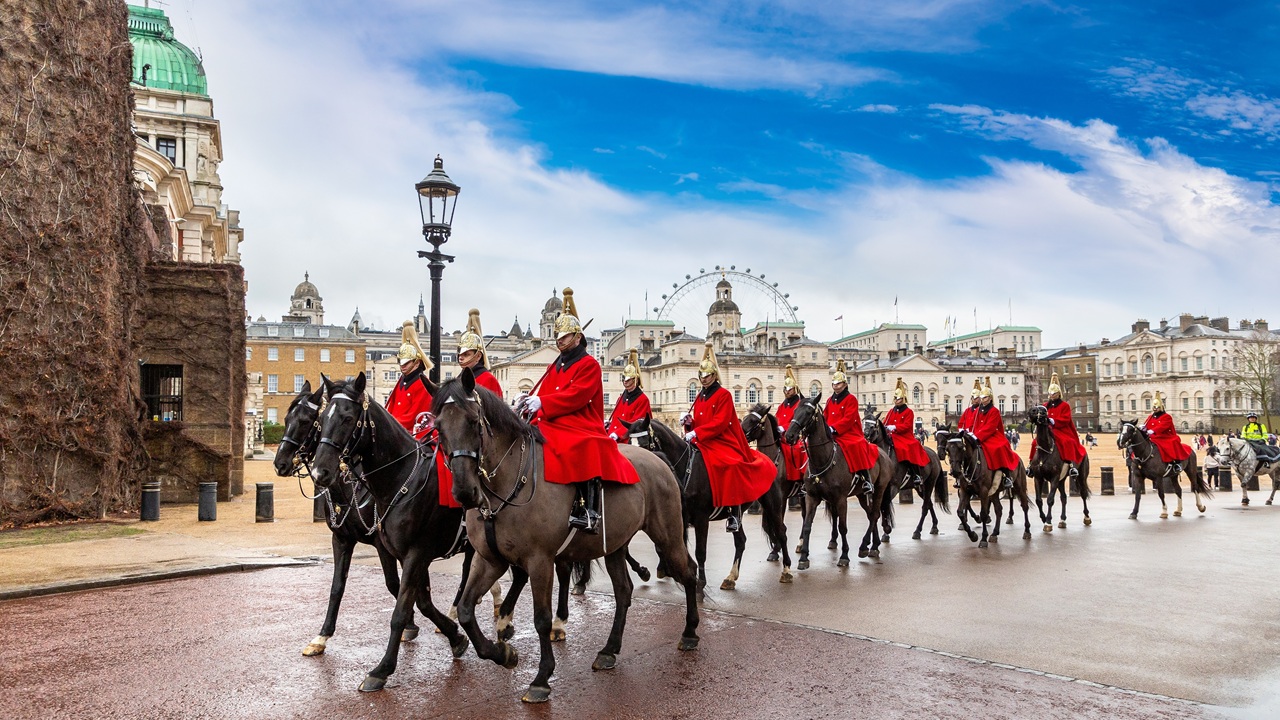
In 2013, the BBC raised eyebrows after reporting that the British Army had more horses than it had tanks. At that time, the British Army had only 334 tanks still in service, including the Challenger 2 main battle tank (MBT). Conversely, it retained 501 horses, primarily for ceremonial purposes with the King’s Troop Royal Horse Artillery and the famed Household Cavalry.
In the decade since, the British Army has continued to reduce its tank force, with the number of horses remaining unchanged at around 500. Today, the balance is even more lopsided, with twice as many horses in service as there are tanks. Current estimates show the British Army operates between 227 and 288 MBTs—and upwards of half of those may not be combat-ready.
This isn’t the first time that the British Army has had far more horses than tanks. During World War I, the British military had possession of roughly one million horses, including in combat roles. Only 62,000 of these survived the war. By comparison, the British Army fielded approximately 2,600 tanks by 1918.
The advent of trucks for logistics during and after the war drastically cut down on the need for horses. Only a generation later, during World War II, the only significant use of horses by the British military was by General Orde Wingate and the Chindit raiders in Burma, where horses and mules carried supplies behind enemy lines.
It’s Been a Long Time Since the UK Fought a Tank Battle
It has been more than 20 years since the British Army deployed tanks in any combat operations. British Challenger 2 MBTs were used during the 2003 invasion of Iraq, where they formed a significant part of the ground forces. The tanks were present at the Battle of Basra from March 21 to April 6, 2003, the largest tank battle of the war. Two British MBTs were damaged, but the Royal Scots Dragoon Guards successfully destroyed 14 Iraqi tanks in the same engagement.
British armor’s heyday came during the 1991 Gulf War, when it truly dominated the battlefield. British tank crews fought alongside US forces in the Battle of Norfolk—named for “Operation Norfolk,” the area where several desert trails intersected and a large Iraqi supply depot was located. The battle, fought in late February 1991, was a major coalition victory, where British and American forces destroyed approximately 850 Iraqi tanks and hundreds of other vehicles.
It long served as a reminder of what British MBTs could do on the battlefield. Yet the massive losses of Russian tanks in Ukraine to drones and man-portable anti-tank weapons have upended that thinking. Are MBTs really still what is needed in the 21st century?
The British Army Has Fewer, but More Capable, Tanks
The British Army hasn’t entirely given up on its tanks. Development continues on the Challenger 3, a significant upgrade effort for the aging Challenger 2 MBTs. The tanks will receive next-generation modular armor, including the Rafael Trophy active protection system (APS) and composite armor. The modular protection was developed by a team of “armor experts” at the UK’s Defence Science and Technology Laboratory (DSTL) with additional support from the Ministry of Defence’s Defence Equipment & Support (DE&S) and RBSL. In addition, new turrets will be outfitted on the tank hulls.
A total of 148 of the British Army’s Challenger 2s are currently scheduled to receive the upgrade, which could keep the MBTs in service into the 2040s.
The US Army is seeking to update its M1 Abrams with the M1E3 variant, recently unveiled at the Detroit Auto Show. The US Army also reversed course on its plans to retire most of its ceremonial equine units. It will keep two for ceremonial roles, as well as the “Old Guard” units that are used in high-profile military funerals—but unlike across the Atlantic, it is likely to maintain far more tanks than horses for the foreseeable future.
Finally, even as the British Army has more horses than tanks, it should be noted that the UK’s Royal Navy now has more admirals than combat warships!
About the Author: Peter Suciu
Peter Suciu has contributed over 3,200 published pieces to more than four dozen magazines and websites over a 30-year career in journalism. He regularly writes about military hardware, firearms history, cybersecurity, politics, and international affairs. Peter is also a contributing writer for Forbes and Clearance Jobs. He is based in Michigan. You can follow him on Twitter: @PeterSuciu. You can email the author: [email protected].
Image: Shutterstock / Sergii Figurnyi.