One of the most persistent myths since October 7, 2023, is that college students organically gravitated toward militant pro-Palestinian activism. On those campuses that saw the most aggressive demonstrations, in fact, radical elements may have seeded the ground for disruptive protests.
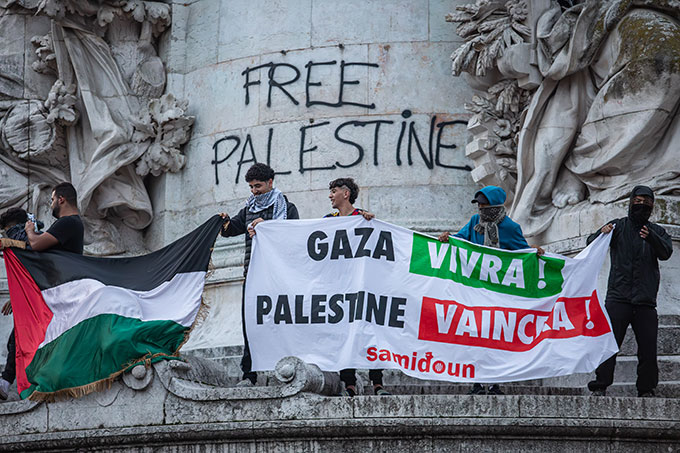
One such radical group has embedded itself at the University of Washington: the Tariq El-Tahrir Student Network, which presents itself as “an international network of Palestinian, Arab, and Internationalist youth, students and organizations,” and which is linked to a designated foreign terrorist organization. Tariq El-Tahrir is the youth arm of Masar Badil, a Canada-based political group with close ties to the terrorist group Popular Front for the Liberation of Palestine and to Samidoun, the “sham charity” that fundraises on the PFLP’s behalf.
Finally, a reason to check your email.
Sign up for our free newsletter today.
Tariq El-Tahrir is also closely tied to SUPER UW (Students United for Palestinian Equality and Return at University of Washington), the campus activist group responsible for doing $1 million in damage during a building occupation last May and, separately, laying siege to Microsoft’s offices later that year. Together, the groups organized an online seminar featuring a reported Hamas terrorist, among other notables.
The connection between a student protest organization (SUPER UW) and the youth wing of a terrorist proxy (Tariq El-Tahrir) gives a glimpse into the extreme edge of campus activism—and potentially provides a hook for legal action.
Tariq El-Tahrir is active around the globe, acting alternately as a proxy for and supporter to Samidoun and Masar Badil. In places where Samidoun is banned—like Israel, Germany, Canada, and the United States—Tariq El-Tahrir works to connect young people to its broader operation. In nations like Brazil, Greece, Italy, Belgium, and Spain, where Samidoun can operate freely, Tariq El-Tahrir amplifies its efforts.
In the United States, the group has fostered connections between activists and hostile foreign powers. For example, it has sent multiple delegations to the Permanent Mission of the Islamic Republic of Iran to the United Nations. One of these events featured the prominent radical Calla Walsh, who three weeks later appeared in Iran at the Sobh Festival, where she publicly chanted, “Death to America, Death to Israel.”
A glimpse into Tariq El-Tahrir’s campus influence comes through the “Path of Liberation” webinar series the network launched in October, featuring SUPER UW as a “collaborator” on each installment. The lectures covered “a range of critical topics related to building a revolutionary youth alternative to the liquidationist Oslo path”—a reference to the Oslo Accords, an attempted détente between Israel and the terrorist Palestinian Liberation Organization.
The series kicked off with a session titled, “What to Do When You, Too, Become a ‘Terrorist’: The Enemy’s Attempt to Destroy Resistance Organizations in the Diaspora.” The nearly two-hour, multilingual webinar called for an escalation of activism concerning Palestine, portraying anti-terror designations as instruments of repression.
Charlotte Kates, co-founder of Samidoun, was a featured panelist. Speaking just nine days after the ceasefire agreement in Gaza, Kates declined to call for deescalation.
“There isn’t anyone in the world . . . who expects that the Zionist regime can be trusted to adhere to a ceasefire agreement,” she said, suggesting that activists had a “responsibility now, at an international level, not to sit back while these violations and attacks are taking place, but to escalate the struggle to stand with the Palestinian resistance.”
Kates also discussed Elias Rodriguez, who allegedly murdered two Israeli embassy workers. “If anybody believes that Elias Rodriguez’s action was adventurist,” Kates said—referring to the Leninist concept of disruptive actions that fail to advance proletarian interests—“then it’s necessary for them, rather than focusing on criticizing Rodriguez, to instead direct their critique at the insufficient level of organizing being done by revolutionaries and communists in the United States.”
Later in the talk, Kates criticized anti-terrorism laws. These, she suggested, disrupted the pro-Palestinian movement’s “grassroots basis of support.” In a “just world,” she said, leaders of the “movement” could sit “down directly with people who are leading the resistance in Palestine and Lebanon and in Yemen and say[], ‘Hey, let’s work on our strategy together. How can we support you?’”
Those anti-terrorism laws, however, did not prevent attendees from encountering alleged Hamas and Popular Front for the Liberation of Palestine members at the subsequent session, “Intifada of Stones—Popular Resistance, Collective Memory and Grassroots Organization.”
Osman Bilal, a Hamas member who was allegedly involved in planning a lethal bombing attack, delivered an unnerving message. He told attendees that “all . . . tools,” including “violent work,” “armed resistance,” and “armed struggle,” “must be employed in time and place [that] serves the great struggle.”
Khaled Barakat, founder of Masar Badil and an alleged member of the PFLP, also laid out his vision for what he called the “revolutionary wing” of the student movement.
The fall semester’s final webinar, “Gaza—the Compass of the Student Intifada,” featured student activists from around the world, including from the University of Washington, Vrije Universiteit Brussel, and Madrid.
Sana’a, a mononymous activist who said she was suspended by the University of Washington, was introduced as “a Kashmiri organizer and coordinator of SUPER.” Shortly after beginning her remarks, she declared, “I think when we say, ‘Globalize the Intifada . . . these aren’t just empty words. We can’t be watering down the word . . . ‘Intifada.’ We aren’t looking for reform. We’re actually looking to flip these institutions,” she said—likely referring to universities, NGOs, and other bodies that could be used to support Palestine.
Core to Sana’a’s ideology was the importance of allowing the on-the-ground “resistance” in Palestine to lead the “fight.” She called the people “in Palestine and Gaza who are continuing the Intifada” the “compass in our fight.” She also claimed that a building occupation orchestrated by her group was inspired by Palestinians: “We heard the call from students and youth in Gaza to occupy and disrupt the buildings and operations of the governments and corporations who fueled the genocide in Palestine.”
The University of Washington acted against SUPER UW last year, suspending 21 students and barring them from campus. But last week, the university confirmed that it had reinstated the suspended students. None has been charged with a crime, according to the Post Millennial.
Readmitting these students is dangerous. Allowing the University of Washington’s most radical elements to return to campus could invite further disruption. This is especially so given their connection to Tariq El-Tahrir.
More aggressive action needs to be taken. Tariq El-Tahrir is linking UW students to members of Hamas; its campus proxies must be held to account, both by UW and by law enforcement, where appropriate.
Moreover, the connection between the two groups highlights how the most extreme campus activism is rarely organic. Rather, it is usually the work of well-organized networks like Tariq El-Tahrir—groups that explicitly prioritize the interests of America’s enemies.
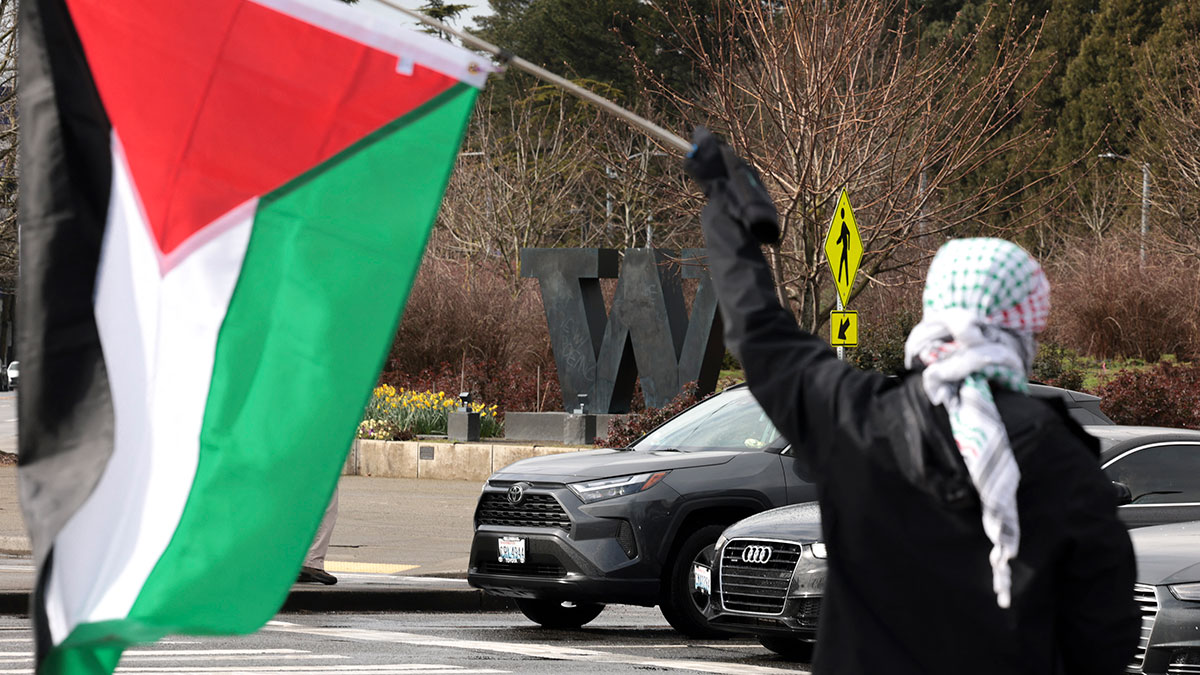
Top Photo by JASON REDMOND/AFP via Getty Images
Source link