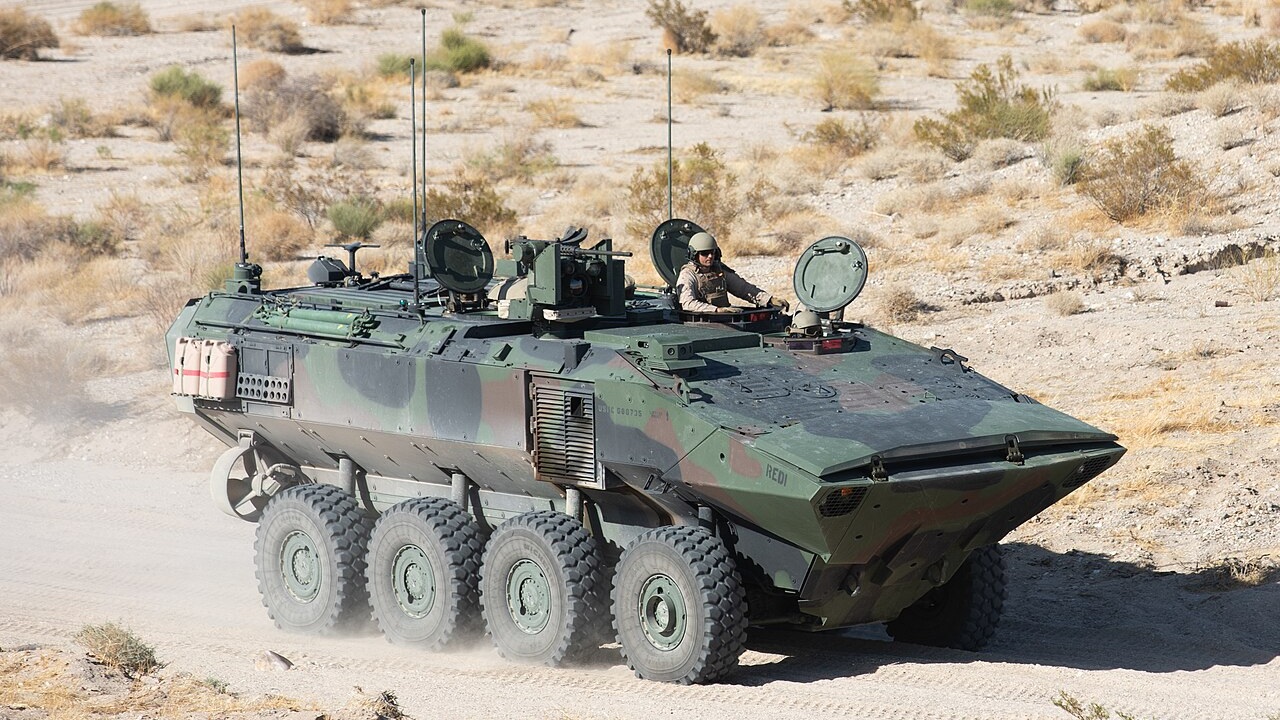
The new “ACV-130” amphibious armored vehicles are in a sense a substitute for the Marine Corps’ tank units, which are currently being phased out.
In an effort to return the United States Marine Corps to its “amphibious roots” after taking part in prolonged land wars in Afghanistan and Iraq, the service eliminated its tank force. Although that decision was extremely controversial, it came as part of a shift away from the USMC being a “second land army” and back to its core mission, in which Marines could be tasked with conducting sea-based expeditionary operations.
But even though it won’t operate main battle tanks (MBTs), the Marine Corps will still maintain an armored fighting force—equipped notably with the Amphibious Combat Vehicle, produced by BAE Systems. The 8×8 wheeled armored personnel carrier (APC) was developed to provide the Marine Corps with ship-to-shore capability while still operating on land.
Such vehicles have been seen as necessary for a potential island-hopping campaign in the Indo-Pacific, where forces will need to secure a beachhead and then move inland.
BAE Systems Is Building the ACV-30 Vehicles in Pennsylvania
Last year, the service awarded a $188.5 million full-rate production (FRP) contract to BAE Systems for 30 Amphibious Combat Vehicle 30mm (ACV-30mm) platforms, along with test equipment, spare parts, and field support.
That order was further expanded, and BAE Systems announced this month that a new FRP 6 will see the order increased to more than 100 vehicles.
“The ACV has shown time and time again how adaptable it is, capable of handling everything from open ocean to tough inland missions,” said Rebecca McGrane, vice president of Amphibious programs at BAE Systems. “With its ability to integrate advanced systems like the 30mm cannon, we’re ensuring Marines are ready to meet any challenge, anywhere.”
Primary production of the ACV-30 will be carried out at BAE Systems facilities in Johnstown and York, Pennsylvania. The vehicles will then be outfitted with a Kongsberg-designed turret at the Naval Warfare Information Center in Charleston, South Carolina.
A separate contract, valued at $329 million, was awarded to Kongsberg in late 2024 for the production of 175 medium-caliber weapons systems. The Norwegian-based firm will produce the turret systems at its US-based facility in Johnstown, Penn.
The ACV-30 Is a Modular System For the Marines
Developed to supplement and subsequently replace the aging Assault Amphibious Vehicle (AAV), which first entered service in 1972, production of the ACV began in 2020.
The armored platform is being produced in multiple variants for the USMC, including the ACV-Personnel (ACV-P) and ACV-Command (ACV-C). Each version can “swim” approximately 12 nautical miles (22 km) from a landing ship to shore.
The ACV-P personnel squad maneuver variant can carry a total of thirteen Marines and three crew members. It is equipped with a Kongsberg remote weapon station (RWS) to operate the specially designed turret, which is armed with either a Mk 19 automatic grenade launcher or a .50-caliber machine gun.
The command model is equipped with additional workstations for the crew to “maintain and manage situational awareness in the battle space.”
In addition, an ACV-R recovery variant was also developed, with three produced for the USMC. Each will “provide field maintenance, recovery and repair capabilities” to a US Marine Assault Amphibious company.
About the Author: Peter Suciu
Peter Suciu has contributed over 3,200 published pieces to more than four dozen magazines and websites over a 30-year career in journalism. He regularly writes about military hardware, firearms history, cybersecurity, politics, and international affairs. Peter is also a contributing writer for Forbes and Clearance Jobs. He is based in Michigan. You can follow him on Twitter: @PeterSuciu. You can email the author: [email protected].
Image: Wikimedia Commons.