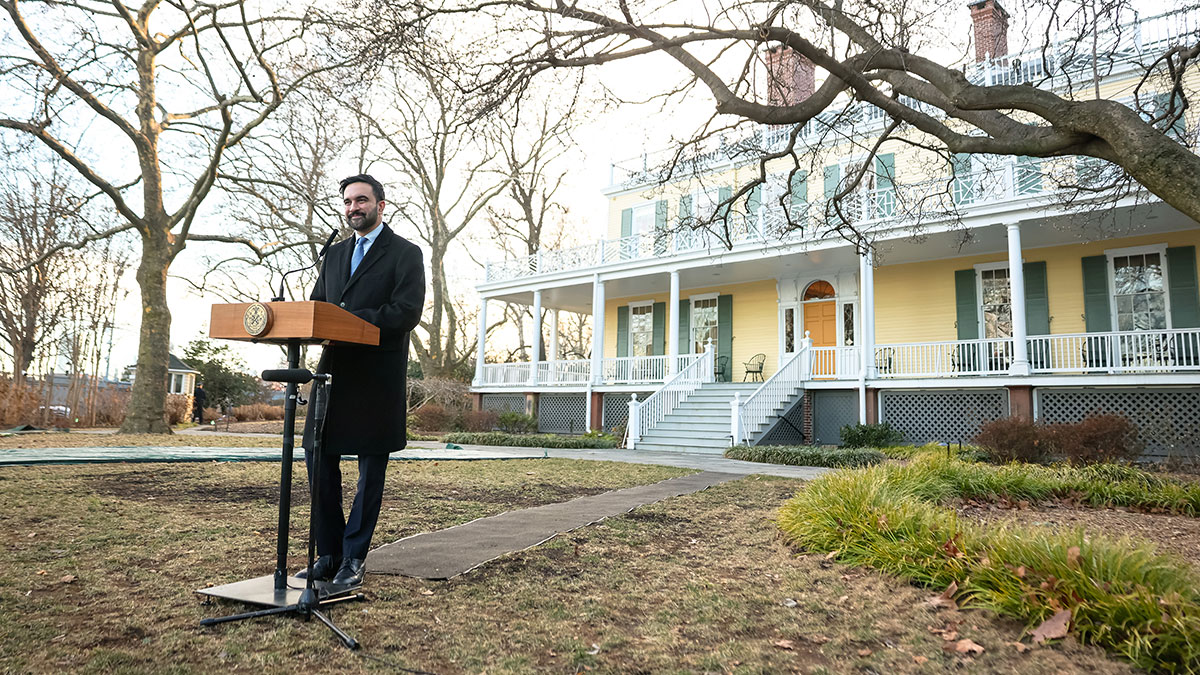
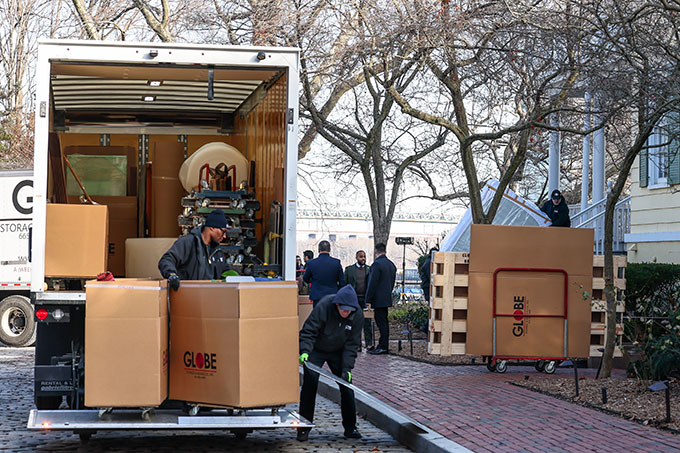
As he entered his third week in office last Monday, New York mayor Zohran Mamdani invited the City Hall press corps to view the progress of his move from a one-bedroom, rent-stabilized rental apartment in Astoria to the five-bedroom Gracie Mansion, the mayor’s official residence on Manhattan’s Upper East Side. A moving truck in the driveway proclaimed its owner to be a “certified women business enterprise;” workers had artfully strewn half-open boxes along the walkway to the press conference, so that reporters could peep at a half-packed plant and mirror belonging to the mayor and his wife, Rama Duwaji. The smiling couple posed together for photographers as they entered the mansion as residents for the first time.
Amid the carefully stage-managed chaos of the scene came the mayor’s odd answer to a question about how he’s handling the finances at his previous apartment.
Finally, a reason to check your email.
Sign up for our free newsletter today.
Most of the questions at the press conference were soft. Would Mamdani get a cat? Where would he buy bagels? But one reporter, the Associated Press’s Jake Offenhartz, ruined the convivial mood: “I assume you’re not holding on to your Astoria one-bedroom,” the questioner said. “Did you break the lease? You got your security deposit back?”
“My lease ends at the end of this month,” Mamdani replied. “Any discussion about the security deposit?” Offenhartz persisted. “The security deposit is being put toward the final month,” said the mayor, giggling uneasily.
Mamdani quickly moved on to other topics, but his answer raised additional questions.
As New York renters know, their security deposit—generally one month’s rent—is not to be put toward the final month’s rent. “A security deposit is money that a tenant . . . deposits with the owner of the apartment for the repair of any damages to the apartment for which the tenant is responsible,” the state’s office of rent administration informs potential renters and landlords. Under state law, “the entire amount of the deposit or advance, shall be refundable to the tenant upon the tenant’s vacating of the premises except for an amount lawfully retained for the reasonable and itemized costs due to non-payment of rent, damage caused by the tenant beyond normal wear and tear,” and the like.
Nor is it likely that Mamdani has excess money on hold with the property owner. A 2019 law—one that his new tenant-protection advocate championed—made it “unlawful for the owner to ask for an additional amount of money from the tenant” and required owners to return “any additional security deposit which exceeds one month’s rent.”
Two owners of rent-stabilized apartment properties confirmed that it’s not industry practice to allow tenants to put their security deposit toward the final month’s rent. “That is not standard or advisable,” said one owner, because “if you allow security to be used for [the] last month’s rent, you have no way to recover payment for damages” to the apartment once the tenant has vacated it.
Given the state-imposed constraints on rent-regulated leases, it’s highly unlikely that the mayor and the owner of his Astoria apartment worked out a specially tailored deal in advance and included this agreement in the lease. Just a sentence or two could clear up any confusion caused by the mayor’s answer, but neither the mayor’s office nor a person believed to be an owner of the mayor’s apartment responded to my request for comment. It also seems improbable that Mamdani’s landlord is a neglectful property owner whose egregious management justifies the withholding of rent: just after the election, Mamdani complained only about a leaky sink—one that his building superintendent was attending to—a common enough inconvenience for homeowners as well as renters.
This silence leads to one of two conclusions. The mayor, like many New Yorkers, may have simply run out on his final month’s rent, wagering that there’s not much the property owner can do about it. “Plenty of tenants skip paying their last month’s rent,” said one owner. Alternatively, the mayor and his landlord worked out an informal, unwritten agreement after his election, when he knew he’d soon be leaving.
Either conclusion makes for an unsalutary start for New York City’s top official. The mayor shouldn’t act like the average absconding New Yorker, because he has unfair leverage: the owner of his building, even if otherwise inclined to pursue a tenant for unpaid rent, would not want to provoke the mayor. Meantime, an informal deal over the security deposit would be just as bad: it would mean his landlord is doing him a special favor, one presumably not granted to other tenants.
And this mayor in particular should be careful not to appear to be accepting favors from a rent-regulated property owner. One of Mamdani’s top four issues in last year’s campaign was a promise to freeze rents on the city’s nearly 1 million rent-regulated units for four years, and he also now has power to enforce housing-code violations at such units. When it comes to rent-regulated apartments—again, a signature issue—the mayor should be acting like Caesar’s wife, leaving no room for doubt about his honest dealing.
The mayor’s answer was unsavory in another way: the implied benefit would be so small. The rent on Mamdani’s Queens apartment is about $2,300 monthly. If he instead paid the final month’s rent rather than put the security deposit toward that purpose, and if he hasn’t damaged the apartment beyond normal wear and tear, the landlord would have to refund him his security deposit, plus interest, within 14 days. All the mayor would be getting, then, by failing to follow the proper procedure, is a no-interest, six-week loan of about $2,300 from his landlord.
Why slip, just for that? The implicit answer on the part of previous generations of municipal politicians—including, most recently, Eric Adams—has too often been because I can. Mamdani’s move-in day was supposed to represent what he calls “a new era for New York City”—but that one moment felt a little too familiar.
Top Photo by Michael M. Santiago/Getty Images
City Journal is a publication of the Manhattan Institute for Policy Research (MI), a leading free-market think tank. Are you interested in supporting the magazine? As a 501(c)(3) nonprofit, donations in support of MI and City Journal are fully tax-deductible as provided by law (EIN #13-2912529).
Source link