Throughout the Gospels, from time to time, Jesus would “withdraw” from the crowds who followed Him in order to head to a “deserted place” where He could be alone with the Father in prayer and communion. That is to say, there were times in which Jesus sought to get away from those for whom He came. It seems that when Jesus would heal the sick, it would take something out of Him. It would cost Him. And after all that healing and curing, in His humanity, Jesus could well have come to the point of not “feeling like” ministering anymore. Thus, Jesus would have withdrawn to the “desert” to replenish His strength and renew His will, that it might conform once again to the will of the Father.
Of course, in His divinity, Jesus would have needed no such renewing and restoration. In His divinity, He would have been perfectly capable of continually pouring Himself out as a libation without rest or renewal; His grace would have been both complete and never-ending. But in His humanity, Jesus willed to require that infilling from His Father in heaven. Why? While we cannot know the mind of God, we can imagine that one of Jesus’ intentions would have been to provide an example for the rest of us to follow.
For we do not have a high priest who is unable to sympathize with our weaknesses, but one who has similarly been tested in every way. (Heb. 4:15)
Like Jesus, we too often find ourselves in circumstances that require of us things that we don’t “feel like” doing. But unlike Jesus, sometimes we make excuses as to why we should give up. “It’s too hard.” “I’m not enjoying this.” “It’s not my problem.” “I would rather be doing something else.” “This is not what I had planned.” Jesus knew what it felt like to lose motivation and to want to give up.
The difference between His response and ours, however, is that Jesus never succumbed to the temptation to give up…whereas we sometimes do. It is true, to measure our human strength against Jesus’ divinity is an unfair comparison. But Jesus was also fully human, and so to measure ourselves against His humanity is not.
It is here that Jesus becomes our example to follow: He teaches us that when our own steadfast determination to persevere in our God-given mission is in danger of depleting, we must seek to be restored and renewed in prayer.
But there is a second aspect to this lesson that Jesus exemplifies for us here. Before He received the restoration He sought from the Father, He would first “slip away” from the crowds (Jn. 5:13). Jesus would escape from the people who were surrounding Him. In other words, He would not continue to heal or serve or preach or tend to until He first received an infilling of grace from the Father.
At once the Spirit drove Him out into the desert, and He remained in the desert for forty days. (Mk. 1:12-13)
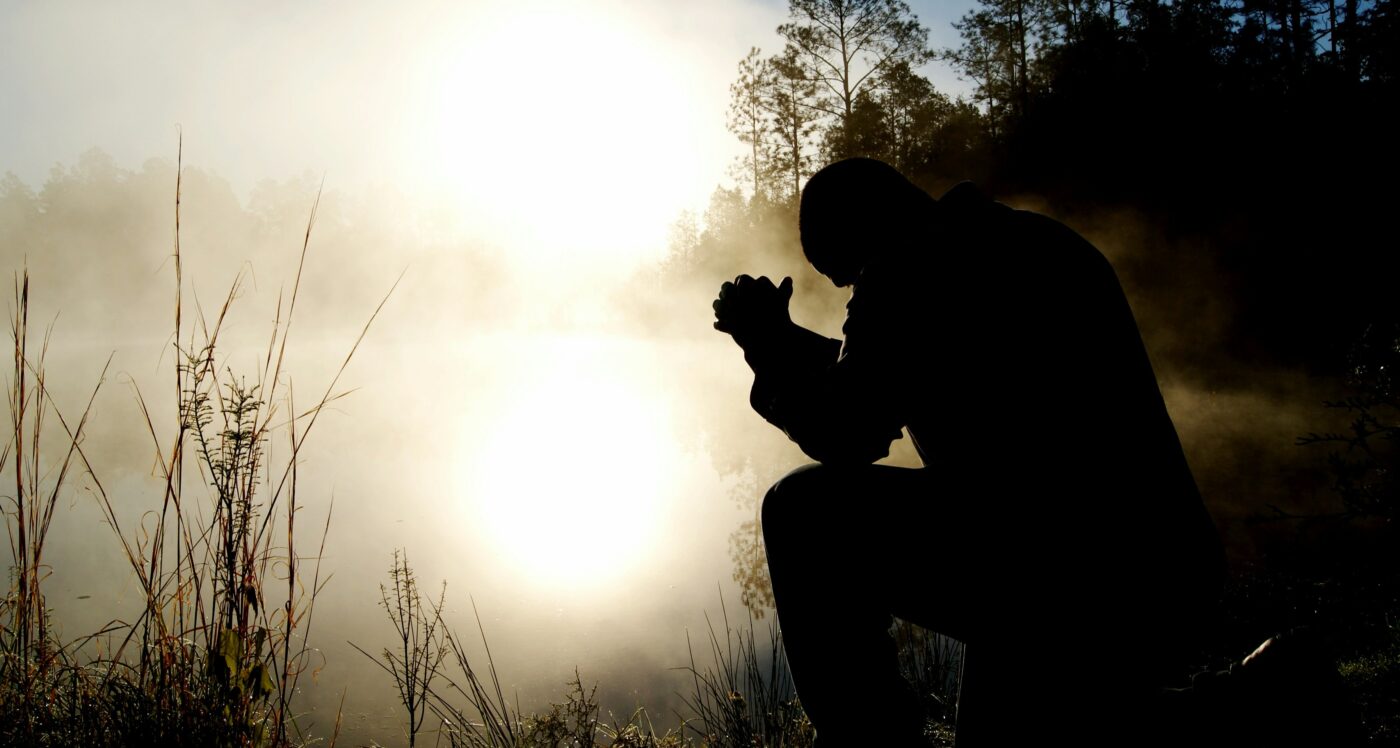
Rising very early before dawn, He left and went off to a deserted place, where He prayed. (Mk. 1:35)
He remained outside in deserted places, and people kept coming to Him from everywhere. (Mk. 1:45)
Jesus’ example teaches us, then, that we cannot properly tend to the ones who need grace in their lives without first receiving the grace of God ourselves. Simply put, our ministry to others is going to cost us, and we cannot give what we do not have. Of course, when it comes to people like our own children, we cannot “slip away” from their presence every time they ask us for something that costs us. We don’t need to run to our “upper room” in order to prepare a sandwich or help with homework. Our early morning prayer hour will be enough to supply us with the strength we need to fulfill the regular duties of our state in life.
But there are other duties that are not so “regular”—ones that require more of us, perhaps even seemingly more than we can bear. An adult child who rejects the teaching of the Church; an elderly parent who requires round-the-clock care; a spouse struggling with an addiction; a caustic family member who pushes our buttons and triggers our every last nerve. It is in situations such as these that we must retreat to our deserted place before attempting to address their needs.
Why? Because if we attempt to tend to them without first retreating to our deserted place, we may well end up tending to them in the wrong way and at the wrong time. We may say words that push those who are doubtful about the Church even further away. We may lose patience with those who require our constant attention. We may end up arguing and increasing rifts between family members with whom we struggle to get along.
In other words, we will not be animated by the Holy Spirit, the only one who knows how to navigate solutions to the trials that are beyond our human scope. These are the kind of situations that God intends to handle, as He works in us and through us, bringing healing and restoration to our difficult circumstances.
So how do we know which of our daily struggles is the kind in which it is time for us to “slip away” to our deserted place to be alone with the Father? A sure sign to us that the trial which befalls us is beyond our human scope is that we have anxiety over it. Of course we will feel distressed over that which we are incapable of “fixing”! In fact, the anxiety we feel, paradoxically, is our signal that we can have peace—or at least, our signal to go back to the Lord to have our peace restored—because when we face the “impossible,” we can be certain that this impossible circumstance is the Lord’s domain.
We don’t have to try to fix it. Only God can.
So, for today, when circumstances threaten to overwhelm us, let’s not allow ourselves to be swept up in the current! Let us run in the other direction to our deserted place to be alone with the Lord. Let us refrain from responding, speaking, debating—even thinking—until we first have asked the Lord what He would have us do.
And then, let us open our hearts to be restored in His peace and grace, that we might to tend to our God-given mission with renewed strength and determination. When it is the Spirit of God who animates us, we will find the strength once again to give of ourselves, without counting the cost.
Photo by Aaron Burden on Unsplash