
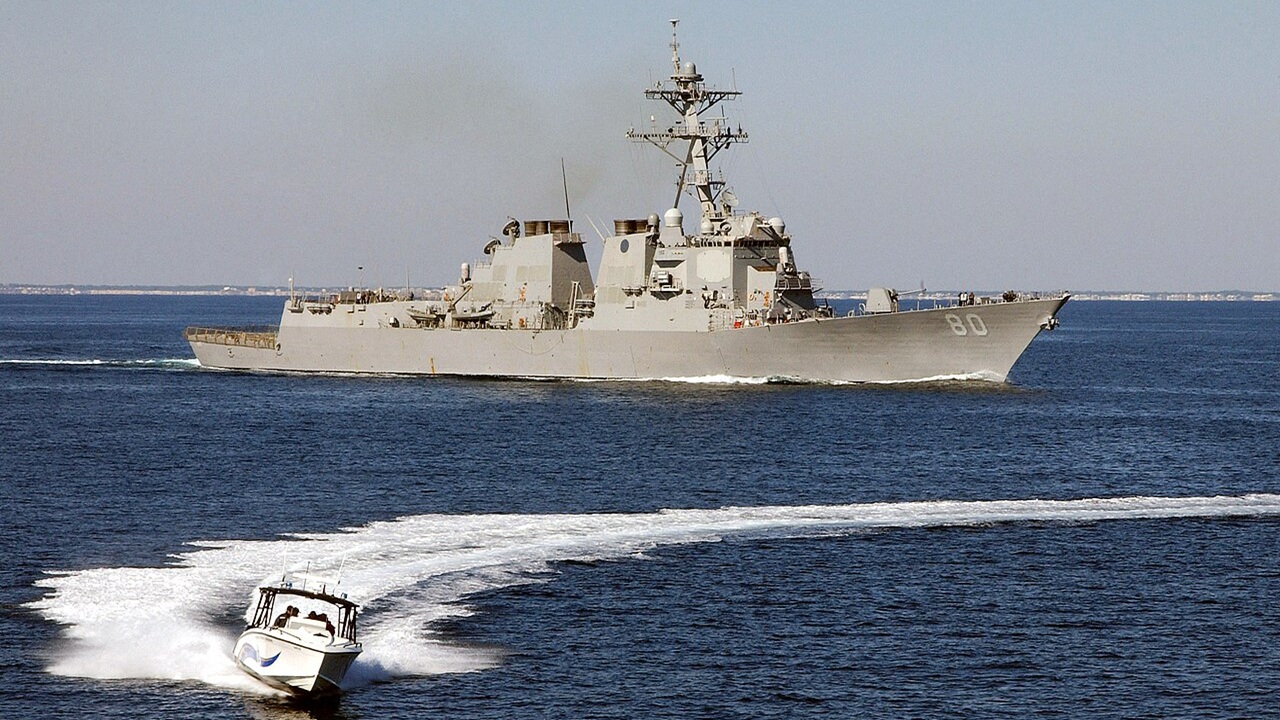
Trump’s naval buildup around Iran mirrors his buildup near Venezuela—raising the possibility that a similar strike on Iran’s leadership might follow.
An Arleigh Burke-class guided-missile destroyer belonging to the Flight IIA variants of the model, the USS Theodore Roosevelt (DDG-80), has reportedly been moved into the United States Central Command (CENTCOM) area of responsibility, as tensions between the United States and the Islamic Republic of Iran intensify.
This is an important warship that provides sea-to-surface strike capabilities as well as protection for at least one aircraft carrier in that region by later this week. The USS Abraham Lincoln is inbound to the Gulf from the Indo-Pacific area of operation.
The USS Roosevelt initiated its operations in the Gulf earlier this month. Its mission will be to support broader American maritime security and regional stability operations. The warship was deployed to the region at the start of what was President Donald Trump’s campaign of brinkmanship directed against the Iranian regime as anti-regime protests were underway.
At the time, many assumed it was mere posturing by Trump. Experts assessed that the deployment of the Roosevelt was little more than strategic signaling from the Trump administration in conjunction with the threats that Trump issued against the regime, if they dared to harm the protesters (which, of course, they did).
The USS Roosevelt’s Specifications
- Year Introduced: 2000
- Length: 509.5 feet (155.3 meters)
- Beam (Width): 66 feet (20 meters)
- Displacement: 9,200 tons
- Engines: Four General Electric LM2500 gas turbines
- Top Speed: 30+ knots (34.5 mph, 55.5 km/h)
- Range: 4,400 nautical miles (5,063 mi, 8,148 km)
- Armaments: Mk 45 five-inch gun, a Mk 41 Vertical Launching System (VLS) for Standard Missiles (SM-2/3), Tomahawk, and ASROC, Close-In Weapon System (CIWS), Mk 38 25mm Machine Guns, and Mk 32 torpedo tubes for Lightweight Torpedoes, plus MH-60R Sea Hawk helicopters for enhanced ASW/ASuW capabilities
- Crew: 380
Trump’s Iran Buildup Mirrors His Venezuela Buildup
Now that the Americans have deployed the Carl Vinson to the region, with the USS Abraham Lincoln inbound as well, it is clear that the arrival of the Roosevelt was part of a larger movement of US naval forces into the Mideast.
We saw this with Trump’s slow-rolling Caribbean buildup last year. He started that movement by inserting some destroyers off the coast of Mexico and Venezuela.
From there, however, he continued trickling in warships of increasing size and lethality, until we had roughly 25 percent of all the Navy’s surface warfare capabilities deployed off the coast of Venezuela. And only after that months-long buildup did the Trump administration strike decisively, raiding the presidential compound and capturing Venezuelan leader Nicolas Maduro and his wife.
Contextualized with the last two weeks of developments in the Middle East, it is obvious that the deployment of the USS Roosevelt was the start of a larger move against the Iranian regime.
The USS Roosevelt has an impressive CV in her own right. Named after both President Franklin D. Roosevelt and his wife Eleanor, she has served in the Navy surface fleet since 2000.
In her time, Roosevelt has participated in Operation Enduring Freedom, she has partaken in Mediterranean and Arabian Gulf interdiction missions, NATO operations from Naval Station Rota, and she recently visited Algiers as part of the US Navy’s 250th anniversary celebrations. That visit was especially symbolic, because it was an ode to America’s original naval mission: protecting commerce from the Islamic Barbary Coast Pirates.
Many believe that Roosevelt’s primary mission today, indeed the main mission of much of the Navy’s surface fleet, has been similar to that original anti-pirate mission against the Barbary pirates.
With the Abraham Lincoln nearly in place, the Roosevelt will serve as a vital support ship for whatever sustained air campaign that the Americans are planning to conduct against the Islamic Republic of Iran.
What Comes After the Fleet Assembles?
The arrival of the USS Roosevelt was never meant to be the headline. That’s the point. Destroyers arrive first because they make war possible—they provide a defensive screen for the carriers, launch precision strikes, and enforce American will at sea while the world debates capabilities and intentions.
Washington’s mistake is believing that adversaries don’t recognize this pattern. Tehran and other targets of potential Trump administration regime change missions certainly do, just as Caracas did. The only issue is, can these regimes adequately stop what they’re seeing? Venezuela couldn’t. It is unlikely that Iran will be able to stop the pending strikes (though the regime may yet survive them).
When the fleet assembles piece-by-piece, when the destroyers arrive before the carriers, and when escalation is measured rather than theatrical, it means the decision has been made. The USS Roosevelt was not a question of “if” the forty-seventh president would direct strikes against Iran. It was telling us that those strikes were coming soon.
About the Author: Brandon J. Weichert
Brandon J. Weichert is a senior national security editor at The National Interest. Recently, Weichert became the host of The National Security Hour on America Outloud News and iHeartRadio, where he discusses national security policy every Wednesday at 8pm Eastern. Weichert hosts a companion book talk series on Rumble entitled “National Security Talk.” He is also a contributor at Popular Mechanics and has consulted regularly with various government institutions and private organizations on geopolitical issues. Weichert’s writings have appeared in multiple publications, including The Washington Times, National Review, The American Spectator, MSN, and the Asia Times. His books include Winning Space: How America Remains a Superpower, Biohacked: China’s Race to Control Life, and The Shadow War: Iran’s Quest for Supremacy. His newest book, A Disaster of Our Own Making: How the West Lost Ukraine is available for purchase wherever books are sold. He can be followed via Twitter @WeTheBrandon.
Image: Wikimedia Commons.











_2004.jpg)