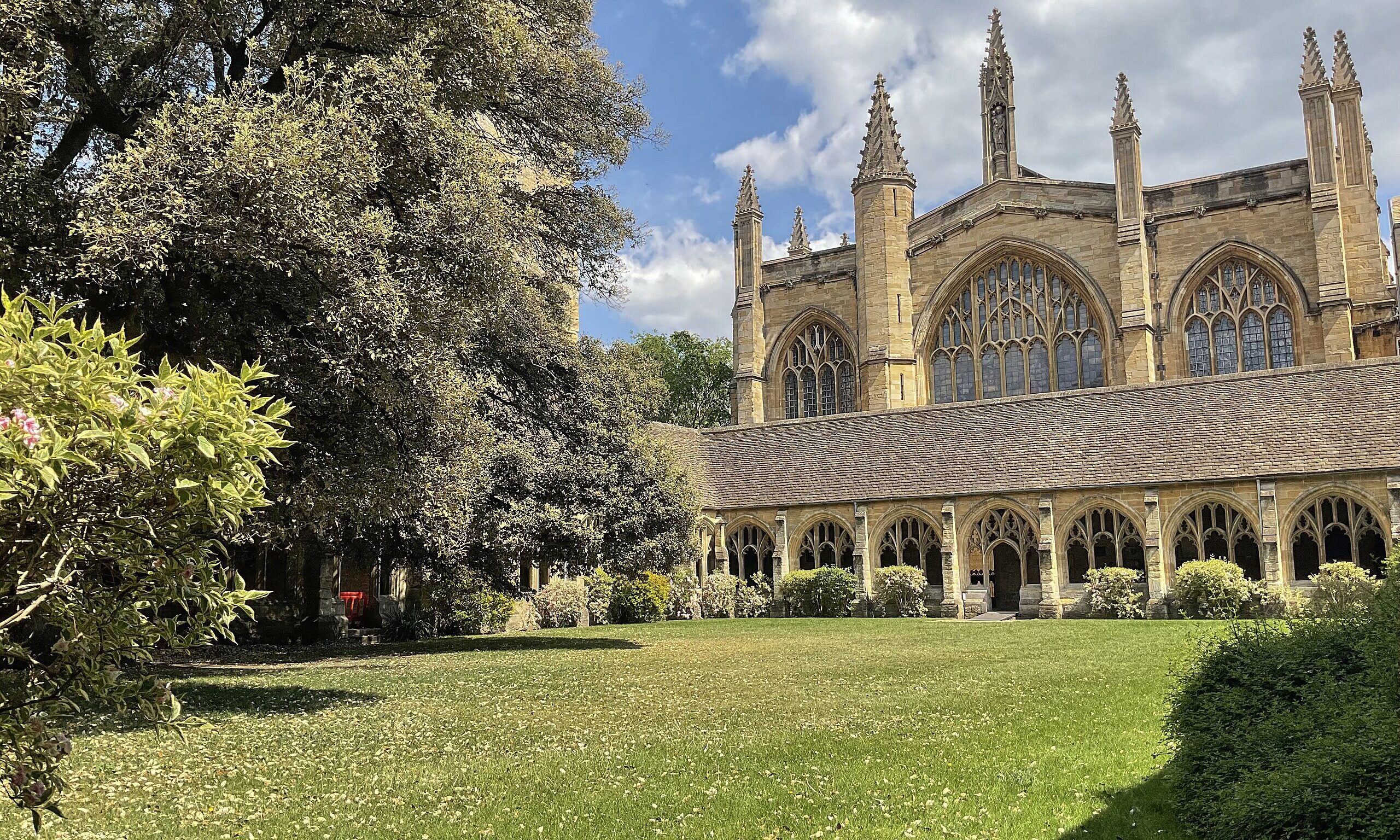
Lunching at Oxford in 1967 with Elizabeth Taylor and his Oxford mentor, Nevill Coghill, the actor Richard Burton was delighted by the appearance of another guest, Lord David Cecil, a Fellow of New College. “Cecil was a joy,” he wrote in his diary, “and both E. and I quite fell in love with him. He is the best kind of well-bred eccentric, sane, compassionate but acerbic maiden aunt—though married and clearly male.”
Burton’s incisive impression of Cecil comes to mind forty years after Cecil’s death on January 1, 1986, at the age of eighty-three. Burton did not mention Cecil’s endless flow of talk, which beguiled but also bewildered the great historian and poet A. L. Rowse when the two men met as undergraduates at Oxford. Cecil talked so quickly that Rowse could only make out half of what he said; Cecil came from a family known for stimulating conversation as well as for general endearing untidiness. Cecil was the younger son of the fourth Marquess of Salisbury, while Rowse was the son of an illiterate Cornish miner. The two became friends, and Rowse, an expert on the Elizabethan age, must have appreciated Cecil’s descent from Elizabeth’s ministers William Cecil and his son Robert Cecil.
In his seventies, Cecil wrote about these Elizabethan forebears and their descendants in a handsome book, The Cecils of Hatfield House (1973). The volume, together with A Portrait of Jane Austen (1978)—generally considered the best on the subject—and Library Looking-Glass: A Personal Anthology (1975), can be seen as part of a trilogy that verges on a spiritual autobiography, documenting the influences that made him the man he was. In 1972, as Cecil was writing his family history, Frances Partridge, the Bloomsbury diarist, who was close to Cecil and his beloved wife, Rachel, noted in her diary that Rachel’s cousin Clare Sheppard found “David’s conservative and aristocratic side even more unsympathetic than I do.” This disapproval did not prevent Partridge from writing a loving tribute to Cecil in The Spectator the week after his death.
He came by his “conservative and aristocratic side” just as he acquired his love of Jane Austen: from his upbringing. Austen was a family favorite at least as far back as Cecil’s grandfather, Lord Salisbury, Queen Victoria’s last prime minister and as invaluable to her as her first, Lord Melbourne. In 1939 and 1954, Cecil wrote two biographies of Melbourne, covering his early and later life respectively. Still in print, now in one volume, Cecil’s Melbourne, one of John F. Kennedy’s favorite books, is a classic. Melbourne was a Whig, and the biography’s first chapter provides a dazzling portrait of the Regency-era aristocracy. For Cecil, that was the most agreeable period the English upper class had ever known.
Cecil had family on both sides of the political divide. The Cecils were full-blooded Tories, but Cecil’s mother, a Gore, came from a Whig family and was descended from Lady Melbourne, as was his friend the society hostess Ettie Desborough (1867–1952), whose parlance and style resembled her Whig ancestors enough to give Cecil a sense of the Whig drawl. Cecil’s background allowed him to approach Melbourne or Jane Austen like contemporaries. One criticism of his portrayal of Melbourne is his disregard of his subject’s cynical political side. Biographers sometimes project their own personalities onto their subjects, and politics were not Cecil’s primary interest, even though he was a scion of one of Britain’s greatest political dynasties. Those of his family who went into politics, including his grandfather and his father (entertainingly portrayed in Kenneth Rose’s 1975 The Later Cecils), were more public servants with a strong sense of noblesse oblige than political animals.
Cecil, a don of English literature whose interests included not only Jane Austen but also Cowper (The Stricken Deer, 1929), Thomas Gray and Dorothy Osborne (Two Quiet Lives, 1948), Thomas Hardy (Hardy the Novelist, 1942), and Max Beerbohm (Max, 1964), considered himself an appreciator rather than a critic. Most of his students at Oxford remembered him with gratitude, recording their memories of him in Hannah Cranborne’s David Cecil: A Portrait by His Friends(1990). The novelist Kingsley Amis was an exception. Cecil was his tutor at Oxford, and Amis, brilliant as he was but of lower-middle-class origins, did not know what to make of Cecil. Even so, Amis admitted that “at least Lord David encouraged one to think of literature as something according pleasure and some insights into human nature rather than material for theory and polemic.”
Library Looking-Glass: A Personal Anthology would be an ideal desert-island book, providing a smattering of Cecil’s favorite authors and passages on topics ranging from “dress” to “nonsense.” His commentary is invariably pertinent and eminently sane. He praises, for instance, Sydney Smith’s suggestions to Lady Georgiana Morpeth on how to combat low spirits, writing of the letter:
Every child should be made to learn this by heart. Its precepts put into practice would do more to increase the well-being of mankind than all the noisy advice proffered by self-appointed prophets that have flourished from Sydney’s time, from Carlyle and Ruskin down to D. H. Lawrence—with Nietzsche and Sartre and the rest of the intellectual Foreign Legion thrown in.
He particularly insisted on the penultimate bit of advice that Smith gives: “Be firm and constant in the exercise of rational religion.”
A passage of Max Beerbohm about literature inspires Cecil to remark that “life is a card game in which everyone is dealt a hand he must accept.” Cecil was lucky in the cards he was given, and he played them well, enjoying a happy marriage and a brilliant writing career. The Cecils are known for their high Protestant faith, which sustained him as he wrote books about the writer Desmond MacCarthy (Rachel’s father), Charles Lamb, and Dorset country houses in his last years, having lost his wife to liver cancer. In what can seem a post-civilized age, those of us in search of sense and sensibility can do worse than to read Lord David Cecil.