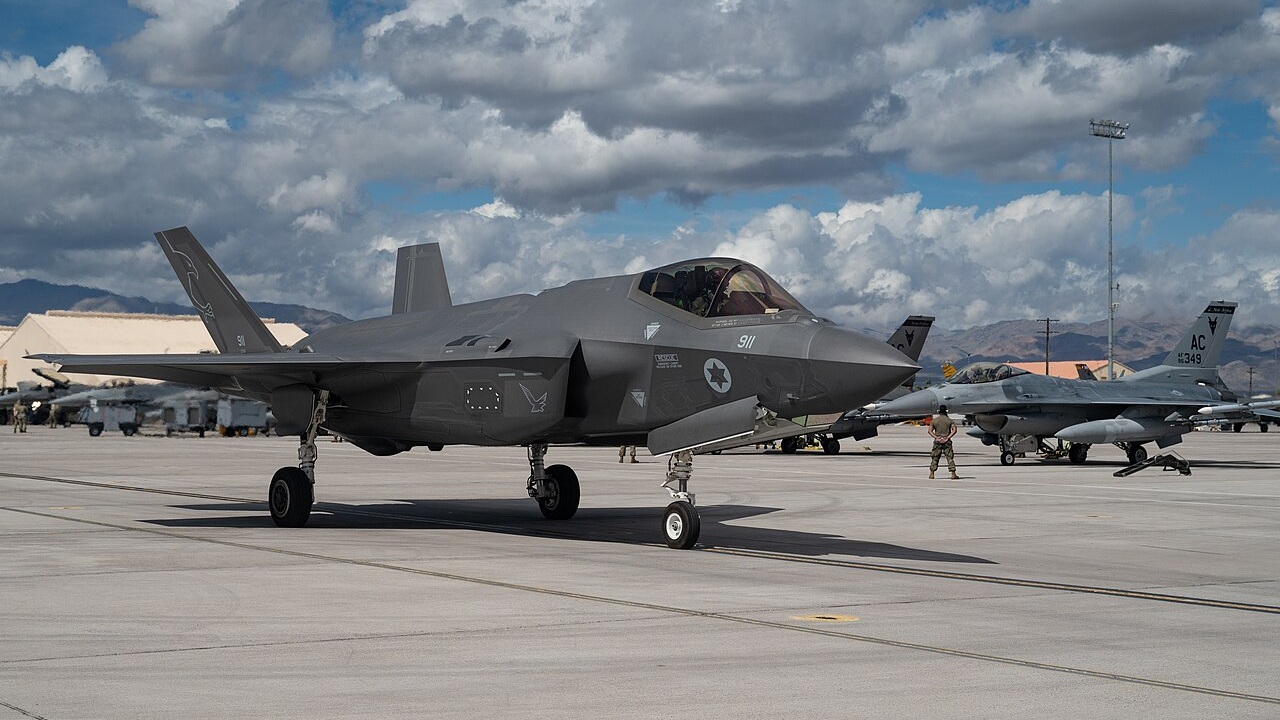
Israel’s total F-35I Adir complement now stands at 48 aircraft, in addition to its hundreds of other fourth- and 4.5-generation planes.
The Israeli Air Force (IAF) received three additional Lockheed Martin F-35I Adir fifth-generation multirole stealth fighters this month. According to an announcement from the Israel Defense Force (IDF), the aircraft arrived at Nevatim Air Force Base last week, increasing the IAF’s fleet to 48 aircraft.
The three Adir fighters, the Israeli-specific variant of the F-35 Joint Strike Fighter, were due to be delivered by the end of 2025, but there were unexpected delays, possibly related to the year-long pause related to the Technology Refresh-3 (TR-3) hardware/software upgrade.
Despite the missed delivery window for the three F-35I aircraft, Lockheed Martin announced this month that it had delivered 191 F-35s in all variants in 2025, a “record-breaking year’ for the program, surpassing the previous delivery record of 142 warplanes in 2021.
The final two F-35Is are scheduled to be delivered to the IAF by the end of 2026, completing the initial program of record that consisted of 50 fighters for the Middle Eastern nation. An additional 25 F-35s were part of a follow-up deal signed in 2023 to bring the program to 75 fighters. Delivery of those fighters, which will allow the IAF to raise a third F-35 squadron, is expected to begin late 2027 or early 2028 and continue through the end of the decade.
The F-35I Adir’s Specifications
- Year Introduced: 2016
- Number Built: ~48
- Length: 51.4 ft (15.7 m)
- Wingspan: 35 ft (10.7 m)
- Weight (MTOW): ~70,000 lbs (31,751 kg)
- Engines: One (1) Pratt & Whitney F135 engine
- Top Speed: ~1,200 mph (1,930 km/h) / Mach 1.6+
- Range: ~1,380 miles (2,220 km)
- Service Ceiling: 50,000+ ft (15,240 m)
- Loadout:
- Internal Gun: One 25mm GAU-22/A rotary cannon
- Payload: Up to 18,000 lbs (8,165 kg) internally/externally
- Aircrew: 1
Israel Has a Long History with the F-35 Program
Israel’s interest in the F-35 jet program dates back to the early 2000s, when the IAF explicitly committed to replacing its aging F-16 fleet with at least 100 F-35A aircraft. The Jewish state signed a Letter of Agreement (LOA) to purchase the advanced aircraft in 2010. It became the first foreign operator of the Lockheed Martin F-35 Joint Strike Fighter on June 22, 2016, when the IAF received its initial F-35A at a ceremony at the aerospace firm’s facility in Fort Worth, Texas.
The IAF declared its F-35 fleet operationally capable in December 2017, marking the completion of an intensive integration and training effort conducted at Nevatim Air Force Base (AFB), Israel.
Israel remains the only operator of the advanced stealth aircraft in the Middle East, and there are two IAF squadrons equipped with the F-35I Adir (meaning “Mighty One” in Hebrew), the specially modified “Israeli only” version of the Lightning II.
The F-35I models are broadly equivalent to the F-35A but incorporate Israeli-made technology and weapons, including a domestic advanced electronic warfare (EW) suite layered on top of the jet’s existing avionics.
Additional changes include special, IAF-tailored helmet-mounted displays, bespoke datalink functionality specific to the Israel Defense Forces, and enhancements to the F-35’s already-potent data-gathering and processing capabilities. All of these enhancements have been significant enough to warrant the ‘I’ designation, making the F-35I one of the few formally acknowledged F-35 variants.
The Adir proved especially mighty during last June’s Operation Rising Lion, the 12-day Israeli military campaign launched against Iran targeting the Islamic Republic’s nuclear and ballistic missile programs. The strikes aided in disabling Tehran’s nuclear program and killed several high-ranking military officials and atomic scientists.
About the Author: Peter Suciu
Peter Suciu has contributed over 3,200 published pieces to more than four dozen magazines and websites over a 30-year career in journalism. He regularly writes about military hardware, firearms history, cybersecurity, politics, and international affairs. Peter is also a contributing writer for Forbes and Clearance Jobs. He is based in Michigan. You can follow him on Twitter: @PeterSuciu. You can email the author: [email protected].
Image: Wikimedia Commons.