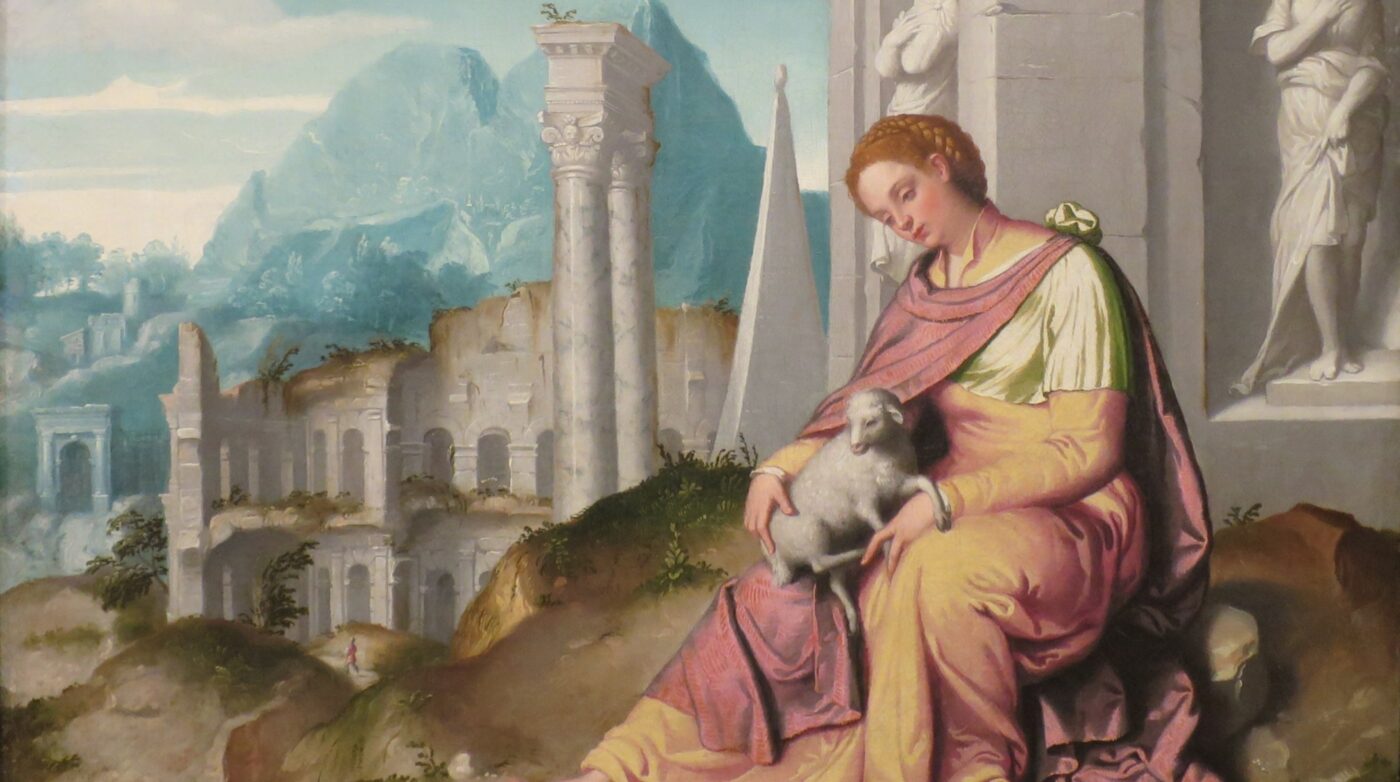
The Church does something curious with St. Agnes. She gives us not one, but two—separated by a thousand years, living in entirely different worlds, yet bound by the same name, the same symbol, and the same unyielding orientation toward Christ. Together, St. Agnes of Rome and St. Agnes of Montepulciano offer a kind of spiritual stereoscopic vision. Look at only one, and you see courage. Look at both, and you see how holiness survives history.
The name Agnes comes from agnus, “lamb.” It is not a flattering image by modern standards. Lambs are defenseless. They do not win arguments. They do not seize power or dominate narratives. And yet, in the Christian imagination, the lamb stands at the very center of reality: “Worthy is the Lamb who was slain.” The two St. Agneses show us what it means to live as lambs in two very different ages—and why that posture is as necessary now as ever.
Agnes of Rome: Refusing the Script
Agnes of Rome lived in a world where the rules were brutally clear. Power was public, coercion was expected, and dissent was crushed openly. She was young—shockingly so—and the forces arrayed against her were not subtle. The Roman state offered her a script: comply, conform, survive. She refused all three.
What makes Agnes compelling is not simply that she died for Faith, but how little she needed to explain herself. She did not write treatises or marshal arguments. She belonged to Christ, and that belonging rendered every threat strangely irrelevant. Her purity was not about moral scrupulosity; it was about singularity of allegiance. She had already given herself away—there was nothing left for Rome to bargain with.
For modern Catholics, this is unsettling. We prefer to think that if we could just explain the Faith clearly enough, defend it cleverly enough, or soften it strategically enough, we could avoid conflict. Agnes of Rome shows us something harder and more honest: sometimes fidelity simply collides with power. And when it does, the question is not whether we can win, but whether we will remain ourselves.
Her martyrdom still unnerves us because it exposes our negotiation reflex. We ask, How much can I give up and still be Catholic? Agnes never asked that question. She asked only Whom she belonged to.
Agnes of Montepulciano: Holiness without Applause
Fast forward a thousand years. The Church is no longer hunted; it is established. Cathedrals rise, universities flourish, and ecclesial politics become—inevitably—complicated. It is here that Agnes of Montepulciano appears, not as a martyr, but as something perhaps more difficult: a woman who lived a long, hidden, obedient, demanding life of holiness.
Agnes of Montepulciano did not confront emperors, but she did govern communities. She did not face execution, but she embraced asceticism, suffering, and responsibility. Her sanctity was so evident that popes, cardinals, bishops, and saints made pilgrimage to her small hilltop town. Authority traveled uphill—not to be seen, but to be corrected by holiness.
This is where she becomes profoundly relatable to Catholics today. Most of us will never be asked to die for the Faith. But many of us are asked to live it without recognition, without clarity, and often without consolation. We navigate Church politics, cultural confusion, liturgical disagreements, scandals, exhaustion, and discouragement. Agnes of Montepulciano shows us that sanctity does not require a perfect Church—only a faithful soul.
Her life reminds us that when the Church is strongest institutionally, it still depends on those who will quietly suffer, pray, govern, and persevere without becoming cynical.
Two Lambs, One Lesson
Together, the two St. Agneses dismantle a false dichotomy we often fall into: that courage looks one way and fidelity another. Agnes of Rome teaches us how to stand firm when the world demands surrender. Agnes of Montepulciano teaches us how to remain faithful when the world—and even the Church—demands endurance.
One sheds blood. The other sheds ego. One confronts violence. The other absorbs weight. Both refuse to belong to anything less than Christ.
For today’s Catholic, this is bracing. We live in a time that does not usually punish belief with death, but does punish it with pressure—to redefine it, soften it, privatize it, or treat it as an aesthetic preference rather than a truth claim. At the same time, we are tempted to disengage when the Church feels messy or disappointing. The two St. Agneses offer no such escape routes.
They tell us that holiness is not about choosing the easier path, but the truer one.
In an age obsessed with influence, platforms, and optics, lambs seem obsolete. Yet Christianity has always advanced not by dominance, but by witness that cannot be absorbed by the culture around it. The lamb stands because it will not become a wolf—even to win.
St. Agnes of Rome reminds us that there are moments when fidelity costs everything at once. St. Agnes of Montepulciano reminds us that there are seasons when it costs everything slowly. Both costs are real. Both are sanctifying.
Their shared legacy is this: the Church does not survive because she is clever, powerful, or popular. She survives because, in every age, someone quietly decides that Christ is worth more than safety, more than comfort, more than control.
Rome and Montepulciano. Arena and cloister. Blood and silence.
The lamb still leads.
Image from Wikimedia Commons