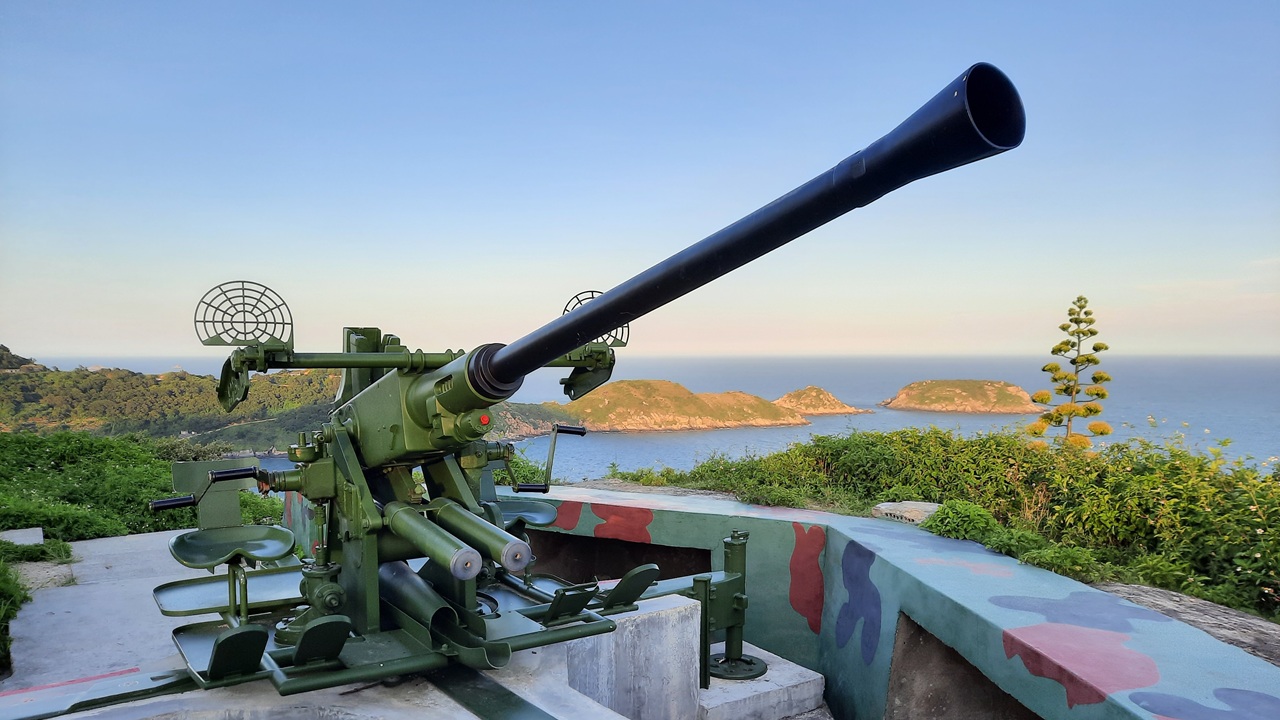
Taiwan understands the importance of artillery in keeping China at bay—and also understands that if it is to secure a reliable supply of shells, it must build them itself.
The United States’ defense industrial base crisis continues to cause massive dislocations and periodic panic among US defense planners. With indications that, if a war erupted between the United States and China over Taiwan the Chinese could defeat the US military, the defense industrial crisis takes an all-new dimension for those charged with defending against China, both in Washington and Taipei.
America’s Defense Industrial Crisis Is Now a Taiwan Problem
To ameliorate these bottlenecks and address the problem in the near-term, the US is smartly pooling its resources with those of its allies to at least give themselves a fighting chance against what is clearly an industrial juggernaut in China.
The South China Morning Post reports that both Taipei and Washington have launched an early-stage cooperation program to jointly produce 155mm artillery shells, the standard NATO caliber used by the US M109 series howitzer artillery system. Should China attack Taiwan, howitzers will serve as a critical element of Taiwan’s defense.
Using Ukraine as a model, Taiwan’s defense planners anticipate that any conflict with China will rapidly deplete their finite stockpile of 155mm artillery shells. As Taiwan is an island so near to China, it is likely that the Chinese navy would successfully enact a blockade around the country in the same way that the United States Navy imposed a monthslong blockade around Venezuela ahead of the successful arrest of that country’s oft-maligned leader, Nicolas Maduro, and his wife.
Thus, Taiwan requires a sustainable and reliable ammunition supply. But a high-intensity conflict with China will ensure that Taiwan cannot count upon access to the stockpiles of their allies, like the distant United States. That’s why Taiwan is fixating on producing shells locally. Indeed, this is but one of many ongoing programs to indigenize the defense of the island in the face of growing Chinese threats to their sovereignty.
Taiwan’s Armaments Bureau has initiated an early cooperative framework with its American partners to co-produce indigenously a new type of 155mm howitzer ammunition. While specifics on the technical details have yet to be released, the effort is connected to Taiwan’s anticipated purchase of US-made M109A7 Paladin self-propelled howitzers. The Paladin fits well with Taiwan’s defense needs; it is built on the chassis of the Bradley Fighting Vehicle, meaning this system is highly maneuverable. As noted above, it features a 155mm M284 cannon, an automated loader, and a digital fire control system enabling up to four rounds per minute of fire.
This weapon provides its users with a range of 30km (with rocket assist) and weighs around 38 tons while being powered by a 675-horsepower engine. It has impressive handling, too, with reports indicating that the Paladin self-propelled howitzer can handle 60 percent slops and 40 percent side slopes, as well as 72-inch trenches.
$440 Million Can Buy Taiwan Some Time…and Deterrence
Taipei’s investment is around $440 million, and the besieged island nation is building an automated production line while upgrading existing facilities at the Armaments Bureau’s 202nd Factory to increase output, according to The Defense Post. Should this model prove successful in quickly and reliably producing indigenous supply chains for 155mm shells, then this method will be scaled and used for other key defensive systems.
Beijing, which views the island as little more than a breakaway province, strongly opposes the collaboration between Washington and Taipei. For China, keeping Taiwan as weak as possible is key. They want an easily digestible target.
Should Taiwan manage to fully indigenize and streamline their production—while making that production line decentralized and harder to destroy with airstrikes—then the island could conceivably have a defensive plan that repels a Chinese invasion and/or blockade.
As the US Army increases its own 155 mm production to meet increased demand globally, and with European producers similarly expanding, there is a broader shift toward greater domestic ammunition production everywhere.
This is a necessary move, especially considering that both China and Russia have long ago indigenized their defense production, making their defense industrial bases far more durable and ready for large-scale conflict.
About the Author: Brandon J. Weichert
Brandon J. Weichert is a senior national security editor at The National Interest. Recently, Weichert became the host of The National Security Hour on America Outloud News and iHeartRadio, where he discusses national security policy every Wednesday at 8pm Eastern. Weichert hosts a companion book talk series on Rumble entitled “National Security Talk.” He is also a contributor at Popular Mechanics and has consulted regularly with various government institutions and private organizations on geopolitical issues. Weichert’s writings have appeared in multiple publications, including The Washington Times, National Review, The American Spectator, MSN, and the Asia Times. His books include Winning Space: How America Remains a Superpower, Biohacked: China’s Race to Control Life, and The Shadow War: Iran’s Quest for Supremacy. His newest book, A Disaster of Our Own Making: How the West Lost Ukraine is available for purchase wherever books are sold. He can be followed via Twitter @WeTheBrandon.
Image: Shutterstock / Tom PJ.