Two US Army Bases—Fort Riley in Kansas and Fort Hood in Texas—are expected to restore their “Military Working Equine” (MWE) programs in the coming annual budget.
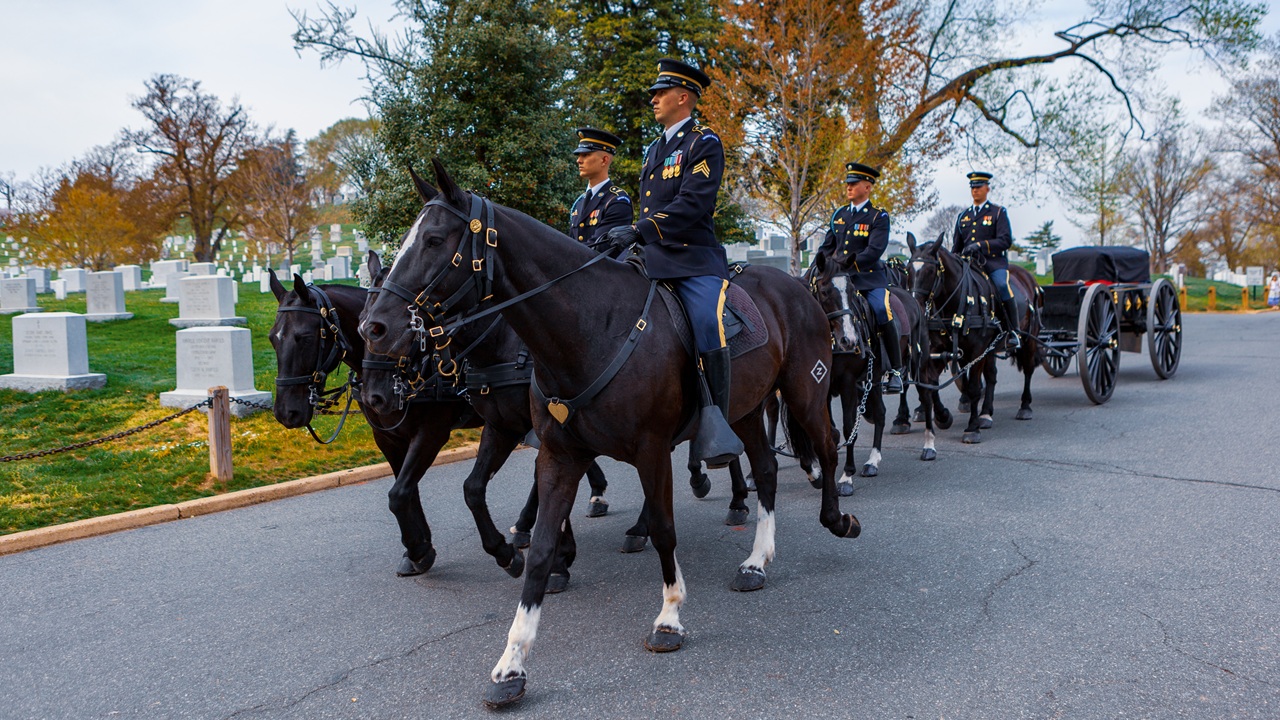
Last summer, the United States Army announced it would disband most of its ceremonial cavalry units and retire 141 horses. Plans at the time called for only retaining the “Old Guard” caisson units at Joint Base San Antonio and Arlington National Cemetery for burial honors.
That move was part of ongoing “cost savings” within the Department of Defense, which has seen multiple military museums closed and some time-honored traditions being phased out. There was some irony in the announcement coming just weeks after the high-profile, but largely lackluster, parade to honor the 250th anniversary of the US Army’s founding—which, in further irony, included ceremonial cavalry units.
Last week, just days after President Donald Trump suggested the Pentagon’s fiscal year 2027 (FY27) could exceed $1.5 trillion, the Army announced that it would reinstate its equine programs at Fort Riley, Kansas, and Fort Hood, Texas.
“After careful consideration, the Army has determined that retaining these MWE programs is in the best interests of the force,” said Col. James Fuhriman, assistant deputy for Army health affairs. “These programs provide unique capabilities and benefits that are difficult to replicate, and their continuation aligns with our broader commitment to readiness and community engagement.”
The broader cutback is still in force, and the ceremonial units from a number of bases—Fort Carson in Colorado, Fort Sill in Oklahoma, Fort Irwin in California; and Fort Huachuca in Arizona—are still likely to get the axe, with their respective horses put up for adoption. Last summer, the Associated Press reported that cutting all equine programs (except horses for caisson duties) would save the US Army approximately $2 million per year, a tiny fraction of the overall budget. (For reference, the Pentagon spent $45 million on the DC parade.)
Each Base Will Get 22 Horses—and Two Mules
The military working equid (MWE) programs at Fort Riley and Fort Hood will return, each with 22 horses and two mules.
The programs will “serve as a link between the Army and the American people through public demonstrations, educational outreach, and participation in local events,” the Army explained. The MWE will also ensure the connection between the “Army’s past and present” remains while honoring its heritage, which long included the use of horses.
“Our commitment is reflected in the ongoing investments in resources, personnel, and infrastructure to support both the animals and Soldiers,” Fuhriman stated.
The service further established a new military occupational specialty (MOS), “Army Equestrian” (08H), which replaced the previous “military horseman” identifier (D2). The goal was to create a specialized career path “dedicated to the professional care of military working equines.”
08H is currently open to US Army infantry soldiers in grades E5-E9. It is unclear if previous experience with horses would be required, however.
“Supplying trained personnel and animals allows us to maintain the program’s high standards,” said Fuhriman. “It empowers the Fort Hood and Riley MWE programs, much like The Old Guard, to continue their legacy of excellence in preserving the Army’s equine heritage.”
It is unclear what exactly led the Army to this decision, but according to Business Insider, “some supporters have said these units serve as valuable recruiting and public engagement tools.” Horses could be another connection to the civilian world when it is needed most.
The US Army met its recruiting goals in its two most recent fiscal years. Still, it struggled for multiple years prior and has gone to great lengths to build interest, including using video and social media campaigns, as well as other non-traditional methods, to connect with today’s youth. Horses could be another part of it, especially as modern Westerns on movies and TV have seen a significant resurgence.
About the Author: Peter Suciu
Peter Suciu has contributed over 3,200 published pieces to more than four dozen magazines and websites over a 30-year career in journalism. He regularly writes about military hardware, firearms history, cybersecurity, politics, and international affairs. Peter is also a contributing writer for Forbes and Clearance Jobs. He is based in Michigan. You can follow him on Twitter: @PeterSuciu. You can email the author: [email protected].
Image: Shutterstock / George Sheldon.