Piety—the awe and respect for God and His Creation—drove philosophers and scientists throughout the Christian era, beginning during the Roman Empire, continuing through the European Middle Ages, and beyond. Christian philosopher-scientists relied heavily on their Greek and Roman predecessors throughout this thousand-year period—the most important ancient influence being Aristotle. His work as the premier scientist in Western Civilization continued after his death in 322 ante Christos for over two thousand years. Part of the reason for this were the thoughts, books, and works of the philosopher-scientists of the late Middle Ages: Anselm of Canterbury, Albertus Magnus, and especially Thomas Aquinas.
Anselm of Canterbury
The eleventh-century saint and philosopher-scientist Anselm of Canterbury, too, was influenced by these ancient thinkers, including the last ancient and first medieval philosopher and theologian St. Augustine. St. Anselm’s famous dictum, that God is “that than which nothing greater can be conceived,” merely expanded on Augustine’s question, “If you find nothing above our reason save what is eternal and unchangeable, would you hesitate to call this God?”
Anselm’s famous ontological argument for the existence of God proves how even an atheist must accept the existence of God. Anselm (and Augustine) believed that the conception of God was the result of an intuitive understanding of the ultimate expression of existence, the ultimate idea beyond what humans can conceive of, the ultimate Being.
Albertus Magnus
An advance in the commensurability of piety and science occurred at the University of Paris in the 13th century, where some of the greatest late Medieval theologian-scientists studied and taught, including Bonaventure, Albertus Magnus, and Thomas Aquinas. The intellectual influences on these theologian-scientists included Plato, Augustine, and Aristotle. At first, Aristotle was sublimated to Plato and Plato to Augustine. But with the arrival of newly discovered works of Aristotle, a more scientific approach to theology occurred first with Albertus Magnus, then with Thomas Aquinas.
The Andalusian Ibn Rushd (Averroes), an Aristotelian commentator who believed that “he who studies anatomy increases his belief in God,” had a huge impact on Albertus Magnus and Thomas Aquinas. Like Ibn Rushd, Albertus Magnus was an encyclopedic synthesizer of the work of Aristotle, seeing the connections between Aristotle’s scientific methods and Christian theology. He believed that the encyclopedic knowledge of Aristotle and the ancients would add to, rather than detract from, Christian piety. This movement incited an intellectual revolution throughout Europe as theologians embraced the thought of the pagan empiricist Aristotle and tied it to Christianity, believing that Christianity would not be the sine qua non of thought unless embraced by philosophy and science.
Thomas Aquinas
Philosopher-scientists during the late Middle Ages benefited from the work of pious Muslim scientists, who were also heavily influenced by the works of Aristotle. Aristotle’s works that survived the Fall of Rome were translated from Greek to Arabic, then spread throughout Muslim lands, such as North Africa and Spain, where his works were translated from Arabic to Latin. Thanks to this widespread access to Aristotle’s writings, there was much interchange between Christian philosopher-scientists in Constantinople and Muslim philosopher-scientists in Damascus, Baghdad, and Cairo.
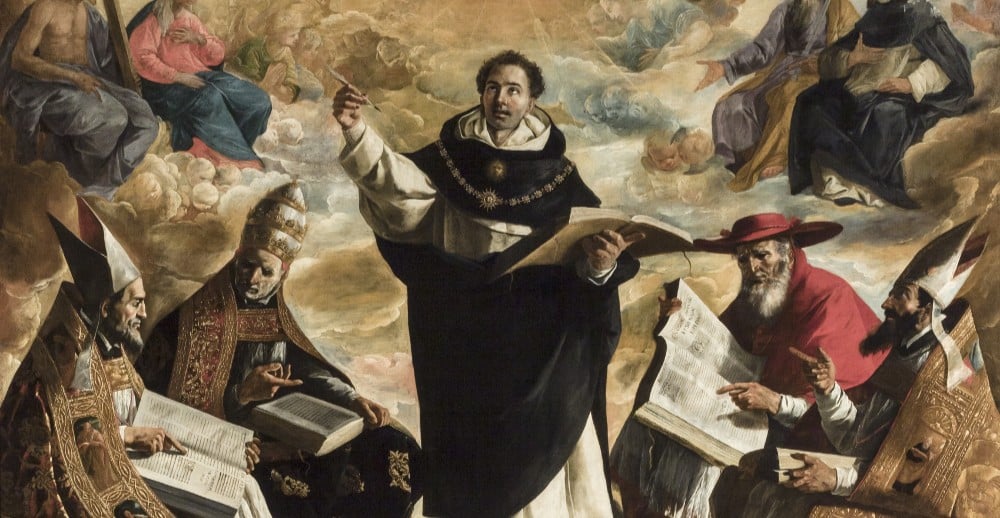
Thomas Aquinas’ Summa Theologica, the Sum of Theology, was the logical outcome of the centuries of Christian and Muslim philosopher-scientists’ work, who slowly synthesized ancient and medieval knowledge, pagan philosophy and science, and Christian theology. Aquinas’ Summa attempted to reconcile Greek philosophy and science with Christian theology. He had at his disposal a vast corpus of Aristotle’s works and relied heavily on Aristotelian methods to arrive at logical proofs about the existence and nature of God and His works. Thomas devoted the Sum of Theology to approaching an understanding of God.
Aquinas’ Proofs
Thomas embraced Aristotle’s view that human senses are the fundamental source of knowledge; hence, the body and the mind are joined to understand the nature of being. These were the principles Thomas used to prove the existence of God—not just by faith, but by reason and the scientific method, utilizing Aristotelian logic.
For example, to prove God as the First Mover, Aquinas begins with sensory observation; he defines that movement occurs when a thing goes from potential to move to actual movement. How does this happen? When the potential is moved by a mover. A mover must already be in actual movement, not in potential, so it, too, must have been moved by a mover. There is no such thing as eternal movement, and a mover and the moved cannot be the same. There has to be a beginning then, a First Mover, who has always been and always will be in actual movement. This First Mover, God, exists out of His own necessity; there is no possibility of His nonexistence. These conclusions are “evident to the senses.” Nothing can be both “potentiality and actuality.” Fire is actually hot, while wood is potentially hot. Fire can transform wood, but then wood is no longer potential fire, but actual fire.
Now combining science and philosophy with theology: All movement derives from the First Mover, God. This movement is directed by His providence. Thus all human intellect is moved or acts because it ultimately is derived from God. The human intellect knows only what God bestows on it. Nevertheless, humans have free will. Human judgment to act is not just instinct, “but some act of comparison in reason.” By free will humans erred, but after the Fall, some Good still prevailed in us, which is the basis for our continual striving for the ultimate Good. This striving, however, requires cooperation with grace to know and draw nearer to the Good.
Much of the thought of the 13th century, including that of Thomas Aquinas, was involved in reconciling science, philosophy, and theology. Aquinas saw that deduction alone is insufficient; reasoning must include inductive analysis, which is to start at the basics and arrive at the pinnacle of human thought—a critical step toward modern empirical science. Thomas as a scientist, achieving vast knowledge, always realized that human reason is insufficient to know, to comprehend God and His Ways. Thus, piety alone remained at the end of his inquiries.
Editor’s Note: Read the previous installments of The Pious Scientist series here!
Image from Wikimedia Commons