Sacrifice or oblation you wished not, but ears open to obedience you gave me. (Ps. 40:7)
The grammatical rule regarding pronoun usage in imperative, or “command,” sentences is referred to as the “understood” pronoun. In other words, if I were to say to my child, “Stop running,” the understood pronoun in this command sentence is “you.” I don’t actually speak the word “you,” because it is already understood that it is my child to whom I am speaking. Just so, not all of God’s commands to us are clearly stated, as is the case with the commandments, “You shall not kill” or “You shall not bear false witness,” for example. There are by far many more instructions and commandments that come to us from God throughout our daily lives that are not explicitly outlined in His list of ten. Because of this, sometimes there are actions that even the most devout among us carry out (or fail to carry out) that are, in fact, contrary to the will of God. Such actions may not be in blatant violation of the Ten Commandments, but they are also not what God calls us to do.
When we offer “sacrifice” or “oblation” or carry out any other otherwise objectively “good” work that does not happen to be the good work that God has asked of us, then we do not have “ears open to obedience.” So what are these non-explicit commandments that God wishes us to do or to refrain from doing?
Before we answer this question, let’s understand why it is important to know the Lord’s non-explicit will. After all, most of us faithful Christians are familiar with the Ten Commandments, and we also know that to love God with all one’s heart, mind, and strength and to love one’s neighbor as oneself are the greatest commandments of all. What more does one need to know to carry out God’s will? Theoretically speaking, nothing. But practically speaking, it’s not so easy for us to discern God’s specific will in our day-to-day, real-life struggles.
For example, if my father has an angry temper, how do I fulfill the commandment to “honor” him when his presence tempts me to “fire” back? What if I am required to answer a question on a legal document that will cause me to violate my conscience; is it then okay to lie? What do I tell my kids about Santa Claus?
It is true, God gives us clear commandments, but how to apply them in every circumstance of our lives requires “ears open to obedience” in order to discern. So let’s dig a little further into the Scriptures to see if we can understand just how we can have ears to hear.
I have waited, waited for the LORD, and he stooped toward me. (Ps. 40:2)
The psalmist tells us that before he received his “ears open to obedience,” he first “waited for the Lord.” In other words, he didn’t rush to act upon his impulses, basing his reactions on rash emotions. He first sought direction from the Lord. And the fact that he “waited, waited” suggests that his discernment didn’t come instantaneously. He stood by in prayer for a long time.
Sometimes when the Lord is taking “too long” (by our estimation) to get back to us on something we want answered right away, we can decide He isn’t planning to give us an answer at all, and so it’s time to take matters into our own hands. But most of the time, just because we want our answer right away, doesn’t mean we need it right away. In fact, there is a very good reason that Jesus often makes us wait.
What does a faithful Christian do when he doesn’t know what to do? He prays! Not knowing all the answers to all our difficulties is precisely what keeps us tethered to the Lord, seeking the peaceful refuge of His cloak, the only place where we can always find rest from our burdens.
And he put a new song into my mouth, a hymn to our God. (Ps. 40:4)
Next, the psalmist tells us that in his period of waiting, God “put” a song into his “mouth.” And not just any song, but a “new” song. What does this mean? It means that as we muster up what little strength we have to wait patiently on the Lord, trusting that He will answer us in His time, the Lord then re-news our spirit, removing the downcast discouragement from our hearts and replacing it with His hope and joy. And as He does so, we find ourselves singing God’s praises! We now offer Him praise and thanks because we have been animated by the Holy Spirit, in whom we live and move and have our being (Acts 17:28). And in this disposition of peace and hope and joy in the Lord restored and renewed, we are finally able to “open” our “ears” to “obedience.” We now have ears to hear!
So now that we can hear…what would the Lord have us do? What is the non-explicit commandment that He wishes us to obey? According to the psalmist, the will of God is that we proclaim the Good News of His love and mercy, regardless of the difficulties and trials which we endure:
I did not restrain my lips, as you, O LORD, know…I have made no secret of your kindness and your truth in the vast assembly. (Ps. 40:8-11)
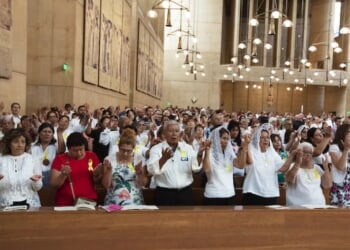
But how does proclaiming God’s love and mercy in the midst of our difficulties help us to discern more practical matters—such as how to find resolution to these difficulties? While it is true, the Lord desires us to proclaim His goodness and mercy in all circumstances, how each of us does this on a personal level is discerned in the time of prayerful trust, as we patiently wait for the Lord to resolve our trials. For the psalmist, his proclamation of God’s goodness was made manifest in the “vast assembly,” but our proclamation of God’s goodness might be made manifest a little differently.
If I struggle with a particular relationship, then my time of prayerful waiting is meant to remove any resentment or bitterness from my heart, that the Lord might renew it with His mercy and love. Then, discerning how to address this relationship is no longer such a challenge for me, because I am no longer riddled with repugnance when I am in their presence, nor am I saddled by guilt when I am not. When my heart is restored in the peace of Christ, I cease to be downcast when outcomes don’t turn out the way that I had planned, because I know that they have turned out as God has planned—and His plan is always best.
Now I find myself excited—even giddy—to see what comes next! It makes no earthly sense, because in my humanity, I should be feeling discouraged and dismayed. But because I have “waited, waited” on the Lord, I no longer react impulsively from my human emotion. I now obey the “non-commandment” that comes to me from the Lord, and I respond to my circumstances animated by the Spirit who lives within me.
Photo by Joshua Hoehne on Unsplash