Turkish influence in Syria has expanded over the last year, leaving grim tidings for the country’s Kurdish population as well as prospects for Syrian unity.
Recent fighting in Syria’s second city, Aleppo, marks the latest in a string of escalations between the central government in Damascus and the Syrian Democratic Forces (SDF). Yet, the hostilities represent more than another instance of disagreement; rather, they represent a step up the escalatory ladder, potentially designed to test the limits of aggressive action against the SDF. That dynamic is likely driven by Turkey, at the expense of US interests in post-Assad Syria, potentially spelling disaster.
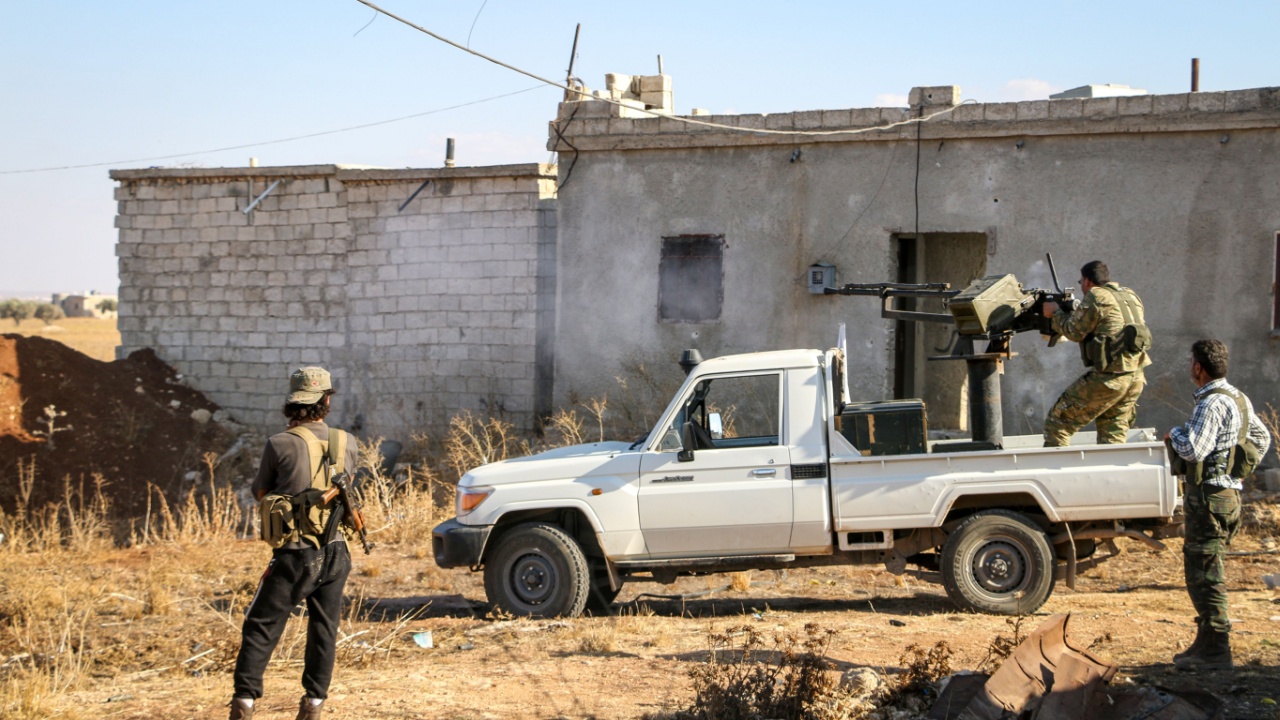
What exactly ignited the exchange in northern Aleppo City’s two majority-Kurdish neighborhoods of Ashrafiya and Sheikh Maqsood on January 6 remains unclear, with both sides blaming each other for indiscriminate and unprovoked attacks on their positions. The fighting began after the last round of unification talks failed to produce a solution, with reports suggesting the central government pulled out of the talks just ahead of the fighting in Aleppo. Initially, the incidents largely reflected earlier exchanges, with the expected outcome constituting another brief round of small-scale attacks between the actors. However, the fighting did not cease; rather, it intensified over the following days.
Those hostilities proved quite destructive, with heavy weapons and small arms exchanges hitting densely populated neighborhoods housing an estimated 200,000–500,000 people. As a result, at least 24 civilians were killed, with an estimated hundreds more injured. According to the latest reporting from the UN Office for the Coordination of Humanitarian Affairs (OCHA), well over 100,000 people remain displaced due to the fighting, with many fleeing to the Kurdish-majority Afrin District to the northwest or to SDF territory in northeast Syria, across the Euphrates River. There are numerous accusations of atrocities committed by both sides during the fighting.
Syria’s central government announced multiple ceasefires and humanitarian corridors between January 8–10 for civilians and local SDF-aligned security forces—known as the Asayish—to evacuate, with the latter only allowed to travel to Deir Hafir and other small patches of SDF-held territory along the western bank of the Euphrates. Initially, local security forces resisted, but they evacuated by January 11. That decision was meant to end the incident.
Still, new hostilities ignited in eastern Aleppo’s Deir Hafir on January 14, with the central government accusing the SDF of reinforcing evacuating forces for new engagements. The SDF has denied the accusations, accusing the government of using the situation to build up forces for an assault on its territory.
Damascus now controls Ashrafiya and Sheikh Maqsood, establishing checkpoints, assessing the landscape for remaining security remnants and booby traps, and removing earthen berms. Yet, with a new humanitarian corridor opened for civilians in eastern Aleppo, this tense moment may not yet be concluded.
Indeed, broader competition between these actors may just be heating up. The central government’s decision to force the remaining SDF-aligned forces out of Aleppo City is significant. Both neighborhoods remained under Kurdish and SDF control for most of the war, marking an important—if somewhat symbolic—stand for the group. Post-Assad, the SDF vied for local Kurdish security control to continue out of fear of former Syrian National Army (SNA) elements, fears that multiple minority massacres on the part of government and government-aligned forces in 2025 only worsened.
The fact that the central government chose force against these neighborhoods in the shadow of those massacres cannot be understated. In Suweida, especially, Damascus attempted a similar method to gain full control of the Druze-majority governorate, likely using instability as a pretense to force local militias to capitulate to its authority. This approach and mindset define the transitional authority and, previously, Hay’at Tahrir al-Sham, when it conquered, ruled, and expanded across northern Syria’s Idlib Governorate.
Yet unlike its failed efforts in Suweida, its assault on the primary vestige of Kurdish autonomy west of the Euphrates outside of the Deir Hafir area largely succeeded because it managed to remove the SDF and most of its heavy weapons from the neighborhoods, leaving only the Asayish and their small arms to resist a weak but still stronger Syrian Army. Understanding the power asymmetry at play, the SDF opted to pull the Asayish as well, living to fight another day. Pragmatism defines the group, as evidenced by its willingness to cooperate with the Assad regime if that meant protecting its autonomy project and Kurdish lives. That dynamic is, in no small part, one significant driver of Damascus’s enmity for the group.
Still, the ideological underpinnings and past frustrations of those now running the central government only partially explain the decision to take Ashrafiya and Sheikh Maqsood. Turkey’s role is significant in this regard. Ankara has directly and aggressively opposed any armed Kurdish presence along its southern border since well before the Syrian war began in 2011, invading Syria three separate times to prevent any contiguous SDF presence across the country’s north in 2016-17 (Operation Euphrates Shield), 2018 (Operation Olive Branch), and 2019 (Operation Peace Spring). Those efforts continued after Assad’s collapse, with Turkish and SNA forces capturing Manbij and most of the SDF’s territorial holdings west of the Euphrates in December 2024.
Indeed, Turkish interests have long dictated Syria’s geopolitical outlook, and their influence has only increased since HTS took Damascus. In this context, Ankara continues to push an aggressive anti-SDF strategy, much to the chagrin of US president Donald Trump’s administration, which hopes to foster a deal between the parties in support of its long-needed withdrawal from its anti-Islamic State effort in Syria. Washington is largely credited with preventing such an operation, correctly understanding that the effort would sink Syria back into a brutal civil war without end. Ultimately, the United States views a stable Syrian transition as necessary for preventing the re-emergence of extremist groups that could flourish otherwise.
The issue, however, is that Turkey views the SDF as an extension of the Kurdistan Workers’ Party and, therefore, a part of that extremist component. It argues that the group cannot be trusted, given the PKK’s decades of fighting within Turkey against the state. For Ankara, Syria falls within its field of influence, meaning its interests there are existential to its strategic depth and national security. This stance is inherently incompatible with the long-running US strategy in Syria, effectively poisoning the well between the two states for over a decade.
While the Turks have given talks a chance, they have also regularly threatened the SDF with an assault. Aleppo is informative in this regard. While the United States has long held a veto over Turkish actions east of the Euphrates, given its troop presence there and general influence over Turkey, the dynamics west of the river are entirely different, given the lack of any such presence. Equally important, Damascus would not have moved on Ashrafiya and Sheikh Maqsood without Ankara’s blessing. As such, the central government’s actions should be interpreted as a Turkish effort to test the limits of military pressure on the SDF amid ongoing unification talks, especially with Washington overstretched in Venezuela, Gaza, Ukraine, and potentially Iran.
Whether that approach can pressure the SDF to meet more Damascus demands is unclear, but it has permanently changed the dynamic between the two Syrian parties. Ultimately, any military approach likely has diminishing returns as the bulk of the SDF presence—certainly a peer force or greater relative to the battered Syrian army, given its long-running Western backing—remains in Syria’s northeast. To be sure, Turkish air power changes that calculation. However, SDF territorial holdings are expansive and, again, Washington continues to veto any military effort there.
Thus, Damascus-SDF fighting could harden the positions of both sides in talks, especially given their inherently incompatible views on Syria’s future. For now, Deir Hafir—the last territorial holdings for the SDF west of the Euphrates—appears to be in Damascus and Ankara’s sights. Rather than producing SDF capitulation, the Turkish-backed assault on Ashrafiya and Sheikh Maqsood may further stymy negotiations, leaving Syria in a de facto state of partition for the foreseeable future.
About the Author: Alexander Langlois
Alexander Langlois is a foreign policy analyst, the senior editor at DAWN, and a contributing fellow at Defense Priorities. He is focused on the geopolitics of the Levant and the broader dynamics of West Asia. Langlois holds a Master of Arts degree in International Affairs from American University. He has written for various outlets, including The Carnegie Endowment for International Peace’s Sada, the Atlantic Council’s MENASource, the Lowy Institute, the Gulf International Forum, the New Arab, the Nation, and Inkstick. Follow him on X: @langloisajl.
Image: Mohammad Bash / Shutterstock.com.