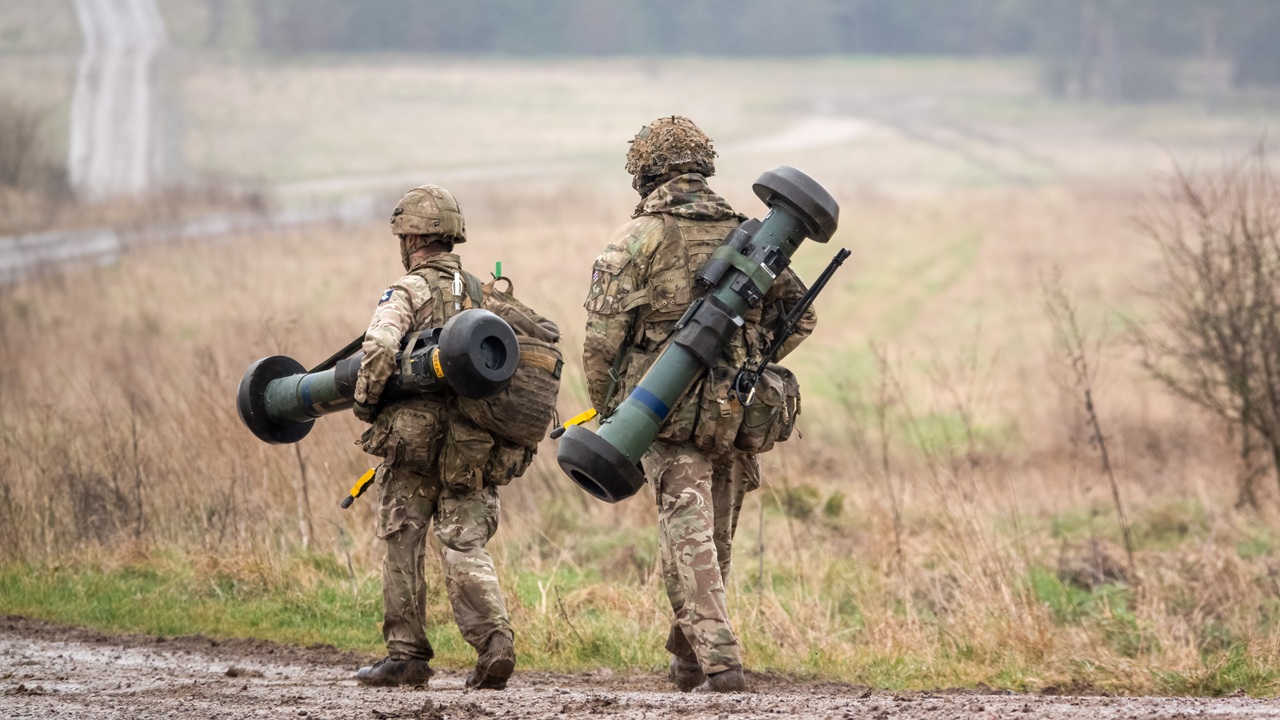
Air Chief Marshal Sir Richard Knighton stressed that the UK had benefited from the “peace dividend” of the post-1991 era—but had failed to adapt to threats posed by Russia.
The British military is not ready for a full-scale conflict with Russia, according to the country’s most senior military officer—a startling admission at a point when the United Kingdom’s tensions with Russia are at a historic high.
Defense Staff Chief Claims UK Military Spending Too Low
In a recent testimony to a parliamentary committee on defense, Air Chief Marshal Sir Richard Knighton, chief of the defence staff, told British lawmakers that due to budgetary shortfalls, the British military is not ready to fight a full-scale war with Russia.
“We are not as ready as we need to be for the kind of full-scale conflict that we might face,” Knighton told the parliamentary defence committee on Monday.
The most senior British military officer added that the UK “[has] taken a peace dividend” in the 30 years since the end of the Cold War and highlighted that increased readiness “is how we ultimately deter our principal adversaries through being ready to fight and win.”
Reduced readiness is largely determined by defense spending. The more a country spends wisely, the more aircraft, tanks, warships, artillery guns, and drones it has and is in a condition to fight.
Knighton said that the British armed forces faced an in-year budget shortfall estimated in the several billions, which would require them to make difficult decisions to stay within spending limits.
How Brexit Hamstrung the UK’s Defense Industry
The economic backlash of the decision to depart from the European Union following the Brexit vote has upended the British economy—and caused pressures in successive governments to cut defense spending in order to fund other societal needs.
This situation is not easily amenable. According to a report released in December, the UK will need to spend more than $1.7 trillion (£800bn) by 2040 on new funding for military acquisition and infrastructure projects. That number is necessary to meet new ambitious goals for NATO following President Donald Trump’s pressure for a 5 percent GDP spending per year. That is an estimate of more than $100 billion per year for 16 years consecutively.
But the current Labour government does not seem willing to meet that target, or at least right away. The expected total defense spending for 2025/26 is approximately $84 billion (£62.2 billion) but is set to increase to nearly $99 billion (£73.5 billion) in 2028/29.
The Russian Threat Isn’t Going Away
Knighton’s statements come at a point in time when Russian aggression in Europe is at a recent high.
The British defense chief stressed Russia posed a bigger threat to peace and stability in Europe at present than at any time in the post-Soviet era. In addition to its large-scale invasion of Ukraine, Russia has attempted to undermine the unity and cohesion of NATO and the European Union through hybrid warfare, including kinetic attacks and sabotage. There have been countless incidents over the past few years and months of unprovoked Russian aggression against NATO and Europe.
The UK is a pillar of European defense and a key NATO member state. It is crucially important that it has a powerful military to deter Russia and, if necessary, counter Russian aggression on the battlefield.
About the Author: Stavros Atlamazoglou
Stavros Atlamazoglou is a seasoned defense journalist specializing in special operations and a Hellenic Army veteran (national service with the 575th Marine Battalion and Army HQ). He holds a BA from the Johns Hopkins University and an MA from the Johns Hopkins’ School of Advanced International Studies (SAIS). His work has been featured in Business Insider, Sandboxx, and SOFREP.
Image: Shutterstock / Martin Hibberd.