Earlier this month, Mayor Zohran Mamdani faced controversy for his appointment of advisor Cea Weaver to run the Mayor’s Office to Protect Tenants. Weaver, X users and the media soon discovered, had made several social-media posts asserting that homeownership was “racist” and “a weapon of white supremacy,” and calling for policies to “impoverish the white middle class.”
I dislike the attitudes expressed in these posts. I even think they’re racist. But it’s easy to treat them as aberrant. In fact, at the time they were made—the late 2010s—those attitudes were culturally dominant.
Finally, a reason to check your email.
Sign up for our free newsletter today.
Such instinctual, casual anti-white statements reinforced the active institutional discrimination against white males recently described by Jacob Savage in his widely noted Compact essay “The Lost Generation.” Savage shows how an entire generation of white males suffered unfair treatment under the DEI regime in applying for and holding certain types of jobs. Everyone else suffered, too, from this bigoted ideology. It led not just to bias in hiring but to an absurd culture of racialized thinking.
In 2008, I attended a conference held by a progressive Washington, D.C., think tank and advocacy group. The keynote speaker was a member of Congress who tried to impress upon us the importance of representation. Many of the conference’s panels, she urged, had not taken local and demographic concerns seriously enough; for instance, calls to shut down private prisons ignored how some local residents might be employed at those prisons. In one particular primary campaign, she claimed, the stakes of representation were high, because a majority-minority community was being represented by someone who, in her words, “didn’t look like them.” It was important to support the opposing candidate, a black woman who had risen through the local party apparatus and would presumably better represent these people.
Back then, I thought that my professional future, as well as my political values, might lie with the Democratic Party. But talk like that unsettled me. So I looked up the primary our speaker had mentioned. It turned out that the incumbent was a Jewish man who was being attacked over his ethnicity and his support for gay marriage. Despite these ugly criticisms, his opponent garnered a number of high-profile endorsements, including from the feminist group Emily’s List. The incumbent’s campaign manager responded matter-of-factly that this was “a matter of plumbing: they don’t endorse males.”
Ideas like the speaker’s became increasingly dominant among progressive elites. Consider how, in its interview with then-presidential hopeful Pete Buttigieg, the New York Times editorial staff asked him how he countered “Mayo Pete” memes, making clear that “mayo” here meant “white.” America’s paper of record, in other words, was asking a presidential candidate whether he could compensate for the fact of his race.
Maybe this shouldn’t have surprised me. A former Times editor, Sarah Jeong, was well-known for tweets like “White men are bullshit.” In 2017, the paper had published an opinion piece by a University of Michigan law professor asking the question, “Can My Children Be Friends With White People?,” which included the sentence: “As against our gauzy national hopes, I will teach my boys to have profound doubts that friendship with white people is possible.”
Many academic and journalistic superstars of the woke era got their start with anti-white rhetoric and conspiracy theories. When she was in college, Nikole Hannah-Jones, the MacArthur-approved “Genius” who masterminded the Times’s 1619 Project, wrote that “the white race is the biggest murderer, rapist, pillager, and thief of the modern world,” that “Africans had been to the Americas long before Columbus or any Europeans,” and that “even today, the descendants of these savage people pump drugs and guns into the Balck [sic] community, pack Black people into the squalor of segregated urban ghettos, and continue ot [sic] be bloodsuckers in our communities.” She also favorably cited a nineteenth-century writer who claimed that “whites have always been an unjust, jealous, unmerciful, avaricious, and bloodthirsty set of beings, always seeking after power and authority.”
Another MacArthur honoree, Ibram Kendi, wrote similarly in college that “Europeans are simply a different breed of human. They are socialized to be aggressive people. . . . Caucasians make up only 10 percent of the world’s population and that small percentage of people have recessive genes. Therefore they’re facing extinction. Whites have tried to level the playing field with the AIDS virus and cloning, but they know these deterrents will only get them so far. This is where the murder, psychological brainwashing and deception comes into play.”
A third MacArthur Genius, Ta-Nehisi Coates, interviewed for Vox by Ezra Klein, said more euphemistically and ambivalently in 2017: “It’s very easy for me to see myself being contemporary with processes that might make for an equal world, more equality, and maybe the complete abolition of race as a construct, and being horrified by the process, maybe even attacking the process. I think these things don’t tend to happen peacefully.”
Against these outbursts, consider some minor political theater conducted in the same period. On a number of college campuses in 2018, conservatives put up signs that said merely, “It’s Okay to be White.” These signs infuriated some people, which was their goal. But why was the language so offensive?
Back in 2017, Catherine Almonte Da Costa—who recently had to resign from Zohran Mamdani’s incoming administration—wrote that it was “important that white people feel defeated.” What forced her to leave Mamdani’s team, however, was not that sentiment but a series of anti-Semitic social-media posts, including remarks such as “Money hungry Jews smh.” The episode underscores a pattern that critics of left-wing anti-Semitism have often missed: because Jews are typically classified as “white” within progressive racial frameworks, anti-white rhetoric and anti-Semitic tropes frequently overlap—much as, on the right, anti-Semitism has often aligned with hostility toward Indians and Asians.
Anti-whiteness was endemic in academia. In my field, philosophy, “white ignorance” is considered a legitimate and inoffensive research topic. A 2021 article, “On Having Whiteness,” begins: “Whiteness is a condition one first acquires and then one has—a malignant, parasitic-like condition to which ‘white’ people have a particular susceptibility.” This past summer, University of North Carolina philosopher David Decosimo noted on Twitter that when he was at Boston University, during one job search, “student comments saying ‘Don’t hire another white man!’ were read aloud approvingly as part of the faculty hiring decision.”
These attitudes were often reproduced in media. The other day, I noticed that the first episode of Suits, a popular television show about a law firm that premiered in 2011, features a secretary telling a job applicant: “What makes you think that I’m going to let the whitest man that I have ever seen interview for our firm?” It’s presented as a clever challenge—but saying such a thing to a job candidate would be patently illegal.
Oddly, anti-white sentiment even persisted into anti-wokeness. Despite the prominence of thinkers, writers, and nonwhite activists in the woke movement, the anti-woke love to cast wokeness as a movement of rich, white virtue signalers—which apparently would make it somehow worse. We defer nearly as much to nonwhite anti-woke figures as the woke do their nonwhite compatriots, implicitly accepting the identitarian frame even when challenging it.
In the early days of my anti-wokeness, I argued for a “substitution test,” reflecting what I now see as a somewhat naïve classical-liberal approach to identity questions. If you’re about to say something about white people, try substituting another race and see how it sounds. If you’re about to say something about men, substitute “women.” If it sounds bad after the substitution, it was probably bad before, too.
I still think this is a useful test, but in some ways it gets things backward. It rests on the notion that white men have as much claim to grievance as anyone else—and that we ought to clutch that grievance like a prize. Such eagerness to be victimized, however, does us no more credit than it does any other group. Taken to its extreme, it risks making us as tedious as the people criticized in this essay.
Instead, like many targets of bigotry throughout history—including some of our woke opponents—we should cultivate an attitude of pity. Those drawn into this absurd movement deserve pity for their weakness, their silliness, and their inability to see the contradictions in their views, or how their behavior would ultimately backfire.
In some cases, of course, such traits may be disqualifying. But we should be wary of prosecuting old tweets or private correspondence—another excess of the woke era.
After all, it is probably hard even for people like Weaver to remember why it once seemed funny or clever to take jabs at white men in TV shows, stand-up routines, political speeches, or academic papers. I, for one, am curious to see what they forget next.
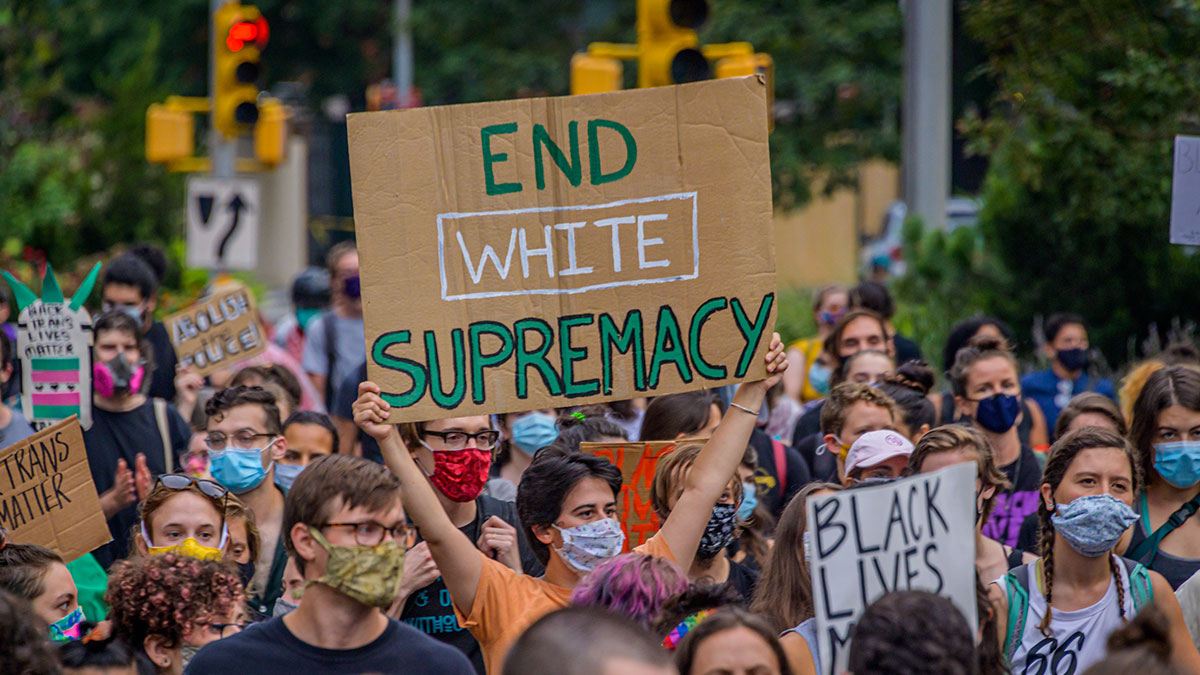
Photo by Erik McGregor/LightRocket via Getty Images
Source link