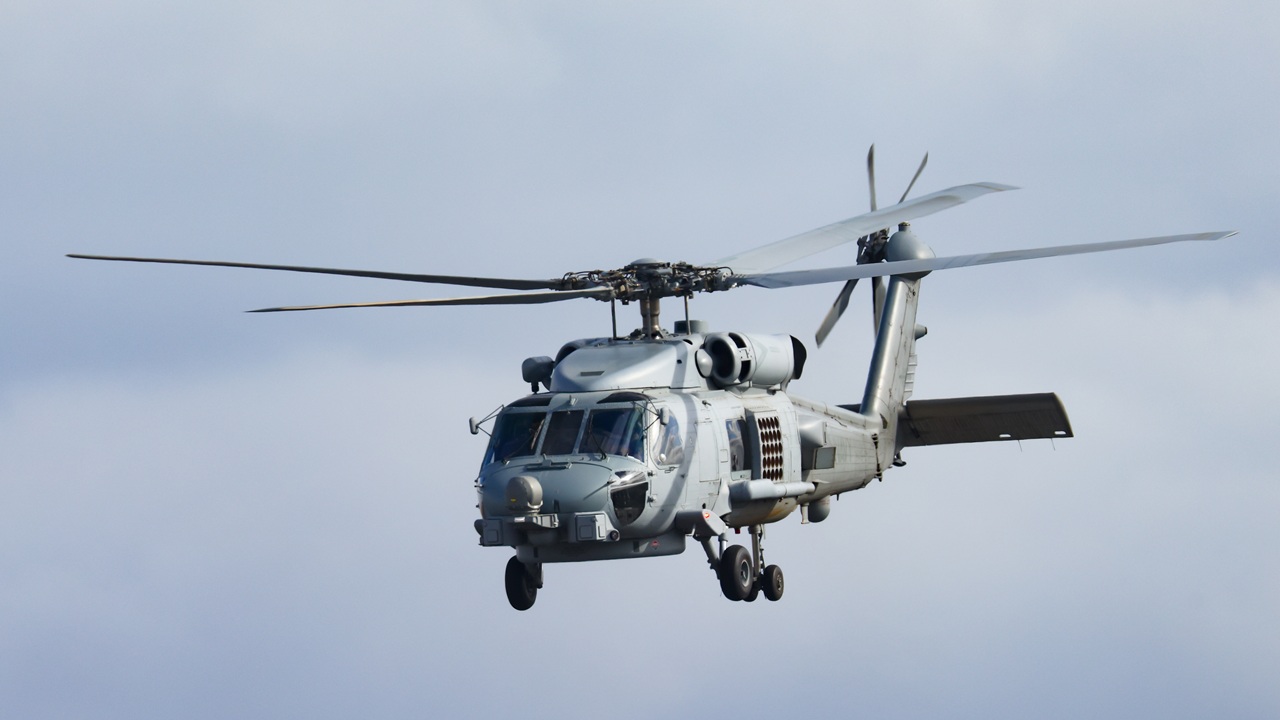
The MH-60R “Romeo” helicopter has proven invaluable to the Navy since its introduction in the mid-2000s, showing great versatility and proficiency in combat.
Aerospace and defense giant Lockheed Martin delivered its 350th MH-60R “Romeo” helicopter to the United States Navy. The multi-mission rotary wing aircraft is a variant of the United States Army’s Sikorsky UH-60 Black Hawk.
HSM-41, the US Navy’s Helicopter Maritime Strike Fleet Replacement Squadron, received the MH-60R aircraft earlier this month at a ceremony at the company’s Owego, New York facility. The squadron trains aviators and naval aircrewmen for the US Pacific Fleet.
The delivery is seen as a milestone for the program.
“The delivery of the 350th MH-60R helicopter is a testament to the exceptional capabilities of this aircraft and the dedication of our team,” explained Ali Ruwaih, Maritime Systems vice president at Lockheed Martin. “We are proud to support the US Navy and our global partners with this highly advanced multi-mission platform, which will remain a critical component of global ASW operations for decades to come.”
The MH-60R Seahawk in the Crosshairs
- Year Introduced: 1984 (SH-60B); current MH-60R/S variants entered service in early 2000s
- Number Built: ~700+ across all naval variants (SH-60B/F, MH-60R, MH-60S; still in production)
- Length: 64.8 ft (19.76 m) overall
- Rotor Diameter: 53.8 ft (16.4 m) main rotor
- Weight: ~23,500 lb (10,660 kg) maximum takeoff weight, depending on variant
- Engines: Two General Electric T700-GE-401C turboshafts (~1,900 shp each)
- Top Speed: ~168 knots (193 mph, 311 km/h)
- Range: ~245 nmi (282 mi, 454 km) combat radius; ~450+ nmi ferry range with auxiliary tanks; 3.5 hours’ endurance on standard fuel load
- Service Ceiling: ~12,000 ft (3,660 m)
- Loadout: Common Cockpit digital glass cockpit (Rockwell Collins/Lockheed Martin); integrated mission computers, Link-16 datalink, radar warning receivers, GPS/INS navigation, and night vision goggle compatibility
- MH-60R (Romeo): 2× Mk 46 or Mk 54 lightweight torpedoes, up to 4× AGM-114 Hellfire missiles, machine guns (GAU-21 .50 cal or M240D 7.62mm); AN/AQS-22 dipping sonar; AN/APS-153(V) radar; FLIR turret; sonobuoy launchers.
- MH-60S (Sierra): Door guns, rescue hoist, 9,000 lb (4,080 kg) cargo hook; can carry Hellfires, GAU-21s, or 70mm rockets with Armed Helo kit; supports troop or medevac transport for up to 8–10 personnel.
- Aircrew: Typically 3 (pilot, copilot, and sensor operator/crew chief)
The latest development of the MH-60 Seahawk builds on four decades of experience at sea. Developed for anti-submarine warfare (ASW) and anti-surface warfare (ASuW), the MH-60R is equipped with advanced digital sensors, including multi-mode radar, electro-optical/infrared cameras, and dipping sonar and sonobuoys, to track adversarial submarines.
In addition to its ASW and ASuW roles, the Romeo can be employed in electromagnetic warfare, command and control, and non-combat operations. Its second mission includes naval surface fire support, search and rescue, medical evacuation, and intelligence, surveillance, and reconnaissance (ISR). As with older Seahawks, the MH-60Rs can also be used to deploy special warfare operators.
“The MH-60R has been the US Navy’s primary anti-submarine and surface warfare helicopter since 2010,” said Captain William Hargreaves, H-60 Multi-Mission Helicopters program manager. “This true multi-mission asset has proven itself in all aspects of land or maritime operations providing various mission requirements around the globe. We are grateful to the artisans at Sikorsky for keeping this invaluable asset at the ready for all our service men and women for decades to come.”
The MH-60R Helicopter Is Proven in Combat
Lockheed Martin touted the capabilities of the MH-60R in various real-world combat conditions, including how it was able to shoot down “an enemy drone during a maritime security patrol in the Gulf of Aden.” The aircraft employed its advanced sensor suite and rapid engagement capability to take down the drone.
Another Romeo crew was also credited with sinking “multiple Houthi-armed skiffs in the Red Sea, neutralizing threats to merchant vessels safeguarding shipping lanes.”
Lockheed Martin also touted that the rotary aircraft is equipped with a network-centric design that “enables seamless communication and data exchange with other ASW assets, enhancing situational awareness and facilitating coordinated ASW operations,” and that is “aligned” with the company’s 21st Century Security framework.
The MH-60R Romeo is expected to remain in service until the 2050s and has logged more than one million total flight hours. In addition to service with the US Navy, the aircraft is also operated by the militaries of Australia, Denmark, Saudi Arabia, India, Greece, and South Korea, and has been adopted by Norway and Spain, with deliveries set to be completed by early 2027.
For the US Navy, the new delivery of the MH-60R comes just three months after one was lost while operating from the nuclear-powered supercarrier USS Nimitz (CVN-68) in the South China Sea in October. The helicopter suffered a mishap just 30 minutes after one of the carrier’s Boeing F/A-18 Super Hornets was forced to ditch into the sea. The pilot and weapons system officer (WSO) from the Super Hornet, and all seven crewmembers from the MH-60R, were safely rescued.
About the Author: Peter Suciu
Peter Suciu has contributed over 3,200 published pieces to more than four dozen magazines and websites over a 30-year career in journalism. He regularly writes about military hardware, firearms history, cybersecurity, politics, and international affairs. Peter is also a contributing writer for Forbes and Clearance Jobs. He is based in Michigan. You can follow him on Twitter: @PeterSuciu. You can email the author: [email protected].
Image: Shutterstock / FiledIMAGE.