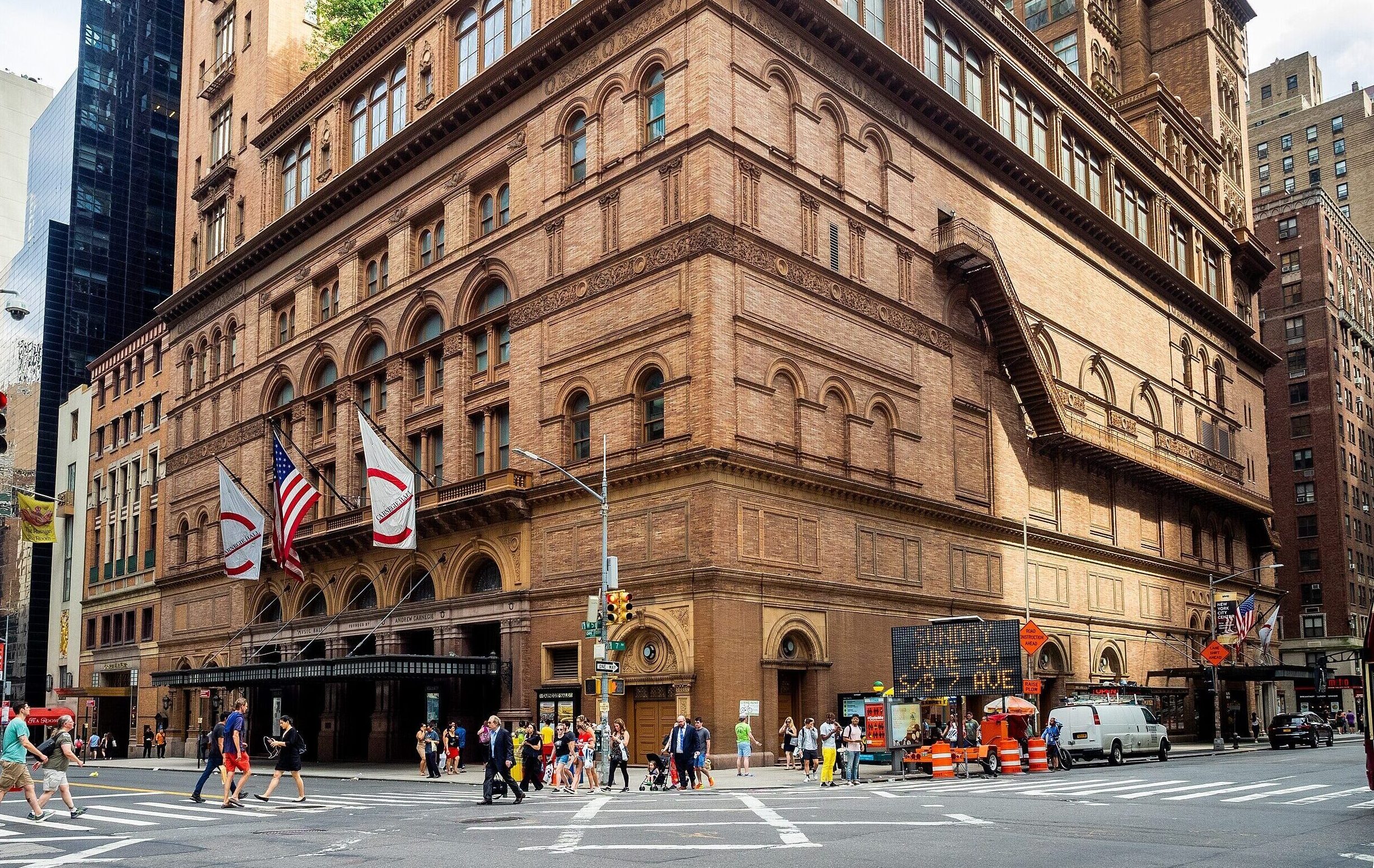
When Isabel Leonard took the stage at Carnegie Hall last night, a man near me said, “Wow.” He drew out the word for about six seconds: “Wowwww.”
I had a memory from about twenty years before. I had taken a young colleague, a woman, to Carnegie Hall with me. Ms. Leonard came out and my colleague said, “That’s the most beautiful woman I’ve ever seen.”
One more story, please—I’ve told it in connection with Isabel Leonard before. Generations ago, a regular concertgoer took a friend—unfamiliar with the world of classical music—to a concert. Elisabeth Schwarzkopf emerged from the wings. (This soprano was known as “the most glamorous woman in Europe.”) The newcomer gasped to his friend, “And she sings, too?”
Isabel Leonard is an American mezzo-soprano. Our program booklet at Carnegie Hall said “Isabel Leonard, Vocalist.” “Vocalist”? Why? Evidently, because Ms. Leonard was going to sing a program of Broadway and popular songs.
By the way, what’s the difference between “vocalist” and “singer”? Could the program have said “Isabel Leonard, Singer”?
The concert was billed as “Isabel Leonard and Friends.” Her friends were three: John Arida, pianist; Ryan Speedo Green, bass-baritone; and Jordan Donica, a Broadway performer.
Incidentally, Green was listed as “bass-baritone,” not “vocalist.” But Donica was listed as “vocalist.” He is famous, as two friendly ladies sitting behind me informed me. I’m afraid I’m clueless about Broadway personnel.
Ms. Leonard began with an art song, or classical song: “Why Do They Shut Me Out of Heaven?,” one of Copland’s Dickinson songs. There was another art song—another Copland/Dickinson song, in fact—soon after. Why? Why not just go all Broadway/pop?
Don’t know.
In any event, Leonard sang her first song well, with a secure technique and a solid understanding, of the words and the music, both.
Then she took a microphone and talked. She explained that she would sing some of the songs she “grew up with.” She was a classical and opera singer, yes, but she loved Broadway and other music. And she would “not silence that part of me any longer.”
I was a little confused. Is there pressure on classical and opera singers not to sing Broadway and other music? It was more than sixty-five years ago—1960—that Eileen Farrell put out her album I’ve Got a Right to Sing the Blues.
Plenty of classical and opera singers love and sing Broadway and pop songs. I will name just four of Ms. Leonard’s fellow mezzo-sopranos: Marilyn Horne, Frederica von Stade, Kate Lindsey, and Lea Desandre.
Said Ms. Leonard in Carnegie Hall, “Good music is good music is good music.” (I thought of Duke Ellington: “If it sounds good, it is good.”) Yes. But does anyone argue against it?
The mic put down, Leonard sang “I’ll Be Seeing You” and “My Ship.” The second one is a Kurt Weill song (words by Ira Gershwin). In a review last season, I wrote,
Question: Is “My Ship” happy or sad? The answer, I think, is yes. The words are happy enough. But there is a melancholy in the music. The song always makes me sad, honestly.
Last night, Leonard and Arida performed it in rather chipper fashion.
Then came the second Copland/Dickinson song: “Heart, We Will Forget Him!” I’m going to pick at Leonard, in part because I admire her so much. The song was a little soupy, a little leisurely. I think it ought to be stricter. It erred on the grand side, where I like it more inward.
And why did Leonard pronounce the word “lagging” “lahgging”? I mean, you don’t lahg behind or drahg on a cigarette, do you?
But I confess: like many people, I’m sure, I have a recording in my ear—that of Auger and Baldwin, made in the 1980s. And Leonard is entitled to her own rendering.
How did she render the next song, “The Way You Look Tonight”? Well, she and her pianist had a souped-up arrangement, interpolating a Mozart aria, “Voi che sapete.” It had its charm and its pizzazz.
You know who sang that song well? The dancer who premiered it: Fred Astaire. He was so plain. But so effective in his plainness.
Out came Ryan Speedo Green, to spar with Leonard in “Anything You Can Do (I Can Do Better).” Green was game—and, as always, exceptionally likable—and Leonard was deft. Amazingly deft.
I had a memory—of Deborah Voigt and Kristin Chenoweth doing this duet in this hall about ten years ago. Voigt, in particular, was hilarious.
It was Green’s turn to take the microphone and give a little talk—about society, “relevance,” and so on. Then he sang a group of songs that included three by Copland. Or rather, three of his arrangements of traditional American songs.
One was “The Dodger.” May I give you another memory? Many years ago, Samuel Ramey sang this song at the Metropolitan Museum of Art. Sitting in the first row, as I recall, were Rudolph Giuliani and his incumbent wife. The song kind of mocks politicians. Afterward, Ramey leaned forward and said, “Sorry, Mayor.” Giuliani responded with a gesture that said, “No problem.”
There is plenty to say about Ryan Speedo Green and about Jordan Donica, the Broadway star. But I will keep this post of mine Isabel-centric.
After intermission, she came out in a different dress, accompanied by woos in the audience. Now she was singing with a microphone—not just talking with one but singing with one. Was this necessary? Regardless, she did it.
She sang “Many a New Day,” from Oklahoma!, and “If I Loved You,” from Carousel. Her partner in the latter was Mr. Donica. I could talk about each page, or each phrase, of each song. But let me say merely that Isabel Leonard’s musical intelligence—coupled with a theatrical intelligence—is a gift to the cultural life of our time.
Enough. She is delicious—and smart smart smart—in everything she does.