A church, as an ecclesiastical building, carries profound spiritual significance. It serves as a sacred space where man encounters the Divine, fundamentally distinguishing it from utilitarian structures, like hospitals, schools, or theatres. Within its walls, a unique spiritual triad emerges—a mystical relationship between Christ and the priest, Christ and the faithful, and the priest and the congregation. It is here that the community assembles for collective prayer and the celebration of the sacraments. What primarily makes this space sacred is the transformation of bread and wine into the Body and Blood of Christ by the power of the Holy Spirit.
However, such edifices often face criticism. It is not uncommon for Catholics to face verbal attacks from adversaries of the Church, who claim that, instead of gathering in a temple, one could pray at home or in the wilderness. I was once asked by a Polish-Australian—raised Catholic but who later embraced Buddhism—whether I could celebrate Mass in my bedroom.
How much to spend on building a church is a contentious issue. Critics often cannot accept that so much money is lavished on edifices devoted to Someone, they believe, “just does not exist,” arguing that religion is a man-made illusion designed to maintain social and political control.
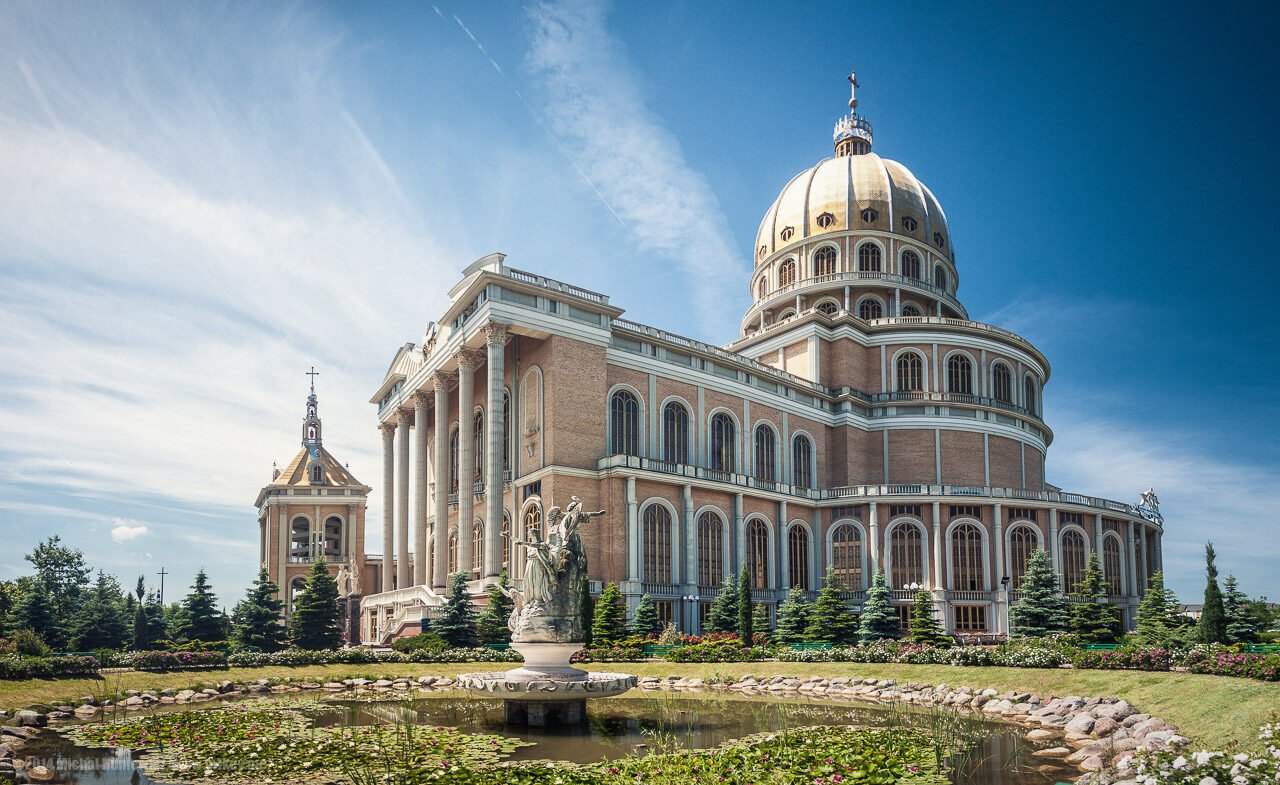
The Basilica of Licheń, which is an example of an exceptional expression of faith and love in God, can only be overshadowed in size by seven churches in Europe and eleven in the world. Costing two-hundred-million zloty, the enterprise rose through millions of small donations—the “widow’s mite”—from Poland and abroad, including early support from Polish-Australians in the 1980s.
To understand how this vibrant centre of devotion came to be, one must return to 1813, when the story of Our Lady of Sorrows, Queen of Poland, began—she who is said to have chosen Licheń as a future site of grace. The events unfolded amid the turmoil of the Battle of the Nations at Leipzig.
A wounded Polish soldier, Tomasz Kłossowski, implored Mary’s intercession and, having been miraculously healed, was entrusted with a mission: to find her image and to ensure its placement in a public location accessible to all. After a 23-year quest, he finally discovered the image in 1836, a tiny painting in a village near Częstochowa that matched his vision. In 1844, he placed the image in the Grąblin Forest, just two kilometers from Licheń.
The painting hung by Kłossowski remained in the forest for years on end, largely unnoticed. Among the few who prayed before it was a pious shepherd, Mikołaj Sikatka, who often tended his flock nearby. To him, the Mother of God delivered her message three times in 1850.
According to accounts, Our Lady said:
When difficult days arrive, those who come to this image, pray, and do penance will not perish. I will heal sick souls and bodies. Whenever this nation turns to me, I will never abandon it, but I will defend it and draw it to my heart, like this White Eagle (which has for centuries been a symbol of Poland) (…) I shall reign over my nation forever. In this place, a magnificent church shall be built in my Honor. If people do not build it, I shall send my angels to put it up.
This vision has come to fruition.
When a cholera epidemic broke out in 1852, the sick and vulnerable from nearby villages gathered at the apparition site and its small shrine. As the local people experienced healing and grace, a chapel was built in the forest to house the image. On September 29, 1852, accompanied by 80,000 pilgrims, the miraculous image was solemnly moved to a temporary church in Licheń; six years later, a solid brick church dedicated to St. Dorothy was constructed.
On August 15, 1967, Bl. Cardinal Stefan Wyszyński ceremoniously placed the Papal Crown upon the image of Our Lady of Licheń.
It is he who shall build a house for my name; he shall be a son to me, and I will be a father to him, and I will establish the throne of his kingship over Israel forever.” (1 Chr. 22.10)
In 1994, once all the necessary documentation had been finalized, hundreds of workers commenced the construction of the basilica. The builders can take pride in its remarkable volume of 300,000 cubic meters, with a capacity to accommodate approximately 20,000 worshippers. The structure features six monumental staircases, four passenger lifts, and a ramp for the disabled. At 103.5 meters above ground level, a golden cross and crown sit atop a grand dome, twenty-five meters in diameter, which acts as a familiar landmark for approaching pilgrims.
The cruciform basilica is profoundly emblematic; the thirty-three steps leading to the temple represent the years of Jesus’s life on Earth, while the building’s 365 windows and fifty-two doors correspond to the days and weeks of the calendar year. The structure is supported by twelve columns symbolizing the Apostles. Inside, the design richly reflects Poland’s national and religious heritage; for instance, the pews feature decorative motifs honouring the Winged Hussars. This elite cavalry—under the special protection of the Mother of God—played a decisive role in King John III Sobieski’s 1683 victory over the Ottoman forces under Grand Vizier Kara Mustafa.
On June 6, 1999, Pope St. John Paul II came to bless the basilica and celebrate a Mass for over one million pilgrims:
Let us give thanks to God for this church! Gratitude is due also to the guardians of this Shrine, the Marian Fathers who for years have taken care of it and have faithfully served the pilgrims. […] I thank also those who built it and all who, with their offerings, have supported and continue to support this important undertaking.
The National Conference of Bishops recognized it as the votive offering of the Polish Church for Great Jubilee of 2000 years of Christianity. After ten years of construction, on June 12, 2004, the Apostolic Nuncio to Poland, Archbishop Jozef Kowalczyk, consecrated the Shrine of Our Lady.
Currently, the Shrine stands as Poland’s second most popular Marian place of worship, surpassed only by Częstochowa, with its world-renowned Black Madonna icon. Each year, approximately 1.5 million pilgrims journey to the site. The international visitors—hailing primarily from Slovakia, Lithuania, and Czech Republic—comprise a broad cross-section of pilgrims, including a notable presence of both American civilians and military personnel.
In September 2020, about fifty soldiers from the U.S. Army National Guard’s 297th Regional Support Group, stationed at the Powidz Air Base, dropped by the Licheń Shrine. They were welcomed by Fr. Adam Stankiewicz, MIC, the Shrine’s Vice-Custodian. On behalf of the Marian Fathers, he presented the unit with an icon of Our Lady as a gift to the soldiers.
Reflecting on this, one must remember that, while the magnificent Shrine of Licheń is a breathtaking masterpiece, the structure itself does not guarantee salvation. However, it undeniably serves its highest purpose: to turn the hearts of the faithful toward the One who is Infinite Beauty—the Creator of all things.
I wholeheartedly encourage anyone to visit this sacred site and immerse yourself in its atmosphere. Whether staying for a few hours or an entire weekend, take the time to pray, adore the Blessed Sacrament, and participate in the Holy Mass. Even a solitary walk to admire the surrounding natural beauty can be a soul-stirring experience, especially in the spring.
Author’s Note: To view pictures of this beautiful shrine, visit its website here!
Image from Wikimedia Commons