Denmark has supported America’s military aims for decades, deploying alongside US troops in Afghanistan and Iraq—and suffering a higher per capita casualty rate than the United States.
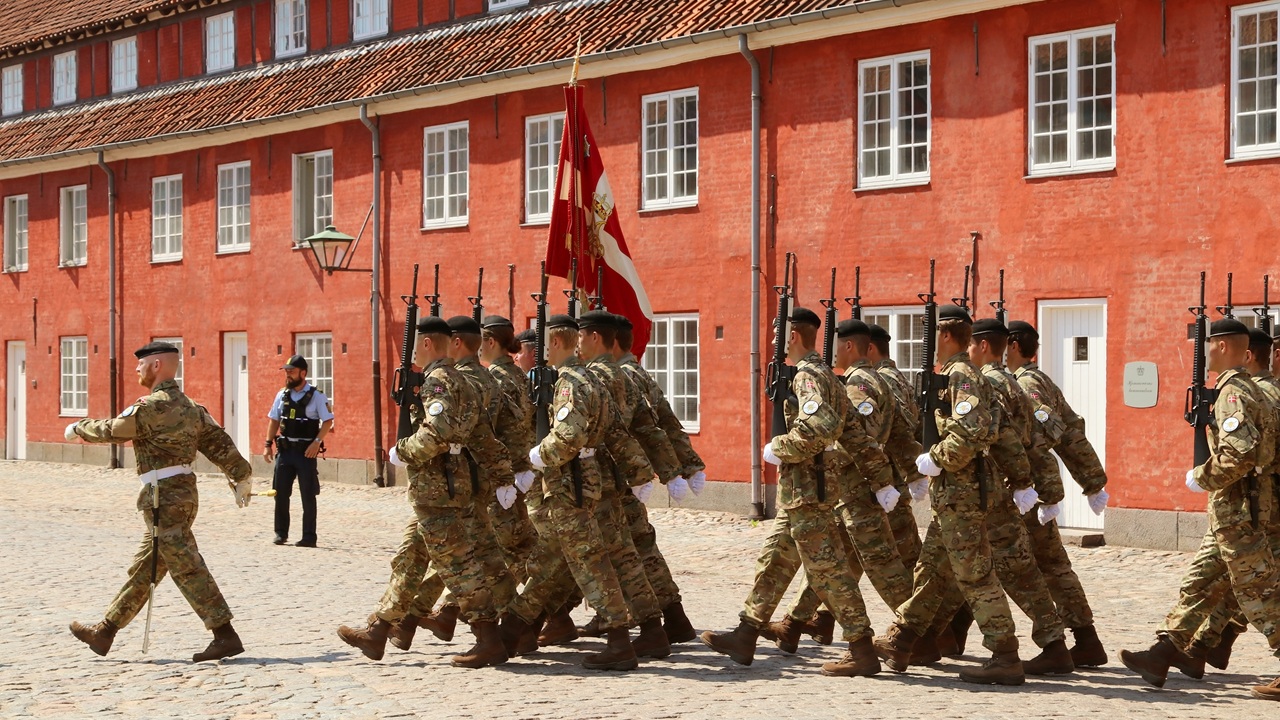
Denmark maintains a small but highly professional military. Designed not for territorial conquest or great-power warfare, the Danish Armed Forces are optimized for NATO integration, expeditionary missions and maritime and Arctic responsibilities. Strategically, Denmark punches above its weight, but militarily, they rely heavily on alliances.
Denmark’s Force Structure: Small but Professional
The Danish Armed Forces have about 20,000 active personnel, slotted with three main services: the Royal Danish Army, Royal Danish Navy, and Royal Danish Air Force. The Army features light and medium mechanized units and is optimized for deployment not mass warfare. The Navy is frigate-centric with a focus on air defense, ASW, and maritime security rather than blue-water operations. The Air Force is small but modern, and is currently transitioning from the F-16 to the F-35A. Denmark does not have nuclear weapons, strategic bombers, or missile forces.
The key platforms within the Danish Armed Forces are the F-35A fifth-generation stealth fighter, the Iver Huitfeldt-class air-defense frigates, and the Absalon-class support ships. Denmark’s strengths include modern sensors, NATO interoperability, and well-trained personnel. Denmark is limited, however, with small fleet sizes and limited redundancy, which means they would struggle to absorb attrition. Basically, Denmark fields capable units, but lacks depth—which is why, in part, Denmark’s military effectiveness depends on coalition context and sustained allied support.
Danish Troops Have Long Supported America’s Wars
Danish forces are deployed abroad. Typical roles include coalition operations, stabilization missions, and maritime security. Denmark seems to prefer high-impact yet limited deployments and rarely acts alone, with an emphasis on special forces, naval task groups, and air policing missions. Denmark uses their military more as a foreign policy tool than as a territorial shield.
Surprisingly, Denmark has much more combat experience than its size or posture would suggest. Notable deployments include the Balkans, Afghanistan, Iraq, and air operations in Libya—all of which were led by the United States. Danish troops have earned a reputation for professionalism and bravery. The military is especially active relative to its size, having earned real combat experience. It has also paid the price; 52 Danish soldiers lost their lives in Afghanistan and Iraq, a higher per capita casualty rate than the United States.
Denmark Can’t Defend Greenland Militarily—but Hasn’t Had To
Greenland is Denmark’s greatest strategic responsibility. Denmark’s military presence in Greenland, however, is minimal, consisting mostly of patrol units and surveillance. There are no fighters or air defenses or heavy ground forces. Instead, Denmark relies on administration, diplomacy, and—perhaps ironically—its alliance with the far more powerful United States. Sovereignty is asserted more through legal mechanisms than militarily.
Denmark’s military strategy assumes collective defense, not unilateral action. Its strengths lie in a willingness to deploy and in reliability as an ally. Vulnerabilities are a limited capacity for independent defense and a heavy reliance on the US for security guarantees. Denmark’s military has gotten by through integration with a larger system, which raises questions about Denmark’s viability should that system fray.
Denmark can be commended for assembling a capable and modern force, albeit one designed for coalitions and contribution not dominance. Denmark’s power lies in alignment, rather than autonomy, an arrangement of which US rhetoric may force reevaluation. Greenland underscores this reality: a defense posture that is dependent upon alliances is only as strong as those alliances are.
About the Author: Harrison Kass
Harrison Kass is a senior defense and national security writer at The National Interest. Kass is an attorney and former political candidate who joined the US Air Force as a pilot trainee before being medically discharged. He focuses on military strategy, aerospace, and global security affairs. He holds a JD from the University of Oregon and a master’s in Global Journalism and International Relations from NYU.
Image: Shutterstock / Anna50.