Editors’ note: The following passage is excerpted from Book III of the Meditations of Marcus Aurelius, translated by Aaron Poochigian, published this month by Liveright.
Written at the fortress of Carnuntum.
Our lifetime is dwindling every day, and we constantly have less left. There’s that, and then there’s this: even if someone does live for a long time, nobody knows whether his mind will hold out and still be capable of managing his own affairs and reflecting on the experiences that teach us what gods and humans are.
When someone starts revealing in his speech his mind is gone, he goes on breathing, eating, imagining, feeling urges and the like. What he has lost the power to do is live with purpose, accurately assess his duties, learn from experiences and decide whether the time has come to die. The rational faculty he had trained to do all sorts of things has been snuffed out in him.
There is urgency, then, both because death is drawing forever nearer and because we lose our ability to think along with our awareness of what is going on around us.
One has to be on the lookout for exceptional sights that, though inadvertent by-products of Nature, still have their own appeal and charm. When bread is being baked, for example, cracks form in the crust, and they, though faults, one could say, in the baker’s art, look strangely perfect and excite our appetite in a special way. Figs burst in their prime, and an olive’s imminent peril of dropping into decay lends it a peculiar beauty. The nodding of ears of wheat, the furrows on a lion’s brow, the foamy slaver dripping from a boar’s mouth and so many other things, though far from comely when looked at on their own, fit in as embellishments adorning Nature’s works and can entrance us.
If a person has enough experience and a deep understanding of the natural world as a whole, almost everything will please him with its presence, even Nature’s incidental offspring. He will look at a real-life wild beast’s gaping jaws with no less delight than at a painting or sculpture that had captured them. He will see a sort of bloom and ripeness in elderly men and women and take in the attractions of his slaves with unlascivious eyes. This vision is not accessible to all, but only the one who has become truly intimate with Nature and its creations.
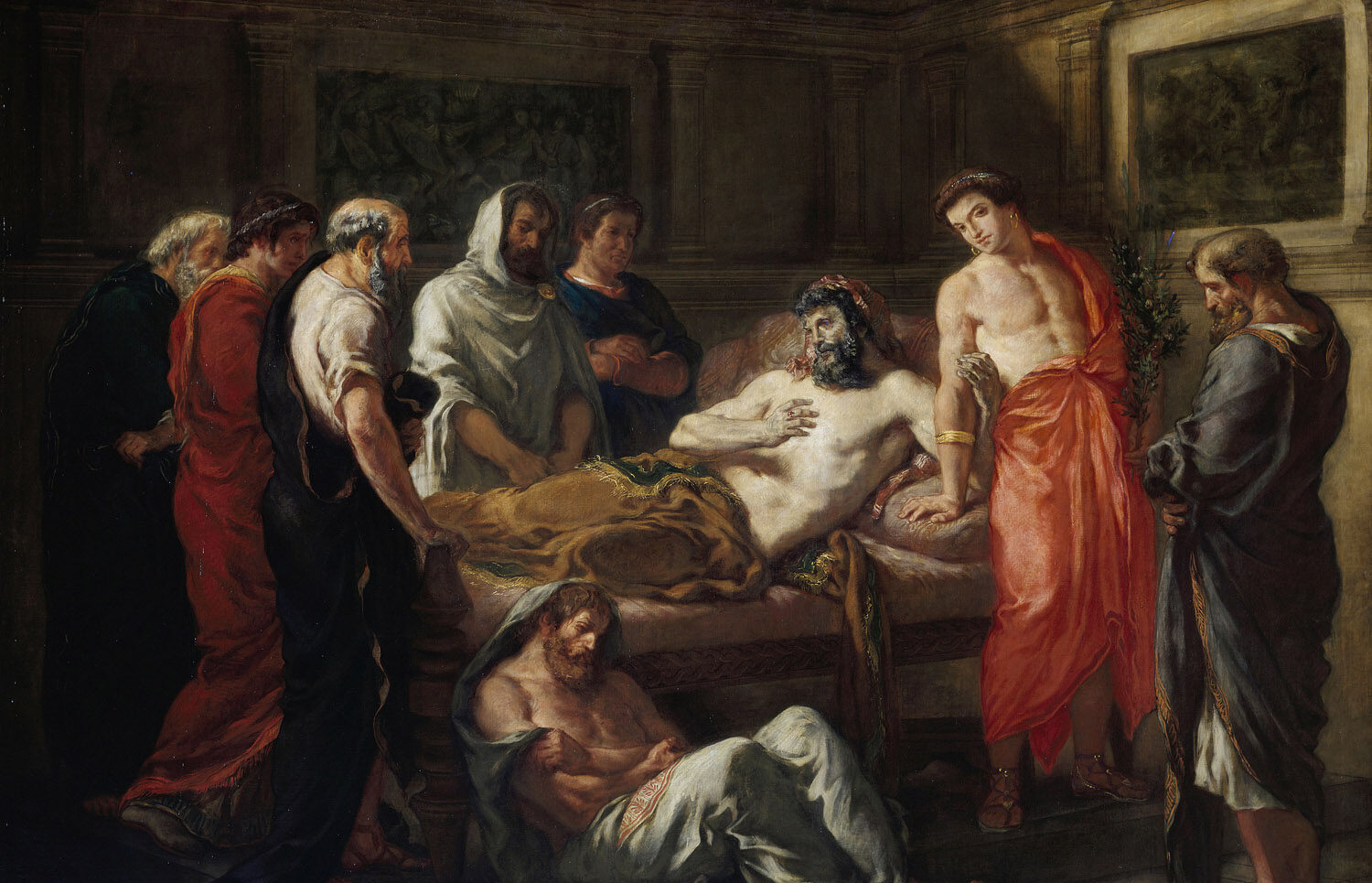
Hippocrates, the Father of Medicine, after curing so many illnesses, got sick himself and died. The Chaldeans with their horoscopes predicted the fated death-dates of countless people, and then their own fated demises arrived on schedule. Alexander the Great, Pompey the Great and Julius Caesar razed many cities to the ground and cut down thousands upon thousands of foot-soldiers and cavalrymen in battle and still eventually had to die, too. After Heraclitus spent his life arguing that fire is what vitalizes the universe, he drowned in his own dropsy while smeared with cow dung. Lice killed Democritus; louses killed Socrates.
So, yes, what does a lifetime come to? You boarded, set sail and have arrived. Now step ashore. If into an afterlife, it will, like this life, be brimming with the gods. If into oblivion, you will no longer be at the mercy of pain and temptation and no longer be a slave to the earthenware receptacle that is your body—a master vastly inferior to what is compelled to wait upon it. The lackey: intelligence and divinity. The overlord: clay full of gore.
Don’t spend any of the life you have left dwelling on what’s in other people’s minds, unless you are doing it in pursuit of the common good. If you do get caught up in them, you will be wasting time that would be better spent on something else. To be specific, when you set about imagining what people are doing, intending, saying, contemplating, utilizing and other such things, you end up straying from what should be a strict observance of the ruling power within you. You should shut all that is gratuitous and futile out of the sequence of your thoughts, especially idle curiosity and malice.
Train your mind to work in such a way that you could at any moment answer the surprise question, “What are you thinking right now?”, with a full and ready disclosure of exactly this or that. It should be immediately clear from your answer that your thoughts are unconvoluted, benevolent, socially appropriate and removed as much from sensuality and hedonism as from contentiousness, envy, paranoia or any other angry feeling—anything you would blush to admit had been in your mind.
A man who can pass that test, once he accepts at last his place among the truly excellent, is a sort of priest, an agent of the gods, because he knows how to use the divinity lodged within him. That power renders him innocent of lust, invulnerable to pain, impervious to pride and unaware of any wrongness in the world. He is a wrestler in the greatest match of all and will not be pinned by anything that touches him. His whole being is dyed the color of justice, and he embraces what has been allotted to him with his whole soul. He rarely, and only ever at the insistence of the public good, thinks about what other people are saying, doing and thinking. Having only his own project to perfect, he focuses day and night on his one strand in Nature’s woven whole. He makes sure he does his work well and never doubts that what happens to him is good. The destiny he carries inside himself just keeps carrying him onward.
He understands, moreover, that all of us rational animals are kin but, while human fellowship demands he care about each of us, he will not share the opinions of everyone, but only of those who live in accordance with Nature. He knows, from experience, those who don’t live that way—the kinds of things they do at home and on the town at all hours of the day and night, and the types they fall in with. He disregards the praise such people give him. They aren’t even people they themselves would praise.
Excerpted from Meditations. Copyright (c) 2026 by Aaron Poochigian. Used with permission of the publisher, Liveright Publishing Corporation, a division of W. W. Norton & Company, Inc. All rights reserved.