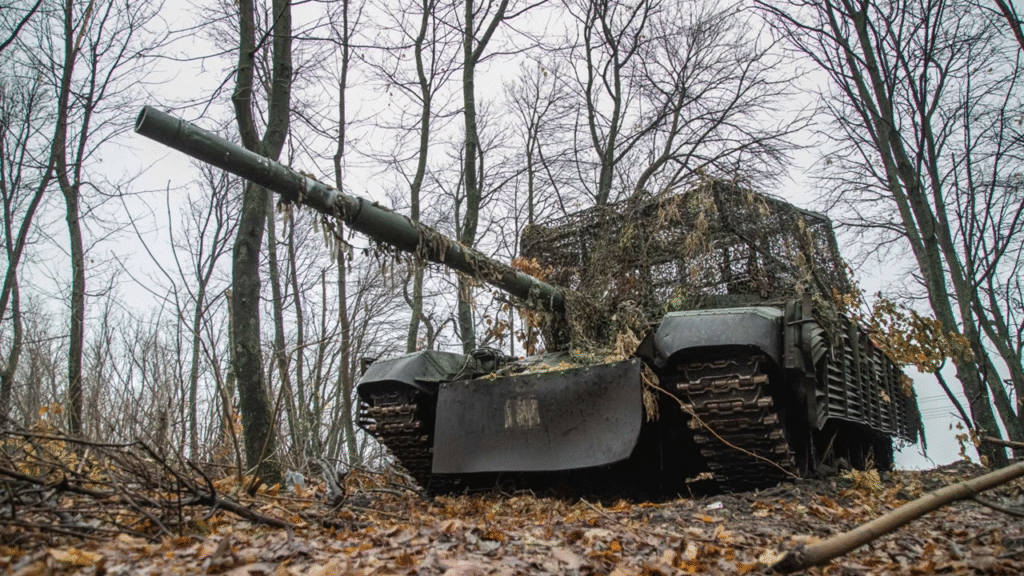
Unlike past instances of ineffective shielding, Russia’s “dandelion” tank armor appears to be useful against FPV drones—and aids in the vehicle’s camouflage as well.
Last month, images emerged online showing Russian T-80BMV main battle tanks (MBTs) with shipping containers mounted over the hull and chassis in an attempt to provide extra protection from Ukrainian drones and man-portable anti-tank rockets. This curious display was only the latest attempt to counter the threats that have seen literally thousands of tanks destroyed in the ongoing fighting.
However, as previously reported, a shipping container would likely stop small-arms fire but would dramatically increase the vehicle’s profile. Moreover, it would limit the crew’s situational awareness, as they could see only what was directly in front of the tank. This was one variant of the so-called “Turtle Tanks” that sought to place a shell over an MBT. Some have been more effective than others, but all have essentially the same limitations—limiting speed and visibility in exchange for additional armor.
Russia’s “Dandelion” Tank Armor Actually Seems to Work
That is why last fall, Russian forces began employing so-called “hedgehog armor” on their tanks, consisting of thousands of metal wires welded to the frames. So far, this has proved more effective than the harder shells.
“The wires, which protrude a foot or more from their frame, can detonate incoming first-person-view drones a safe distance from a vehicle’s hull,” Euromaidan Press explained.
The downside of this add-on protection is that it is highly time-consuming, and the additional cables and wires add considerable weight. This has led to the introduction of “dandelion” armor, which resembles the common garden weed. It includes thin wires that branch out, creating a cage around the vehicle. The thin cables alone provide just part of the protection.
“A T-90 already has significant base armor that’s equivalent to more than 1,000 millimeters of steel,” explained David Axe on Trench Art. “Add explosive reactive armor, a metal cage, and dandelion stalks, and you’ve got the best passive anti-drone protection currently available.”
Of course, the additional armor still adds weight and could be as time-consuming to apply as the hedgehog armor. However, based on photos, it could also help a tank blend into the environment, especially near wooded terrain. Adding foliage can make the tank harder to spot, and stealth is more effective than pure armor at keeping the crew safe from enemy drones and other threats.
Some downsides remain. All the cables still impair the crew’s situational awareness and make it harder for the tanks to engage a target. Still, the primary purpose of this add-on armor is for tanks deployed at the vanguard of an assault, where they’re expected to take heavy fire.
Ukraine Often Copies Russian Anti-Drone Technology
What is also noteworthy about the add-on armor is that Kyiv’s forces haven’t been leading the efforts, but several factors are at play. Ukraine pioneered anti-tank efforts, including the deployment of drones, as it was on the defensive in early 2022.
Since late 2023, Ukraine’s forces have largely been on the defensive—and have had less need for anti-drone protection.
“A pattern has emerged: the Russians innovate new vehicle armor. Some observers laugh at how ugly it is. But then the armor proves it actually works in combat,” Euromaidan Press added.
Soon afterward, if the design works, Kyiv copies it. This was the case with the hedgehog tanks, which allowed us to see Ukraine’s armored vehicles, including its Western-made MBTs, outfitted with dandelion armor just as the actual weeds begin to crop up this spring.
About the Author: Peter Suciu
Peter Suciu has contributed over 3,200 published pieces to more than four dozen magazines and websites over a 30-year career in journalism. He regularly writes about military hardware, firearms history, cybersecurity, politics, and international affairs. Peter is also a contributing writer for Forbes and Clearance Jobs. He is based in Michigan. You can follow him on Twitter: @PeterSuciu. You can email the author: [email protected].
Image: ArmyInform / Ukrainian Ministry of Defense.