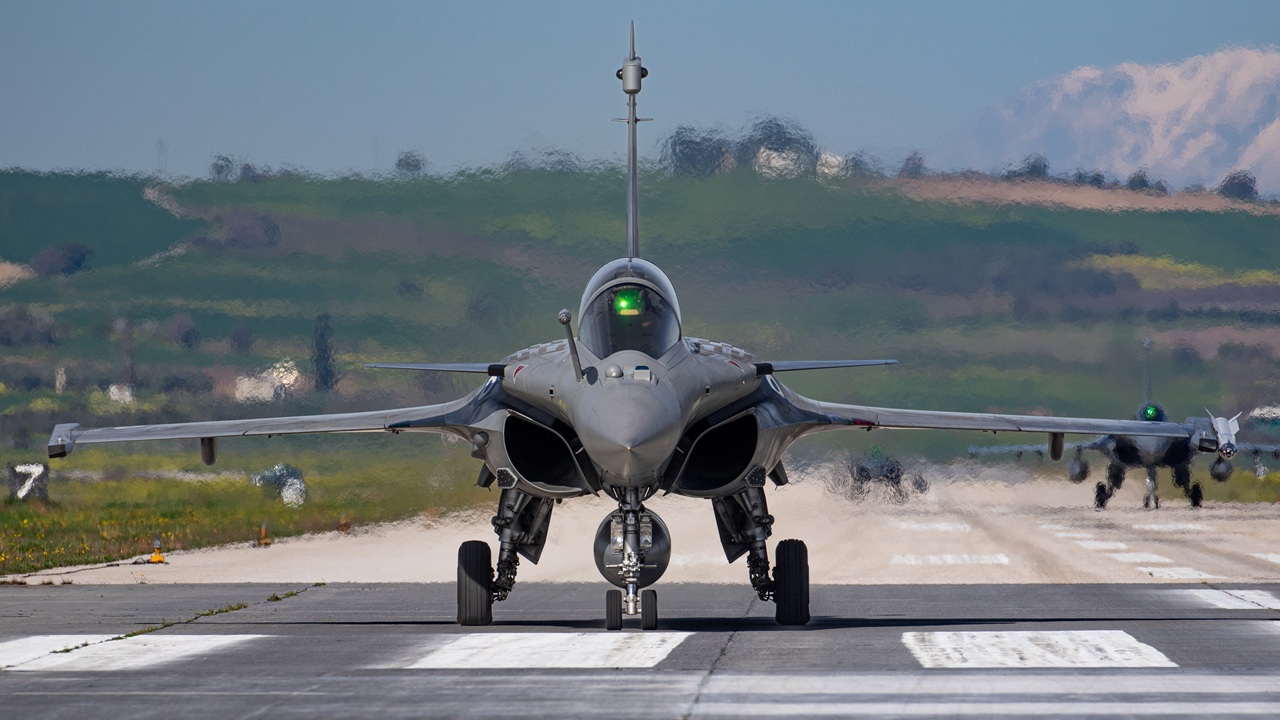
Croatia bought an additional 12 Dassault Rafale fighter jets from France, along with training and spare parts, for a total cost of $1.2 billion.
On January 1, 2026, NATO member Croatia assumed complete air policing duties, concluding a transition period during which aircraft from the Italian and Hungarian air forces had filled the role. Following the modernization of its air force, Croatia now independently monitors the skies over its homeland—yet it continues to operate 24/7 under NATO’s Integrated Air and Missile Defense System (NATINAMDS).
The changes came after Croatian pilots and ground personnel completed their intensive training on the French-made Dassault Rafale, for which Zagreb first closed a deal for a dozen of the omnirole jet fighters in November 2021. The first six Rafales arrived in the Balkan nation and former Yugoslavian republic in April 2024, with the remaining aircraft delivered last year.
Croatian President Zoran Milanovic, Prime Minister Andrej Plenkovic, and Minister of Defense Ivan Anusic welcomed the arrival of six aircraft in 2024.
The Croatian Air Force Just Got a Major Upgrade
The French-made Dassault Rafales replaced the country’s fleet of Soviet-era Mikoyan-Gurevich MiG-21 (NATO reporting name “Fishbed”) fighters, either acquired from the Yugoslav Air Force during Croatia’s War of Independence in the early 1990s or purchased from Ukraine in 1993-1994.
Paris and Zagreb finalized the purchase of 12 Rafale fighters in a deal valued at approximately $1.21 billion, which also included spare parts, three years of logistical support, and training for Croatian Air Force pilots and personnel in France. The acquisition was part of Croatia’s efforts to increase defense spending, with Zagreb previously pledging to hit the NATO goal of 2 percent of Gross Domestic Product (GDP) by the end of 2024, and to reach 2.5 percent by 2027, and to reach 3 percent in the years after that.
The adoption of the Rafales is part of a former Communist Bloc nation’s efforts to steadily modernize its military, including the divestment of Soviet-era and Russian-made military hardware.
Croatia hasn’t been the only former Yugoslav republic to embrace the Rafale; Serbia closed a $3 billion deal with France for a dozen aircraft, including nine single-seat and three two-seat Rafales, in August 2024. Belgrade has also sought to modernize its air force, which currently consists of Soviet-made Mikoyan MiG-29 (NATO reporting name “Fulcrum”) fighters and other aging Yugoslav-era combat aircraft. Delivery of the Dassault Rafale omnirole fighters is expected to begin in 2028.
About the Dassault Rafale Fighter Jet
- Year Introduced: 2001
- Number Built: ~240+ delivered (production ongoing for export customers)
- Length: 50 ft 2 in (15.3 m)
- Wingspan: 35 ft 9 in (10.9 m)
- Weight (MTOW): ~54,000 lb (24,500 kg)
- Engines: Two Safran (formerly Smecna) M88-2 turbofans (17,000 lbf each with afterburner)
- Top Speed: Mach 1.8 (approx. 1,190 mph / 1,915 km/h at altitude)
- Range: ~1,000 nmi (1,850 km) combat radius; ~2,000 nmi (3,700 km) ferry range with drop tanks
- Service Ceiling: ~50,000 ft (15,240 m)
- Loadout: 14 hardpoints (13 on Rafale M naval variant); 9,500 kg (20,900 lb) total payload capacity
- Aircrew: 1 (Rafale C and M); 2 (Rafale B twin-seat variant)
The Dassault Rafale – which means “gust of wind,” or “burst of fire” in a more military sense – was conceived for use by France’s air and naval services as an “omnirole” fighter, meaning that it would replace seven types of combat aircraft in operation at the time of its development.
The new aircraft was developed to perform a wide range of missions, including air defense/air superiority, anti-access/area denial, reconnaissance, close air support, dynamic targeting, air-to-ground precision strike/interdiction, anti-ship attack, nuclear deterrence, and even buddy-buddy refueling.
Dassault announced in October 2025 that the 300th Rafale had been delivered, underscoring the aircraft’s success.
Balkan Air Policing Changes
The Italian Air Force’s Eurofighter Typhoons and Hungary’s Swedish-made JAS 39 Gripen fighters will become a far less common sight over Croatia. Now, Croatian Air Force Rafales will conduct the NATO air policing mission, a milestone for Croatia as it confirms its further integration into NATO’s collective air and missile defense framework, the country’s Ministry of Defense announced.
The change will remove a burden from Italy and Hungary.
“As part of NATO practice, Croatia did not incur any financial costs for this temporary arrangement, as Air Policing support between allied countries is provided free of charge,” Croatia Week reported.
About the Author: Peter Suciu
Peter Suciu has contributed over 3,200 published pieces to more than four dozen magazines and websites over a 30-year career in journalism. He regularly writes about military hardware, firearms history, cybersecurity, politics, and international affairs. Peter is also a contributing writer for Forbes and Clearance Jobs. He is based in Michigan. You can follow him on Twitter: @PeterSuciu. You can email the author: [email protected].
Image: Shutterstock / Kostas Alkousis.