On January 3, 1799, seven years after Wolfgang Amadeus Mozart’s death from natural causes, Antonio Salieri’s Falstaff had its premiere at the Kärtnerthortheater in Vienna. (Such causes did not include, as best as can be ascertained, malevolent action by a rival composer.) The opera was the subject of a welcome revival last month by the Chicago Opera Theater, Chicago’s second opera company and an ensemble acclaimed for performing unjustly neglected works. The production at the Studebaker Theater, marking the bicentennial of the composer’s death, coincided with performances of Peter Shaffer’s brilliant but factually fanciful Amadeus at Chicago’s Steppenwolf Theater.
Although Salieri, born in 1750, lived another quarter century after its completion, Falstaff was among the last of his forty-some operas. In his long, Vienna-based career, Salieri concentrated on opera buffa and opera seria, but the long Viennese tradition of creating Italian operas was nearing its end. German opera was coming into its own, propelled by Mozart’s Die Entführung aus dem Serail and Die Zauberflöte and translations of his Italian comedies.
Born in Venice and orphaned in his early teens, the talented Salieri was discovered by the composer Leopold Gassmann, who brought him to Vienna. There he fell under the influence of the celebrated operatic reformer Christoph Willibald Gluck and progressed quickly.
Having impressed the emperor, Joseph II, with his Armida (1771), Salieri was appointed Court Composer and Conductor of Italian Opera in 1774 (and elevated to Court Kapellmeister in 1788). A teacher who later gave starts to Beethoven and Schubert, Salieri was also in a position to help Mozart but chose not to. He faced a setback when the emperor dismissed the court’s Italian opera troupe in favor of a German one but quickly found opportunities elsewhere, including in Italy. His notable achievement there was the inaugural opera for Milan’s Teatro alla Scala in 1778, L’Europa riconosciuta. It is an impressive work, if a bit pretentious.
Joseph II reinstated Italian opera in Vienna with an opera buffa troupe that began operations in 1783 with a revised version of Salieri’s La scuola de’ gelosi, for which Lorenzo Da Ponte altered the libretto. By then Salieri was also composing a work for the Paris Opera: Les Danaïdes (1784), with a translation of an Italian libretto originally written by Ranieri de’ Calzabigi for Gluck (some of its music may in fact be by Gluck).
That opera, dedicated to Joseph II’s sister Marie Antoinette, has a gruesome plot drawn from Aeschylus’s incomplete Danaid trilogy, which includes massacres engendered by fraternal conflict and a bloody closing set in the underworld. Salieri employed to excellent effect the resources of the Paris Opera, including its orchestra, the largest for which he had ever written. In a letter urging support in Paris for Salieri and his new opera, Joseph II described him as the “only one [in Vienna] capable of replacing [Gluck] one day,” thereby placing Salieri above Mozart.
The last of Salieri’s three Parisian operas was Tarare (1787), a setting of the only libretto written by the playwright and polymath Pierre-Augustin Caron de Beaumarchais, whose comedies Le Barbier de Séville and Le Mariage de Figaro inspired the renowned Italian operas. Tarare’s French trappings include a Lully-like celestial prologue in which “Nature” creates two humans, one a king, the other a soldier. True to Beaumarchais’ egalitarianism, the soldier outshines the volatile, despotic king.
A success in Paris, Tarare won even greater acclaim in Vienna, where it appeared in a refabricated version as Axur, re d’Ormus (1788), assembled with assistance from Lorenzo Da Ponte. It expanded the comedy of the original while retaining the work’s splendor and its serious dimension, including the villain’s onstage suicide. It is one of six Salieri operas with librettos written or revised by Da Ponte, the literary force behind Mozart’s greatest Italian comedies. Da Ponte had served as poet to the court theater since the Italian company’s revival, but in 1791 he was dismissed by Joseph II’s successor, Leopold II, for which Da Ponte blamed Salieri among others. Axur, along with Les Danaïdes, stands at the summit of Salieri’s operatic achievement.
With Da Ponte long gone, the libretto for Falstaff, ossia Le tre burle was written by the little-known Carlo Prospero Defranceschi. Those familiar with Shakespeare’s The Merry Wives of Windsor or Verdi’s Falstaff will be struck by the elimination of the young lovers (Nanetta and Fenton in Verdi). The principals include Falstaff and two married couples: the Fords and the Slenders (called Page in Shakespeare and Verdi, though the latter omits Mr. Page). They are supplemented by Falstaff’s servant, Bardolf, and Mistress Ford’s maid, Betty. Salieri’s opera depicts all three episodes in which the wives shame Falstaff for writing them identical love letters, including disguising him as the “fat woman of Brainford” (omitted by Verdi), a scheme already in the works when Falstaff is dumped into the Thames at the close of Act I.
The opera begins promisingly with an overture consisting of contradances, which leads directly into a festive introduzione for principals and chorus. Musical numbers are noticeably compact compared to those in Mozart’s comedies and yet are, for the most part, cleverly and engagingly conceived. Characters are well individualized. Mistress Ford, as usual, takes charge, and she also informs Falstaff of the wives’ availability for assignations—a task performed by Mistress Quickly in Shakespeare and Verdi. She does so in the guise of a young German, speaking in her “native” language spiced with Italian, which, as delivered by the prima donna Irena Tomeoni, surely delighted the Viennese audience. Mistress Slender is more amused by Falstaff than irate but accedes to her friend’s desire for revenge. Much is made of Ford’s jealousy, whereas Slender has unshakeable confidence in his wife’s fidelity, and (as far as we know) it is not misplaced. Falstaff has ample moments to display his grandiosity.
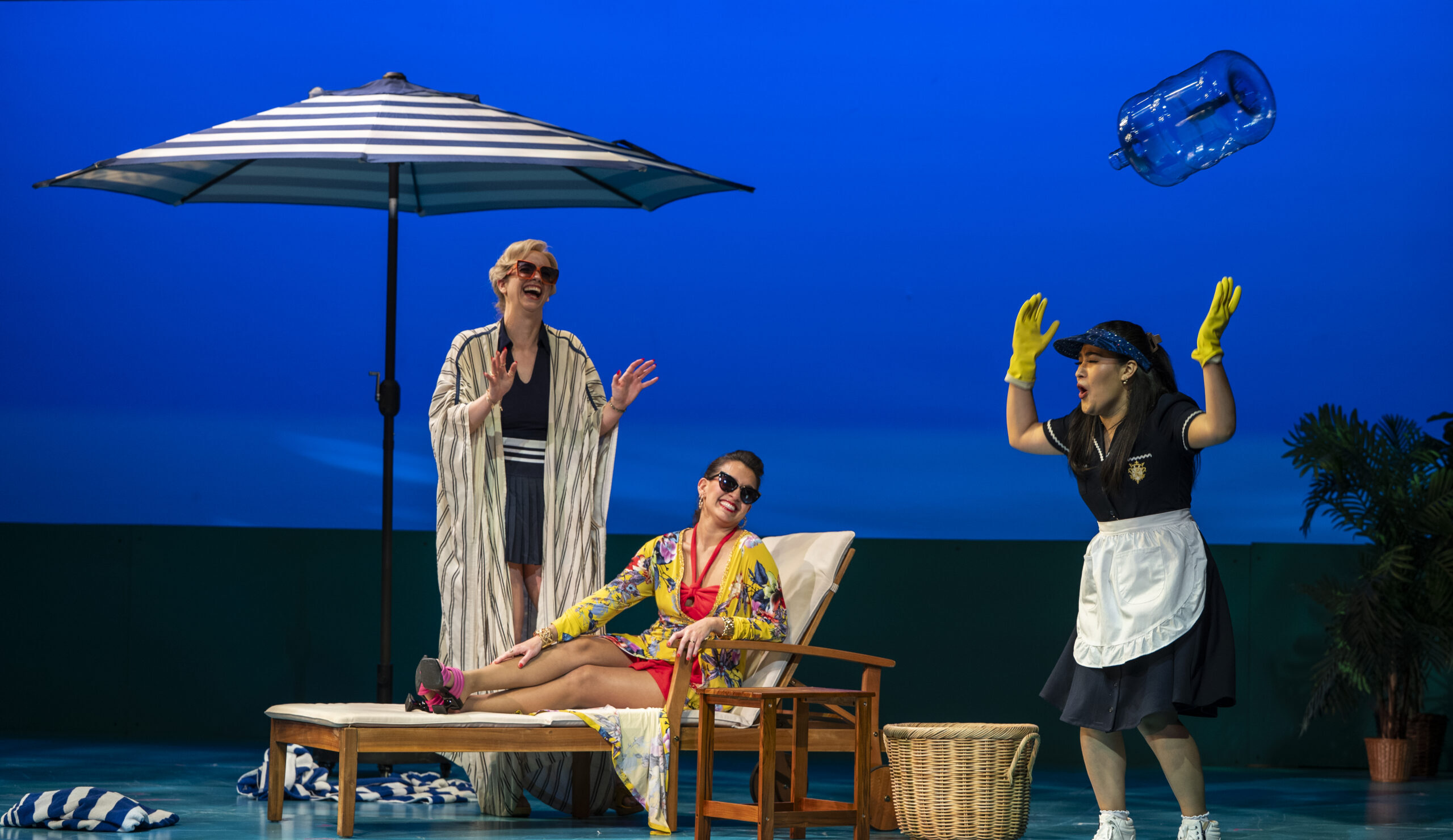
Each act concludes with a multi-sectional finale in a Mozartean vein, but in Act II the often-fragmentary nature of the musical pieces, performed amid much recitative, brings scant musical rewards despite being effective dramatically. Robin Guarino’s fast-paced, fun-filled staging sets the opera in a glitzy beachside hotel (Andrew Boyce designed the sets, Jessica Pabst the provocative consumes), in which Falstaff hangs out in a broom closet. In Act II, an overturned chaise longue and other signs of disarray on the beach show the consequences, we learn, of the tsunami created by Falstaff’s landing; an enormous rubber ducky helped save him.
The bass-baritone Christian Pursell, slim of girth and voice as Falstaff, was not helped by Guarino’s less-than-grand concept of the role. Otherwise, the scintillating cast included the soprano Vanessa Becerra and the tenor Andrew Morstein as the Fords, and the mezzo-soprano Tzytle Steinman and the baritone Laureano Quant as the Slenders. Christine Brandes, having accrued eighteenth-century expertise as a valued soprano, productively deployed it here as the conductor.
As the Chicago Opera Theater amply demonstrated, Salieri could create good entertainment. A review in the Allgemeine musikalische Zeitung (1799–1800) of excerpts from Falstaff published in vocal score, however, found it to have “pleasing, fluent melodies and light harmonies throughout” but “nothing great,” and it dismissed several numbers as “inconsequential.” The scholar John A. Rice observed that “the review seemed to judge Salieri’s music by Mozartean standards,” noting that Figaro was performed the day before Falstaff’s premiere. Nevertheless, enterprising opera companies would do well to look into Les Danaïdes and Axur.