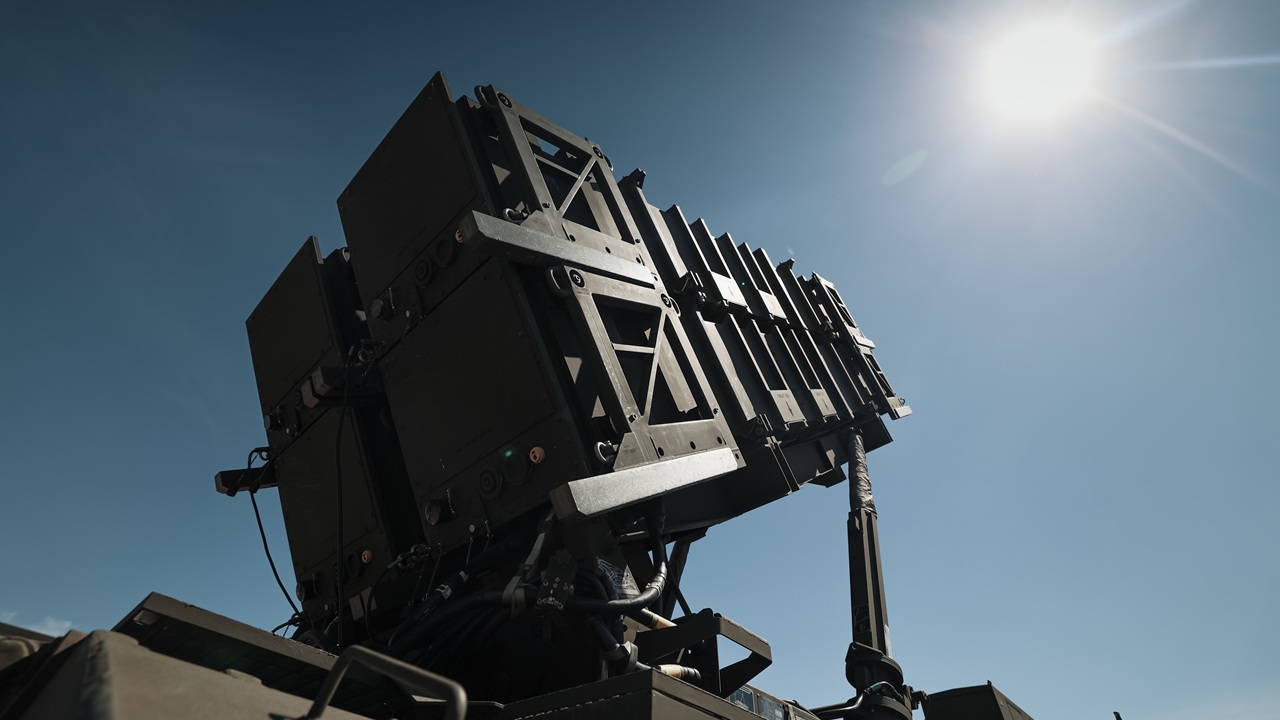
The aerospace giant has claimed that it can produce up to 2,000 PAC-3 ground-to-air missiles per year—vastly exceeding the current production rate of around 600 per year.
Lockheed Martin and the Department of Defense (DoD) announced this week the accelerated production of the PAC-3 (Patriot Advanced Capability-3), the latest-generation interceptor for the MIM-104 Patriot missile defense system. The aerospace and defense giant has pledged to more than triple Patriot missile production as part of a new seven-year agreement with the DoD.
Under the new “transformative partnership,” Lockheed Martin will increase its production capacity for the PAC-3 MSE from approximately 600 to 2,000 to support the US military, allies, and international partners.
“This framework agreement marks a fundamental shift in how we rapidly expand munitions production and magazine depth, and how we collaborate with our industry partners,” said Michael Duffey, undersecretary of defense for Acquisition and Sustainment. “Lockheed Martin’s willingness to help pioneer this transformative acquisition model is a win-win for the taxpayer, our national security, and the rebuilding of the industrial base needed for the Arsenal of Freedom.”
How the Pentagon Is Overhauling Its Acquisition Plans
The increased production of the PAC-3 MSE is part of the Pentagon’s ongoing Acquisition Transformation Strategy, which is meant to ensure long-term demand certainty, enable industry investment to increase production rates and further drive operational efficiency, and enhance “magazine depth,” the stockpiles of ordnance needed for potential future conflicts.
For the PAC-3 MSE specifically, production has already increased by more than 60 percent over the past two years. The aerospace firm reported that in 2025 it delivered 620 PAC-3 MSEs, an increase of more than 20 percent over the previous year.
The Pentagon also announced it would work with “key suppliers of PAC-3 MSE” by including seven-year subcontracts to “ensure facilitization investments” and support component production capacity.
“We appreciate the Department of [Defense’s] leadership in advancing acquisition reform,” said Lockheed Martin chairman, president, and CEO Jim Taiclet.
“This first-of-its-kind approach builds on years of advocacy and collaboration to bring commercial practices to major acquisition programs,” Taiclet added. “We will create unprecedented capacity for PAC-3 MSE production, delivering at the speed our nation and allies demand while providing value for taxpayers and our shareholders.”
About the Patriot and the PAC-3 MSE
The MIM-104 Patriot (Phased Array Tracking Radar for Intercept on Target) is widely regarded as one of the most advanced air defense systems in operation today. Developed in the 1970s to counter Soviet missiles, the MIM-104 Patriot is a mobile interceptor surface-to-air missile (SAM) system. The long-range, all-weather, all-altitude platform is more than a single unit. The Center for Strategic and International Studies’ Missile Threat explains that each “Patriot battery includes a radar set, an engagement control system, power generation and other support vehicles” as well as “several launch stations.”
The Patriot was first employed in combat in the 1991 Gulf War, and batteries were used to protect Saudi Arabia and Israel, shooting down more than 40 Iraqi Scud missiles. It now protects 19 NATO nations across Europe and Asia and is widely regarded as one of the most capable Western-made defense systems supplied to Ukraine. It has gained additional recognition for intercepting some of Russia’s most advanced ballistic missiles, including the air-launched Kh-47M2 Kinzhal and the vertical-launched 3M22 Zircon.
The improved PAC-3 MSE interceptors were introduced in October 2015 and reached Initial Operational Capability (IOC) in August 2016. Full-rate production of the missiles began in 2018, significantly expanding the Patriot’s range and capability.
The PAC-3 MSE is noted for employing “hit-to-kill” functionality, which employs direct body-to-body impact for maximum kinetic energy, rather than relying solely on fragmentation from the warhead. It is also equipped with a larger dual-pulse rocket motor and larger fins to provide increased speed, range, and maneuverability. The PAC-3 can be integrated with advanced sensors and command systems beyond just the Patriot radar. Up to a dozen MSEs can be loaded onto a single Patriot launcher, and each was designed to defeat better tactical ballistic missiles (TBMs), cruise missiles, drones, and enemy aircraft.
About the Author: Peter Suciu
Peter Suciu has contributed over 3,200 published pieces to more than four dozen magazines and websites over a 30-year career in journalism. He regularly writes about military hardware, firearms history, cybersecurity, politics, and international affairs. Peter is also a contributing writer for Forbes and Clearance Jobs. He is based in Michigan. You can follow him on Twitter: @PeterSuciu. You can email the author: [email protected].
Image: Shutterstock / Dragos Asaftei.