European NATO members are willing to provide security guarantees to Ukraine to protect it from a future Russian invasion—but the Kremlin has not yet supplied its own peace terms.
Ukraine’s European partners are willing to provide significant security guarantees to Kyiv as part of a peace plan. The United States is also willing to support these measures as diplomatic talks continue.
How to Keep Ukraine Safe After the War
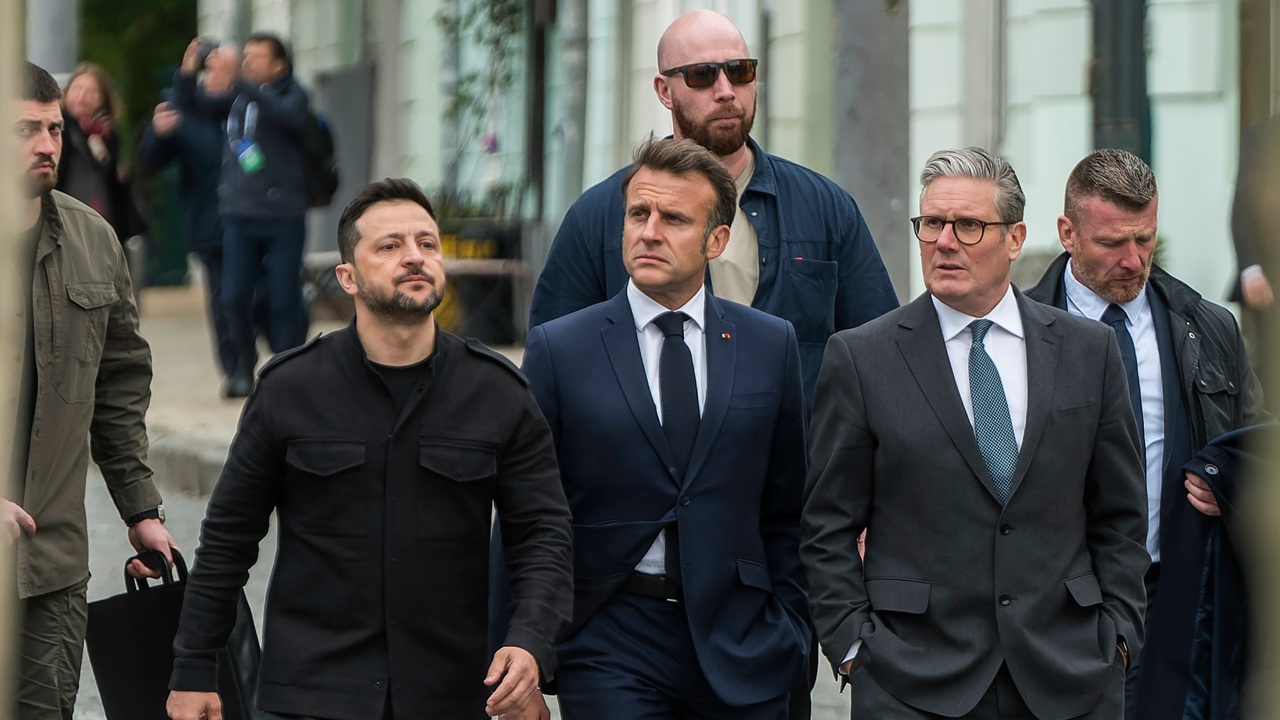
On Tuesday, dozens of European leaders met in Paris to discuss the future of Ukraine. At the conclusion of that meeting, the Europeans issued a joint statement committing to continue the critical long-term security assistance and armament to the Ukrainian military and to provide a multinational military force “to support the rebuilding of Ukraine’s armed forces and support deterrence.”
Moreover, in the event of a future Russian attack, Ukraine’s European partners committed to supporting Ukraine with defense measures that “may include the use of military capabilities, intelligence and logistical support, diplomatic initiatives, [and] adoption of additional sanctions.”
“Those security protocols are meant to deter any attacks, any further attacks in Ukraine, and if there are any attacks, they’re meant to defend, and they will do both. They are as strong as anyone has ever seen,” US Ukraine envoy Steve Witkoff said in a joint news conference with the leaders of France, Germany, the United Kingdom, and Ukraine in Paris.
Discussions will continue in the days ahead. The Ukrainian delegation will soon meet with US representatives for the third time in a handful of days. The agenda will revolve around the more technically complex parts of the agreement, including the future status of the Zaporizhzhia Nuclear Power Plant and the topic of territorial concessions in exchange for peace.
The Zaporizhzhia Nuclear Power Plant has been under Russian occupation since the early days of the conflict. The Russian forces have fortified the nuclear power plant and used it to house troops and artillery units. At different times in the conflict, fighting has broken out very close to the nuclear power plant, and there were concerns about the possibility of a nuclear disaster should a stray round hit the reactors or other sensitive buildings.
“Ukraine does not shy away from the most difficult issues and will never be an obstacle to peace. Peace must be worthy. And this depends on the partners – whether they will ensure Russia’s real readiness to end the war,” Zelensky added.
Russia Has Not Yet Approved the Peace Plan
Regardless of any diplomatic progress achieved by Ukraine and its partners, the war will not end until Russia agrees.
The United States understands this reality. The second US envoy present at the meeting, Trump son-in-law Jared Kushner, said that if the Ukrainians reach a final agreement with the Kremlin, “they have, obviously, a robust deterrence [in the proposed security guarantees], and there’s real backstops to make sure that this will not happen again.”
Thus far, the Kremlin has not shown a willingness to end the conflict in anything less than its own highly advantageous terms. Although Moscow has not made all of its its terms explicit—a negotiation strategy to maintain leverage in the ongoing peace talks—they will almost certainly demand significant territorial concessions from Ukraine. In particular, the Kremlin will look to get the unconquered portions of Ukraine’s Donetsk, Luhansk, Zaporizhzhia, and Kherson oblasts, as well as to secure formal Ukrainian recognition of its annexation of the Crimean Peninsula, which Kyiv has long regarded as illegal.
The territorial demands in particular would be an extremely heavy ask from Ukraine, and Kyiv is unlikely to agree to them in their current form. Accordingly, the peace talks are expected to continue for the foreseeable future.
About the Author: Stavros Atlamazoglou
Stavros Atlamazoglou is a seasoned defense journalist specializing in special operations and a Hellenic Army veteran (national service with the 575th Marine Battalion and Army HQ). He holds a BA from the Johns Hopkins University and an MA from the Johns Hopkins’ School of Advanced International Studies (SAIS). His work has been featured in Business Insider, Sandboxx, and SOFREP.
Image: Shutterstock / paparazzza.