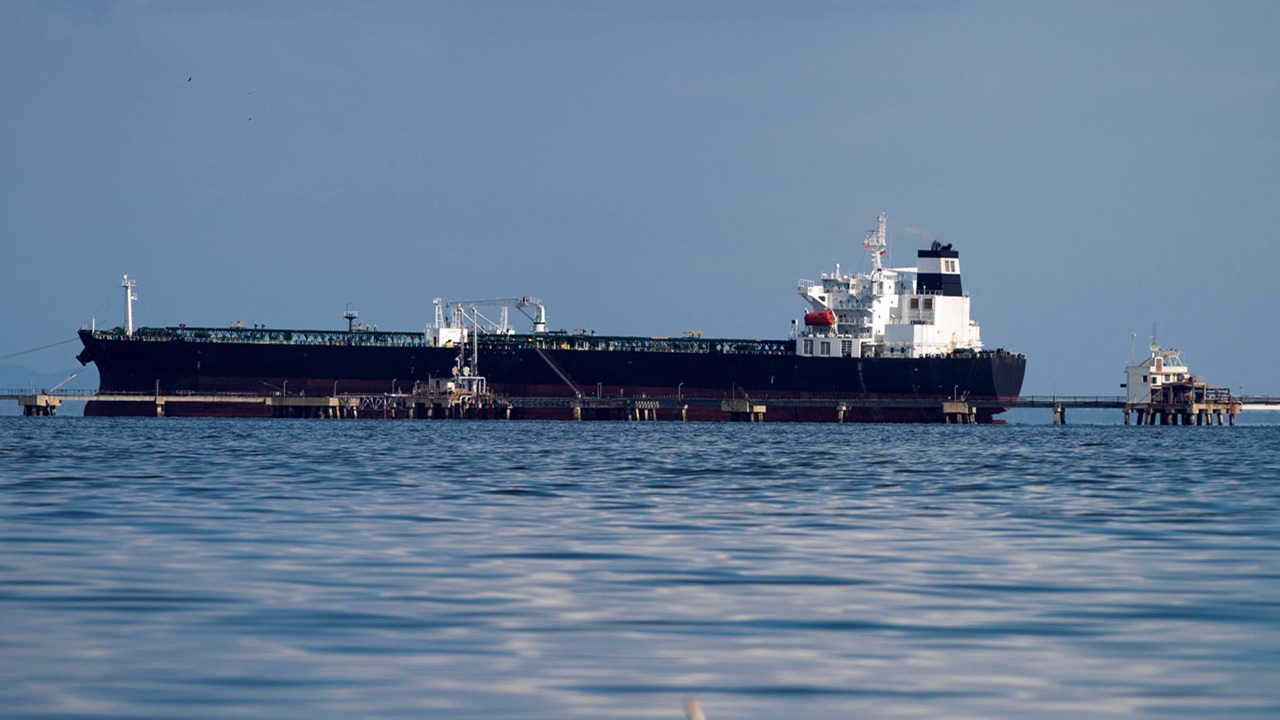
The Bella 1, which refused boarding in the Caribbean and fled into the Atlantic, attempted to redesignate itself as a Russian vessel in order to secure diplomatic protection.
A purported Venezuelan “dark fleet” oil tanker that continued to elude the United States military in the Atlantic was seized by the United States Coast Guard on Wednesday morning.
The vessel, formerly known as the Bella 1, was at the time operating near Iceland’s exclusive economic zone (EEZ). The tanker has been involved in ship-to-ship oil transfers and was previously sanctioned by the United States Treasury Department for having ties to Hezbollah and Iran’s Islamic Revolutionary Guard Corps (IRGC) Quds Force, which specializes in unconventional warfare and intelligence.
The Bella 1’s Voyage of the Damned
An almost odyssey-like journey began in Iran last month when Bella 1 departed the Middle East for Venezuela, almost certainly to pick up oil. On December 21, the United States Coast Guard intercepted it en route, but it refused boarding and fled.
The tanker has since attempted to evade a US blockade of sanctioned oil tankers for nearly a week—during which its crew painted a Russian flag on the hull and renamed the vessel Marinera. On New Year’s Eve, Russia filed a formal diplomatic request that the US cease its pursuit. That demarche, sent to the US State Department, noted that the ship had been assigned a new name on its official Russian register.
But that diplomatic request did not halt the US efforts to interdict the dark fleet tanker.
The Bella 1 Lost the Race to Russian Protection
The Wall Street Journal reported on Tuesday evening that Russia has dispatched a submarine and other vessels to escort the tanker, which is now believed to be heading for the port of Murmansk in northern Russia.
It was a race to see whether the newly-christened Marinera could reach the Russian escorts before they were intercepted.
The US and its NATO allies had been “running near-continuous surveillance flights close to an oil tanker in the north Atlantic,” according to another report from The Financial Times. The tanker was also imaged by a European Space Agency Sentinel-1 satellite, which confirmed its location and the positions of the US Coast Guard vessels now in pursuit.
The US went to extreme lengths to track the tanker, and US Navy Boeing P-8 Poseidon aircraft operating from bases in the UK flew over Irish sovereign airspace on multiple occasions this week. The multi-mission maritime patrol aircraft, based on the narrow-body 737-900ERX, was designed for anti-submarine and anti-surface warfare (ASW), anti-surface warfare (ASuW), and shipping interdiction, as well as intelligence, surveillance, and reconnaissance (ISR) and search-and-rescue missions.
At least two P-8 Poseidon aircraft were deployed on Monday and then again on Tuesday. Ireland is not a member of NATO, and according to a report from The Irish Times, “Under long-standing Irish policy, foreign military aircraft are not permitted to use Irish airspace while on active military operations.”
Still, officials in Dublin and Washington said permission had been sought at the government level and that clearance had been granted.
Ireland’s Deputy Prime Minister (Tánaiste) Simon Harris told the Irish paper of record that he was unaware that permission had been sought, but said he expected that the rules would “have been followed.” Harris further addressed the seriousness of the flights, given Ireland’s longstanding policy of neutrality and non-military alignment.
“That doesn’t mean that we’re in any way immune from or unconcerned about security,” Harris added. “Nor do we generally comment on those matters, for obvious reasons.”
Other Illicit Tankers Are Being Reflagged
Even as the hunt for the Marinera has concluded, there are reports that at least three additional oil tankers suspected of being part of the dark fleet and having operated in Venezuelan waters have also been “reflagged” as Russian in the hope that the Kremlin might be able to offer them some diplomatic protection.
One of the suspected vessels, the motor tanker Sophia, was also seized by US military forces in the Caribbean, but the others remain at sea.
It is unclear how far Moscow is willing to go to protect the sanctioned vessels, but it could put further wrinkles in the US-led peace negotiations to end the war in Ukraine.
The US has rejected Russia’s claims that Ukraine launched a drone strike at Russian President Vladimir Putin’s residence. President Donald Trump first expressed frustration with Kyiv following the Kremlin’s claims, but has now turned his ire to Moscow.
“I’m not thrilled with Putin,” Trump told reporters. “He’s killing too many people.”
Russia’s efforts to protect tankers involved in the illicit oil trade are only likely to further anger the US leader.
About the Author: Peter Suciu
Peter Suciu has contributed over 3,200 published pieces to more than four dozen magazines and websites over a 30-year career in journalism. He regularly writes about military hardware, firearms history, cybersecurity, politics, and international affairs. Peter is also a contributing writer for Forbes and Clearance Jobs. He is based in Michigan. You can follow him on Twitter: @PeterSuciu. You can email the author: [email protected].
Image: Shutterstock / youledtayif.