On the feast of the Epiphany, a month before he sadly and mysteriously resigned the papacy, Pope Benedict XVI preached:
These [wise] men who set out towards the unknown were, in any event, men with restless hearts. They were men driven by a restless quest for God and the salvation of the world. They were filled with expectation, not satisfied with their secure income and their respectable place in society. They were looking for something greater.
They were no doubt learned men, quite knowledgeable about the heavens and probably possessed of a fine philosophical formation. But they desired more than simply knowledge about things. They wanted above all else to know what is essential. They wanted to know how we succeed in being human.
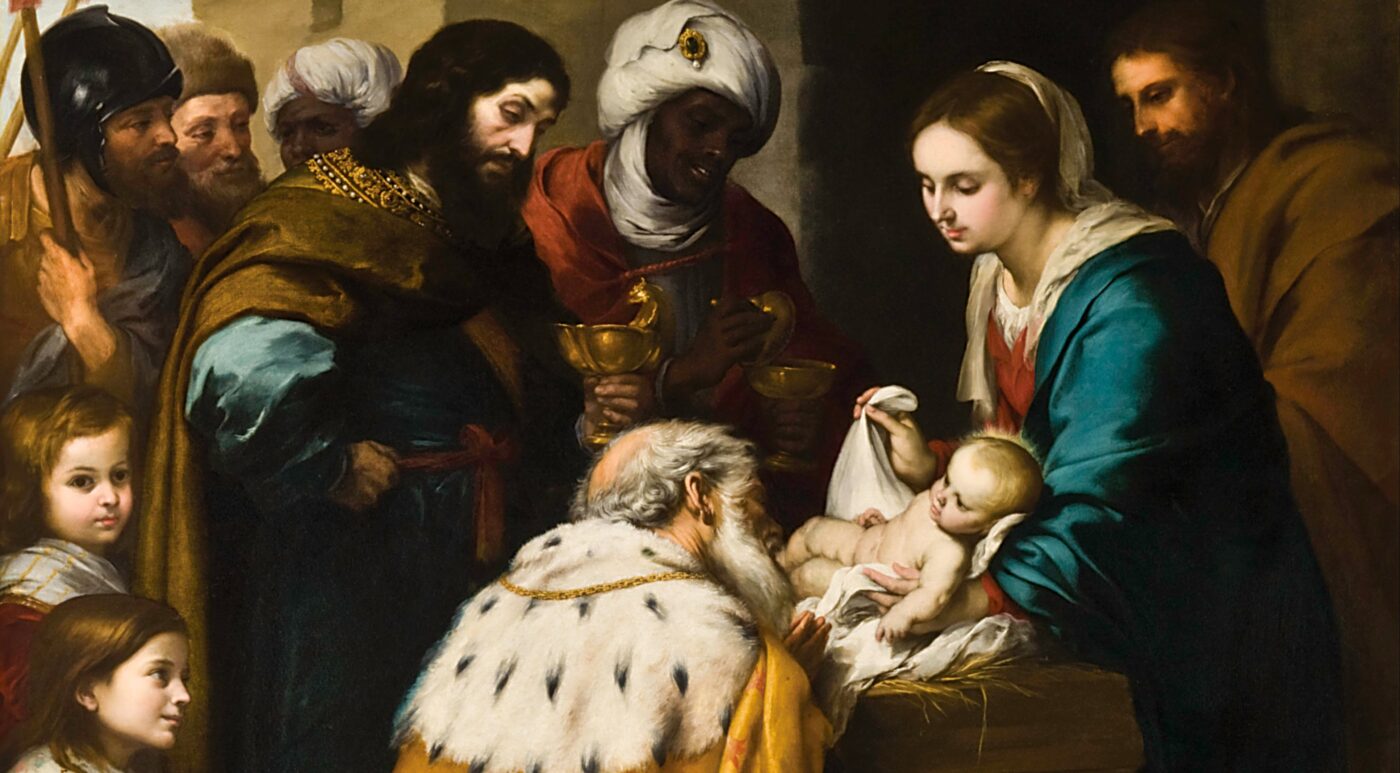
Who were these wise men, driven by a restless quest for God? We put their number at three, “We Three Kings,” not because that is in the Bible (it is not), but as some scholars note, all the nations could be traced back to three families who survived the great flood—those of Noah’s three sons, Shem, Japheth, and Ham. So, traditionally, the Three Wise Men were seen representing the three families that migrated from Noah’s ark.
The Shemites, known in Latin as Semites, formed the Jews and other Middle Eastern peoples. Japheth’s descendants populated areas to the north and east of the Holy Land. Ham’s descendants primarily went to Africa. That is why one king appears Middle Eastern, one is African, and one is Caucasian.
Why the diversity? Well, for the simple reason that, though God’s promise was made to and through the Jewish people, that did not mean the promise was only for them. As St. Paul told the Ephesians, “the Gentiles are coheirs, members of the same body, and copartners in the promise in Christ Jesus through the gospel.” The promise was a universal one. The word in Greek for that is “catholic.”
Speaking of Greek: Our modern translation of the Bible, created in 1970 and used for modern Mass, states that the Wise Men did Christ “homage.” This, I believe, is a lacking translation, for homage can be given to any earthly king, or anyone else for that matter. A priest-scholar notes that the Greek—the original language of the New Testament—is very clear that the Wise Men “worshipped” Christ. “Worship is something given only to God. This means that these men recognized something infinitely greater than their eyes could see” (Robert Altier).
The Latin, translated from the Greek, and used for over 1500 years, is adoraverunt, as in “they adored.” Adoration is something given only to God. There is a big difference between homage and adoration. And there is a big difference between the Holy Sacrifice of Mass and the typical religious service celebrated by our separated brethren. At those services there is no adoration; at Holy Mass there is.
A scholar wrote:
The sacred liturgy is all about touching eternity, about turning our gaze toward our final destination that lies beyond the time-bound limits of this world. In her divine worship, Holy Mother Church raises her eyes above the low, dense, oppressive clouds of the here and now to set her sights upon Him who is the Desire of the Everlasting Hills (see Genesis 49:26). (James Monti)
Do you understand then why nothing profane should enter this sacred building when Holy Mass, the mysterious event not bound by time, is taking place? The word “profane” comes from the Latin profanus, which means “outside the temple,” indicating something that is unholy or secular. That means your demeanor at Mass should be different than what it is outside. It means you should dress for Mass in formal attire. Doing so shows you fear God, and not the world.
To fear God of course is the beginning of wisdom. And speaking of wisdom: Look at the Wise Men. Notice they are dressed for the occasion. They didn’t dress in casual, every-day attire, as if to say, “We’re no better than anyone else here. We don’t want to call attention to ourselves!” No, they showed up and said, “We are the three Wise Men.” Then they humbly asked, “Now show us where the Baby King is, so we can adore Him.”
Bishop Sheen wrote:
Only two classes of people found the Babe—the shepherds and the Wise Men; the simple, and the learned; those who knew that they knew nothing, and those who knew that they did not know everything. For the rest of the people in Judea, including those in their palaces up in Jerusalem…Not even God can tell the proud anything! Only the humble can find God!
The Wise Men found Him and worshipped and offered gold, frankincense, and myrrh. G.K. Chesterton wrote: “…that He should be crowned like a king; that He should be worshipped like a God; and that He should die like a man; and these things would sound like Eastern flattery, were it not for the third.”
That third thing is what makes the story real and true. Jesus Christ was not a myth; He was a man. He was a man born to die—for you. How does that make you feel? When He says, “This is my Body given for you” at Mass, it is His real body. It’s not a myth. How does that not make you want to get on your knees and adore Him?
O Come let us adore Him, Christ the Lord. That is what we sing at Christmas. And we sing it with awe and wonder, like little children pondering the mystery that Almighty God would enter His own creation as a little child. We ponder it at Christmas, a time for children and child-like innocence.
St. John wrote, “See what love the Father has bestowed on us that we may be called the children of God. Yet so we are.”
This is the great epiphany, the great awakening, the great light that has changed the world and human nature. We have become children of God.
And, God-willing, when we migrate out of this world and touch eternity in our heavenly home, we will laugh forever. With awe and wonder, we will laugh, knowing that we had to become like children to see God.
Image from Wikimedia Commons