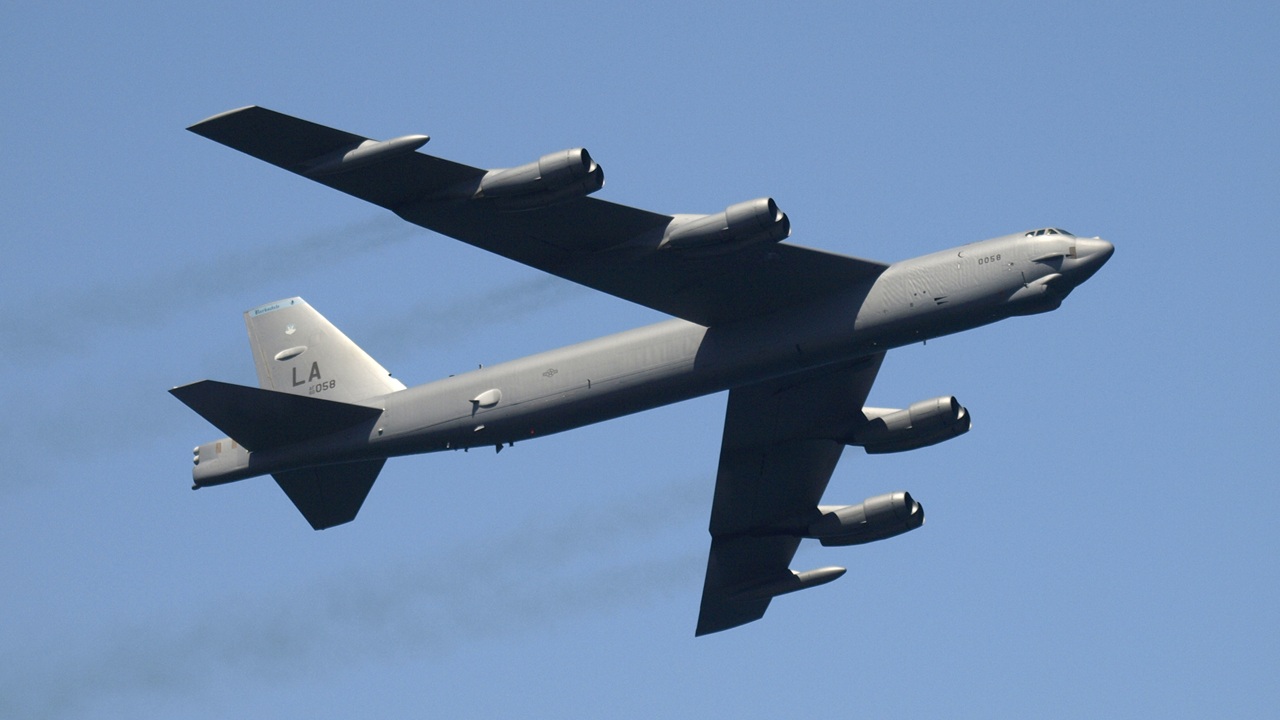
The new upgrade package—on top of an existing $2.6 billion contract with UK engine manufacturer Rolls-Royce—will keep the B-52 bombers flying indefinitely into the future.
The United States Air Force fleet of Boeing B-52 Stratofortress bombers has been in service for more than 70 years, and current plans call for the aircraft to reach the century mark. To get there will require replacing each of the aircraft’s eight original Pratt & Whitney TF-33 engines. Those engines are past their prime, prompting the Air Force in 2021 to award a $2.6 billion contract to Rolls-Royce to produce more than 600 F-130 engines for nearly all 76 B-52H Stratofortress bombers now in service.
The Commercial Engine Replacement Program (CERP) remains on track, with the engines undergoing testing at the NASA Stennis Space Center in Mississippi. Just last month, Boeing was awarded a $2.04 billion contract to support the post-critical design review (PCDR), which ensured seamless integration following the critical design review. It required modifying and testing two aircraft with the new engines, along with associated subsystems.
Work will be carried out at multiple locations, including Oklahoma City, Oklahoma; San Antonio, Texas; Seattle, Washington; and Indianapolis, Indiana.
About the B-52 Stratofortress
- Year Introduced: 1955
- Number Built: 744 (all variants produced); 76 B-52H airframes remain in USAF service (approx.)
- Length: 159 ft 4 in (48.5 m)
- Wingspan: 185 ft 0 in (56.4 m)
- Weight (MTOW): ~488,000 lb (221,000 kg)
- Engine: Eight Pratt & Whitney TF33-P-3/103 turbofan engines (~17,000 lbf / ~76 kN thrust each); planned/announced re-engining programs (e.g., Rolls-Royce F130/BR700 family derivatives) for future service life extension
- Top Speed: ~650 mph (1,046 km/h); about Mach 0.86 at altitude (approx.)
- Combat Radius: Mission- and load-dependent; typical practical combat radii vary widely (roughly several thousand miles / ~3,000–7,000 km depending on payload, routing, and aerial refueling)
- Service Ceiling: ~50,000 ft (15,240 m); varies depending on loadout
- Loadout: ~70,000 lb (≈31,500 kg) of mixed ordnance
- Aircrew: 5 (pilot, co-pilot, weapon systems officer, navigator, electronic warfare officer); varies based on loadout / mission parameters
The original B-52A made its maiden flight in 1954, while the B-52B officially entered service a year later. The last B-52H was delivered in October 1962, sixty-two years ago this month. A total of 744 were manufactured, while the Air Force still maintains 76: 58 are considered operational with the 2nd Bomb Wing and 5th Bomb Wing, 18 are in the reserve forces of the 307th Bomb Wing, and another dozen are now in long-term storage at the Davis-Monthan Air Force Base “Boneyard.”
To keep the aging bombers flying, the Pentagon has literally invested billions of dollars, and the B-52s have received considerable upgrades that have included (or will include) new sensors, new crew workstations, improved cockpit layout, new engines and radars—and even, after seven decades, the addition of a privacy screen for the aircraft’s lavatory!
New Engines Will Keep the B-52 Going for Decades More
As previously reported, the replacement engines have been a long time coming. Boeing, maker of the B-52, has explored replacing the original Pratt & Whitney TF-33 engines since the 1970s. The Air Force rejected the idea, arguing that replacing the engines would cost more than keeping the existing ones. However, the service ultimately changed course, in part because Air Force officials failed to account for the increase in fuel costs.
The B-52 has undergone numerous upgrades in recent years, but none were significant enough for the US Air Force to consider a designation change for the bomber. However, CERP has been significant enough that the service announced last year that, once completed, the aircraft would be redesignated the B-52J. Part of the reason for the redesignation is that swapping the engines has required some retooling of the aging bombers.
Boeing and Rolls-Royce employed state-of-the-art digital engineering tools to determine the best way to integrate the engines into the old bombers.
The engine maker created digital models of the massive bombers, enabling engineers to simulate the new engines and assess how they would interact with other components and systems. It also involved the two companies trading digital models to help engineers ensure the F130 would fit precisely within each B-52 nacelle and determine where newly added components could be placed.
The B-52’s New AESA Radar Is Another Massive Upgrade
Last month, the United States Air Force also conducted the first ferry flight of a B-52 following installation of the APQ-188 AESA systems as part of the B-52 Radar Modernization Program. The flight departed from Boeing’s San Antonio facility for Edwards Air Force Base, California.
“This milestone marks a significant step forward in the aircraft’s ongoing modernization efforts to ensure it remains a critical component of the United States Air Force’s conventional and nuclear long-range strike capabilities,” the Air Force announced. The AESA radar, developed by RTX subsidiary Raytheon Technologies, will provide the Stratofortress with radar capabilities comparable to those of the U.S. Air Force’s F-15EX Eagle II and the U.S. Navy’s F/A-18 Super Hornet.
The 412th Test Wing at Edwards AFB has been evaluating the APQ-188, following ground integration and initial system functional checks completed early this year in San Antonio.
“The ferry flight of this upgraded B-52 marks an important moment in our efforts to modernize the bomber force,” said Secretary of the Air Force Troy Meink in an Air Force statement. “This radar modernization ensures that the B-52 will continue to serve as a cornerstone of American airpower well into the future. We are committed to extending the life of this vital platform, allowing it to operate alongside next-generation fighter and bomber aircraft.”
The Air Force further announced that data gathered during ongoing testing will inform the RMP upgrade for the entire fleet of 76 operational B-52s.
About the Author: Peter Suciu
Peter Suciu has contributed over 3,200 published pieces to more than four dozen magazines and websites over a 30-year career in journalism. He regularly writes about military hardware, firearms history, cybersecurity, politics, and international affairs. Peter is also a contributing writer for Forbes and Clearance Jobs. He is based in Michigan. You can follow him on Twitter: @PeterSuciu. You can email the author: [email protected].
Image: Shutterstock / Bruno Ismael Silva Alves.