As a quadriplegic, growing older brings new challenges constantly: physical limitations, medical complexities, fatigue, loss of independence, and the fears that accompany all of the above. But one practice has become not just a comfort, but a source of deep strength: Eucharistic Adoration, rooted in gratitude.
My wife Amy and I have made Eucharistic Adoration a consistent aspect of our spiritual worship, and thanksgiving became the means of our spiritual survival. These practices equip me personally for aging, disability, and suffering in ways nothing else can.
Aging with paralysis means watching abilities fade that many people take for granted. Adoration, especially approached with gratitude, trains the heart to be thankful for your blessings; not by minimizing your losses, but in realizing that the glorious highs and the crushing lows can all be offered back to God in making us more complete in Christ.
In Adoration, gratitude becomes a discipline: “Thank You for the gift of breath. Thank You for another day with my family. Thank You for the people who care for me. Thank You for the Cross, which gives my suffering meaning.” Thanksgiving doesn’t erase hardship, but it does reshape it. It uproots bitterness—or prevents it entirely from taking root. It transforms self-pity into worship and fear into trust. Gratitude becomes a shield against the temptation to complain, self pity, or despair.
Thanksgiving shifts disability from a burden to a participation in Christ. I give thanks to the Lord for the identity in Him that He’s given me. I give thanks for calling me to His one, holy, catholic, and apostolic Church. For blessing me with Amy and the three children He’s given us. For the health that I do have, and the financial provisions that He’s given us. For my parents who have been able to see me live in my mid 50s and become the man, the husband, and the father that God has allowed me to become.
I give thanks for my suffering because Christ is present in it, and it draws me closer to Him, unifying me to Him through His sufferings. Giving thanks becomes an act of surrender that reframes disability as a share in Jesus’ Cross, a way to intercede for others, a refinement of the heart, and a path to deeper holiness.
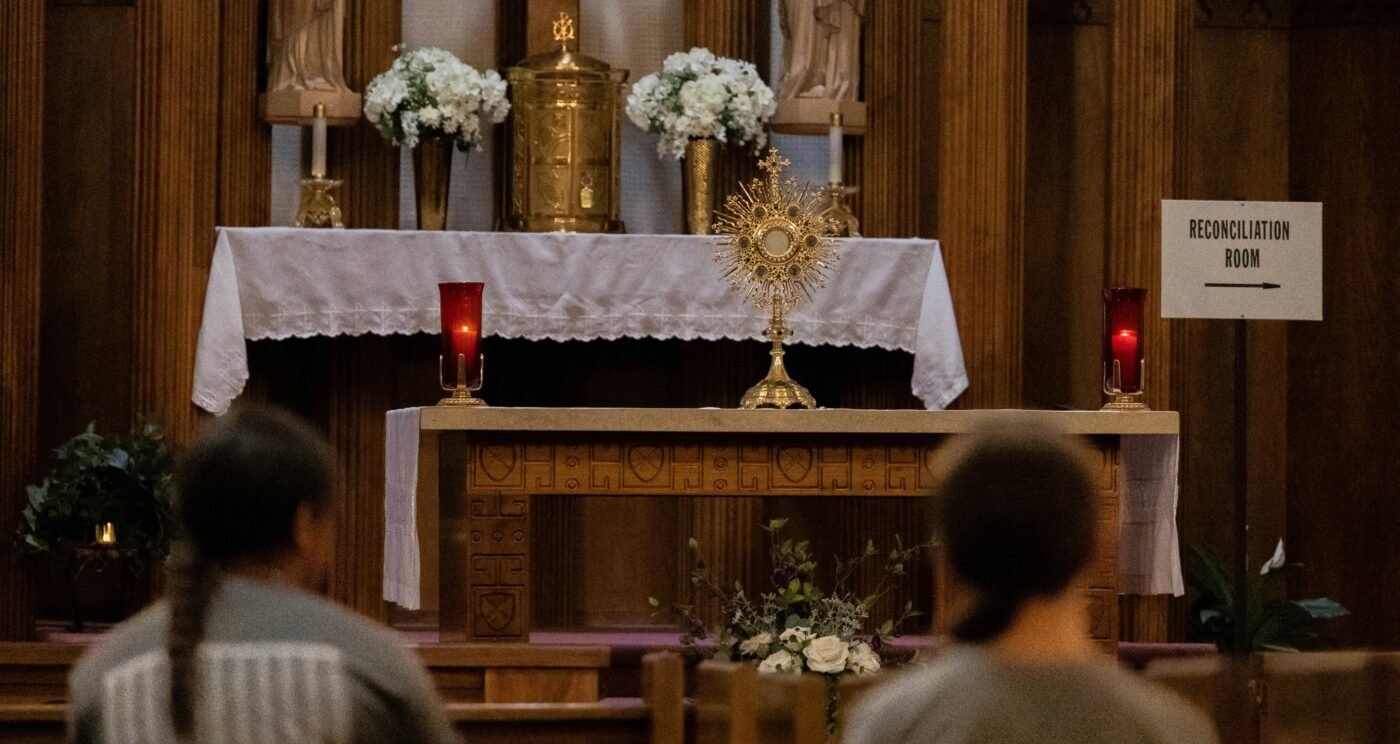
My body limits almost everything I do, but it does not limit Christ. Before the monstrance, I cannot kneel, but He bends toward me. I cannot walk to Him, but He is brought to me. I cannot raise my hands, but He raises my heart. I cannot hold Him, but He holds me. The Eucharist is the great equalizer: everyone is small before God, and everyone is loved without measure.
Adoration also silences fear—and aging with disability brings real anxieties: What will my health look like in ten years? Who will care for me? Will I become a burden? What will the end of my life look like? In Adoration, these fears lose their power. When I look at Him, truly present in the Host, I am reminded: if He can hold the universe together, He can hold me together. If He conquered death, He can conquer my fear. If He is with me in the Eucharist, He will be with me in the hardest moments of old age.
Gratitude in Adoration brings healing to memories of suffering, too. Long-term disability carries physical, emotional, and spiritual wounds. But when I say, “Thank You, Jesus, for being with me even then,” I invite Him into the deepest layers of my story. Gratitude is not denial; it is healing. It rewrites the narrative of suffering from “Why did this happen to me?” to “You have never abandoned me.”
Dependence is a constant reality in quadriplegia, and aging intensifies that dependence. Before the Eucharist, dependence is not humiliation; it’s liberation. “Jesus, I need You. Jesus, I trust You. Jesus, carry me when my strength fails.” Adoration trains the soul in holy dependence and awakens a joy that disability and aging continually try to steal. It anchors my identity: I am loved, wanted, chosen—no matter what my body can or cannot do.
In Adoration, I am equipped—not despite disability, but through it. Giving thanks at the feet of Jesus in the Eucharist gives me spiritual stability, deep peace, joy in weakness, healing of the past, courage for the future, a renewed identity, grace to endure suffering, the ability to love and forgive, and strength for the crosses ahead.
As an aging quadriplegic, I find in Adoration not a retreat from reality, but the only place where reality makes sense. And if my story can help others discover the beauty of Catholicism or the hope hidden inside their own crosses, then every word is worth writing.
Editor’s Note: This article was adapted from a chapter in The Final Pieces: Our Spiritual Journey. For the full story of this author’s testimony, check out his book, available on Amazon.
Photo by Matea Gregg on Unsplash