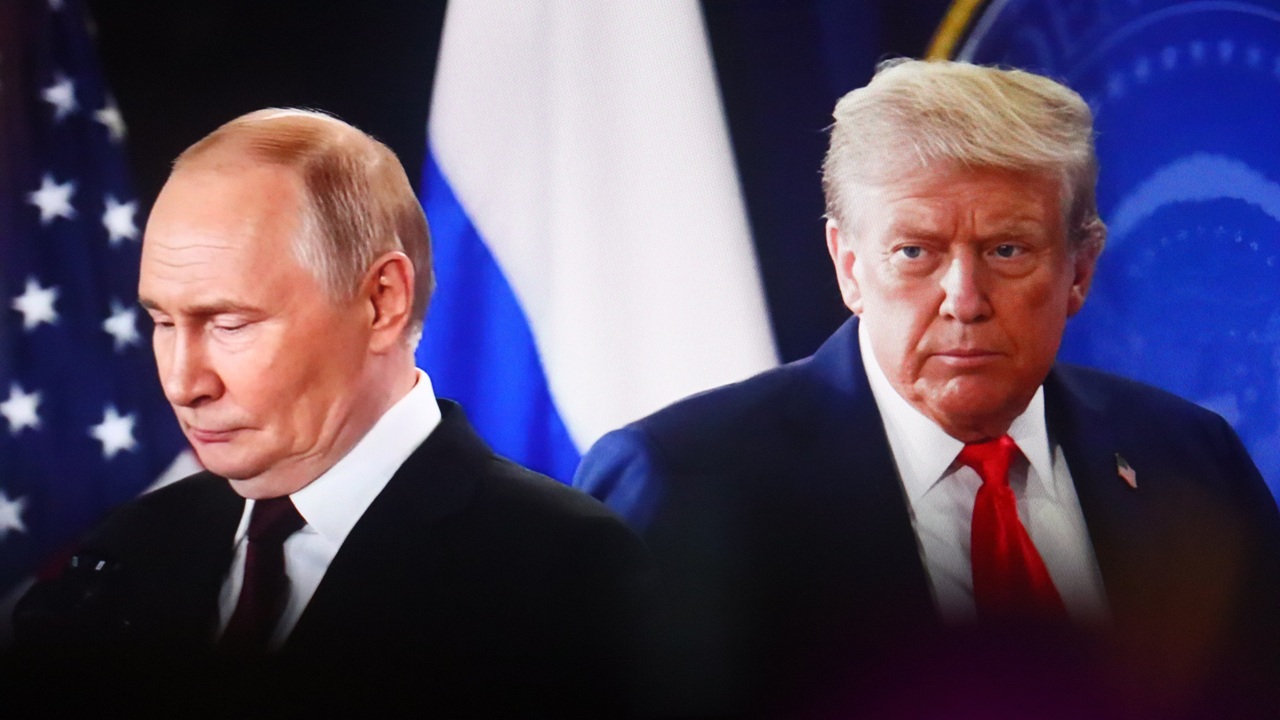
As Russia and China are concentrating on developing “spheres of influence” in their near-abroad, many are still pushing for America to be everywhere at all times.
Following the end of World War II, the United States and the victorious Allies built a world system that was designed to mitigate the chances of another world war from erupting. By the end of the Cold War in 1991, the Americans seemed to have not only ensured the system they established after 1945 would dominate into the new century, but that it would be supported exclusively by unquestioned American dominance far into the future.
Flash forward to 34 years later, and it’s an entirely new ballgame.
The “New World Order” Isn’t What America Hoped For
Today, the United States is hobbled by a turgid economy, seriously divided domestic politics, an unstable society, and a military that has not really won a war since the Gulf War in 1991 (though some would quibble with this, since the United States has not technically fought in a declared war since 1945).
After decades of globalization, wherein the purveyors of American global hegemony paradoxically demanded the gutting of America’s economy and the spreading of America’s once-exclusive wealth and capabilities to the rest of the world, other nations are today rising to power. Many have argued we have entered a multipolar world order. And it is true that many powers have started rising from behind the shadow of the waning American colossus.
Yet the world of many powers balancing against each other seems to be at least a decade away. Instead, it would appear as though there are but three major powers today—the stagnant United States, the resurgent Russian Federation, and the rising People’s Republic of China.
Whether other medium-sized powers, such as Turkey or Japan, can grow to become truly dominant global powers in a sea of powerful nations has yet to be seen.
What we know is that the United States, China, and Russia are the only three nation-states in the world system that today have global reach, massive and lethal militaries, the economic heft that dominant powers enjoy, and the societal and political structures to support being a world-spanning global power.
The Tripolar Age Is Inherently Unstable
Given that the world system has transformed from a unipolar system governed by the United States into an unstable tripolar system, Washington must stop behaving as it is still 1995. It is 2025—and the risk of American overextension, coupled with the growing threat from the increasingly united Russia and China, means that the risks to the United States are greater than they have ever been. Failure to recognize this reality means that the Americans will be the losers of the next several decades.
Right now, the Russians and Chinese are moving decisively to secure for themselves spheres of influence in their respective regions. Russia is working overtime to ensure that they have created buffer zones between their territory and the territory of their European neighbors, who are clearly hostile to Russia.
On the other end of Eurasia, China is moving toward establishing its dominion over the Indo-Pacific. Beijing has already de facto become the dominant player in the First Island Chain, the region spanning from the Kamchatka Peninsula down through Japan and Taiwan to the Philippines and the South China Sea. Indeed, Chinese forces are increasingly moving into the Second Island Chain—the Ogasarawa Islands south of Japan, through the US territories of Guam and the Northern Mariana Islands, down to Palau and parts of Micronesia.
Eventually, China plans to project power into the Third Island Chain, stretching from Alaska down through Hawaii and ending in New Zealand. On the other side of China’s strategic map is its need to maintain supremacy over India, both to better manage its land border with India as well as to ensure access to the Indian Ocean basin (this is sometimes known as the “String of Pearls” Strategy).
The World Has Always Been Divided into “Spheres of Influence”
The other major power in the world today, the established power—the United States—continues operating on the notion that it can be everywhere, all the time. But this is a recipe for disaster. The reason why the great powers have historically focused like a laser on securing their near-abroad is to ensure that they have a stable base from which to project power into the world beyond.
This was a concept that the Americans understood for most of their country’s existence. The Monroe Doctrine, informally proclaimed in 1823, was a self-defensive measure designed to keep the more powerful empires of Europe back from the still-growing United States in the Western Hemisphere. In the decades that followed, the United States took control over the Western portion of North America. After that, the Americans worked assiduously to exert its control over the Western Hemisphere—kicking out the Spanish Empire, reducing the British role wherever possible, weakening the power of Mexico, and absorbing Russian-owned Alaska. Only once that project was completed could the Americans of yesteryear go abroad shaping the world more to their liking.
Since the end of the Cold War, however, things have changed for the United States. It has ignored its own hemisphere, giving its growing competitors, such as China and Russia, a clean shot to increase their influence and presence there. Meanwhile, the regions that America was interested in exerting dominance, such as the Middle East, have been steadily slipping away—even as the Americans invested trillions of dollars, thousands of lives, and decades into holding.
A harsh irony of the post-Cold War era is that America’s various attempts to exhibit its dominance (such as in the Iraq War) have led to the overall diminishment of that dominance. At the same time, every instance where the US attempted to exert greater control—whether it be in the Middle East or in Europe—these actions have militated the rise of great power rivals and exacerbated the decline of the post-Cold War American unipolar world order.
Trump’s “Hemispheric Defense” Plan Gets Back to Basics
To its credit, the Trump administration at least rhetorically recognizes the true limits of modern American power and are working toward creating policies based on a realistic framework that marries American capabilities to the present tripolar moment in world affairs. That is why there has been a decisive shift away from blindly supporting the Ukrainians and the European NATO members in their ridiculous war with Russia.
It also explains why, despite initially assisting the Israelis in their war effort against the Islamic Republic of Iran, the Trump administration has methodically reduced its footprint in the Middle East—all while intensifying its presence in Latin America, quietly working to support Albertan separatism in Canada, and calling for the absorption of Greenland into the United States. This is all part of a “hemispheric defense” strategy that is part of the larger recognition that we are now in a tripolar world order.
Without reducing the unwanted influence over our part of the world while expanding our own control in our sphere of influence, there is no possible way the United States can compete on the world stage with the other two major powers of our day, Russia and China.
There Are Major Problems with the Tripolar System
There are, of course, many downside risks involved with a tripolar world system. Notably, a tripolar system is inherently unstable. Think of it as a three-legged stool in which the legs are of various lengths.
Two of the three powers will inevitably align against the third. Randall Schweller showed how the interwar years of the 20th century were (briefly) dominated by the declining British Empire, the resurgent Soviet Union under Stalin, and the rising Nazi Germany.
That system collapsed into World War II and saw the British Empire, already hobbled from the previous world war and Great Depression, give way to the United States, and Germany become a conquered nation predominantly divided between the Americans and the Soviets.
That’s why the only way forward is for Washington to accept that the unipolar era is over. A tripolar system is rising. It must create a new method for working through diplomatic crises. After 1945, the world’s powers cooperated to create the United Nations. But that system has been rendered obsolete, as the great powers of the world today basically ignore UN authority whenever it suits them.
Embracing Reality—and the New World Order
The United States can either try to fecklessly hold onto the world of yesterday—which is fast slipping away regardless of what Washington does—or it can create a new consensus with the Chinese and Russians, one that accepts spheres of influence and embraces an inherently non-interventionist and restrained foreign policy when it comes to dealing with one of the other great powers’ spheres of influence.
Rather than seek to undermine each other, the three great powers should form the nucleus of what will eventually become a multipolar world order. No one nation will be able to dominate such a system, and any attempts to do so will lead to massive destabilization.
Instead, with the tripolar world as the center of a new multipolar world system, the Americans, Russians, and Chinese must cooperate on matters of trade and peace while reducing the temptation for militarism at all costs.
A new world order is at hand. But if the most powerful state in that order (at least for now), the United States, refuses to engage in reality and insists on fighting for a delusion then a repeat of the worst excesses of the 20th century will occur. America would not “win” in such a scenario—any more than the British Empire did at the end of World War II.
About the Author: Brandon J. Weichert
Brandon J. Weichert is a senior national security editor at The National Interest. Recently, Weichert became the host of The National Security Hour on America Outloud News and iHeartRadio, where he discusses national security policy every Wednesday at 8pm Eastern. Weichert hosts a companion book talk series on Rumble entitled “National Security Talk.” He is also a contributor at Popular Mechanics and has consulted regularly with various government institutions and private organizations on geopolitical issues. Weichert’s writings have appeared in multiple publications, including The Washington Times, National Review, The American Spectator, MSN, and the Asia Times. His books include Winning Space: How America Remains a Superpower, Biohacked: China’s Race to Control Life, and The Shadow War: Iran’s Quest for Supremacy. His newest book, A Disaster of Our Own Making: How the West Lost Ukraine is available for purchase wherever books are sold. He can be followed via Twitter @WeTheBrandon.
Image: Shutterstock / Photo Agency.