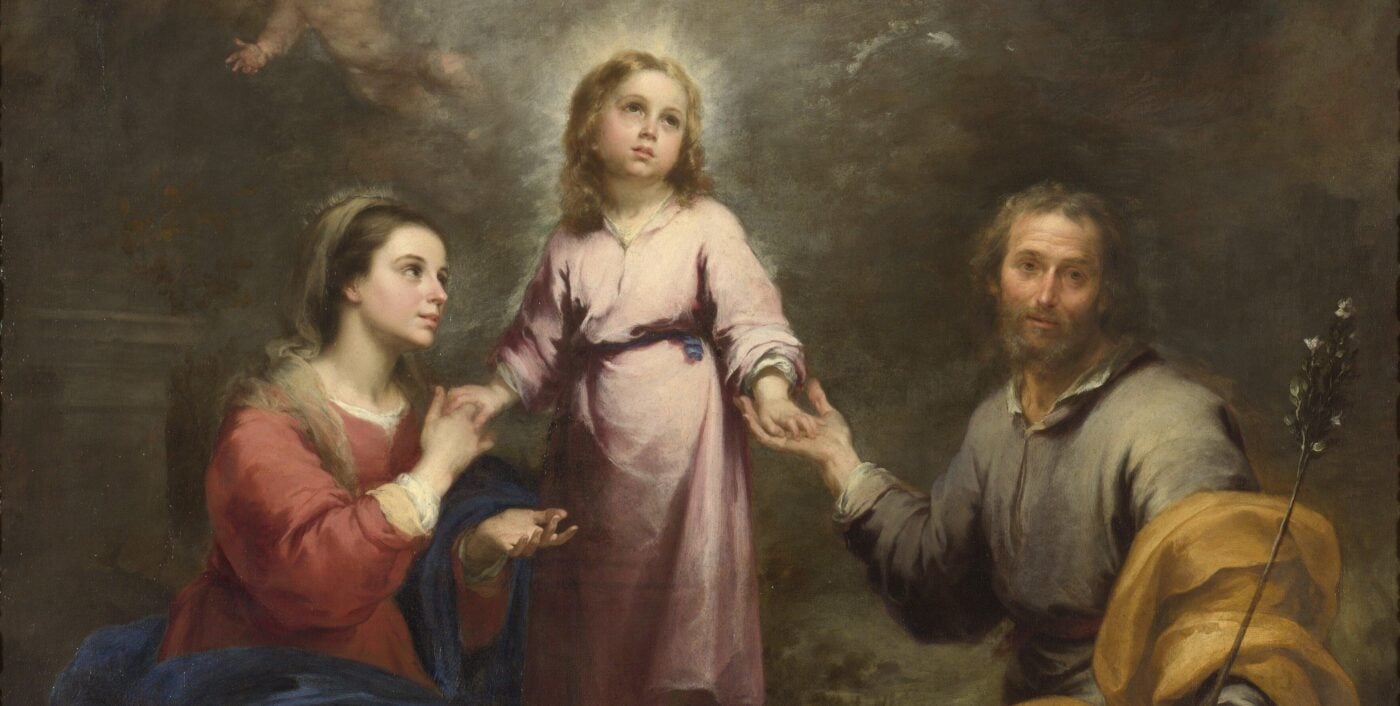
The Holy Family offers us a beautiful model to follow in our own families, even though Scripture reveals so little about the “hidden years” before the time of Jesus’ public ministry.
We are invited to imagine the love that poured forth from their little home, the abundant peace palpable to anyone who entered in, the joyful welcome to any guest, the cleanliness of each room down to every corner, the fresh and delicious smell of warm bread baking in the oven, ready to be served to an unexpected visitor. There would have been a smile ever waiting for a neighbor who happened to pop by, a sage piece of consoling advice, a token gift to be taken home to the kids. It would have been the best place to be!
Jesus, Mary, and Joseph would have absolutely cherished their home, and gratitude scarcely describes how they would have felt to be living there. Anyone who entered their home would have relished their time in this sacred space. Anyone would have felt grateful for the opportunity to be in the intimacy of their presence. The home of the Holy Family would have been, quite literally, heaven on earth, for the presence of God was there.
So this is the model we are given to follow in our own families. Which makes our own example fall rather short of the ideal! We love our family, but we don’t spend our days whispering sweet nothings in each other’s ears. Sometimes the things we have to “whisper” are a few decibels louder than they should be—and our words are not always spoken in charitable ways. We are human, after all, and we are not “full of grace” as was Mary. We don’t have it in us to keep our words and actions looking as clean and spotless as those of the Holy Home.
But this is not what concerns us most about how short we fall of the example of the Holy Family. What concerns us most is our utter and frustrating inability to clean up the mess that lies on the inside of our hearts.
Cleanse first the inside of the cup, so that the outside also may be clean. (Mt. 23:26)
All of us have struggles with relationships—resentment, envy, exasperation—that we cannot seem to change. We know that we “should” let things go, take the higher ground, not concern ourselves with how others behave…but concern ourselves we do. During prayer time, we can imagine ourselves as perfectly patient and peaceful in the presence of the one we find difficult to love. But in their presence, we cannot imagine putting such virtue into practice at all! How do we ever become like the Holy Family? What must we do?
“What can you do to strengthen your resolutions and make them succeed? There is no better mean than to put them into practice…In this life…we shall always have to labor.” —St. Francis de Sales
It sounds almost too simplistic, but the only way to grow in the virtues that were those of the Holy Family is to put them into practice. Daydreaming and envisioning ourselves as perfectly patient is not the same as practicing patience. We must formulate a plan of holiness that we will put into practice. But before we do, let’s understand: the Holy Family had to formulate and follow this plan too.
While it is entirely conceivable that all we imagine about their hidden life is accurate—the peace, the love, the joy, the welcoming, the fresh bread, the immaculate home—let’s also understand, they had to work to get there! Mary was “full of grace,” but she still experienced temptation. And Jesus, fully divine though He was, was also fully human, “tested in every way” (Heb. 4:15). In other words, the Holy Family indeed had abundant love and peace and joy in their hearts, but they also experienced struggle. How do we know this? Because Scripture tells us as much:
But she was greatly troubled at what was said. (Lk. 1:29)
Joseph her husband…decided to divorce her quietly. (Mt. 1:19)
His mother said to him, “Son, why have you done this to us? Your father and I have been looking for you with great anxiety.” (Lk. 2:48)
They did not understand what he said to them. (Lk. 2:50)
If feeling “greatly troubled,” having “great anxiety,” or not “understanding” our circumstances has been our experience, then we don’t “fall short” of the experience of the Holy Family! Such was their experience too. Their example is not meant to place an unrealistic expectation upon us as they stand upon a pedestal, looking down upon our weak and broken families. It is precisely the opposite: the Holy Family teaches us how to address our weaknesses and brokenness that are a part of every human family.
Joseph was a forgiving man because he practiced forgiveness. Mary, in the face of temptation, exercised trust. Her Immaculate Conception and the fact that she was full of grace did not prevent her from feeling “greatly troubled” or having “great anxiety” in her greatly distressing circumstances. Though the perfection of all virtue, Jesus still exercised obedience—He could have lorded His divine authority over His earthly parents, but not once did He disobey them. Mary didn’t ruminate, nor did Joseph accuse. The Holy Family did none of these things because they chose not to, through an act of the will.
We must be very careful when judging our “progress” in the spiritual life. We must not use our feelings as our measuring stick. Of course, any of us would love to eliminate our ugly feelings—our resentment, our envy, our exasperation. But if we are begging the Lord to help us grow in virtue, then we cannot expect Him to take all these miserable feelings away. Why? Because every time we struggle with repugnance, with doubt, with resentment, with envy—and yet, choose to do what is holy and pleasing in His sight anyway—then we become more and more like the Holy Family!
Doing the thing we “feel” like doing anyway is not to practice virtue; that is called “grace.” The Holy Family was not holy because they “felt” holy; they were holy because they chose holiness at every moment of their lives. This is the model of holiness that we are asked to follow.
So, in our morning prayer, let’s understand and imagine our goal. Let us take the time to formulate the plan to achieve that goal by asking the Lord in the silence of our hearts what He would have us do. And then, as Mary advises, let us put this plan into practice by doing “whatever he tells [us]” (Jn. 2:5).
Author’s Note: Excerpt from: 26 Steps With the Mother of God: A Treatise on the Life of Mary by M.C. Holbrook.
Image from Wikimedia Commons