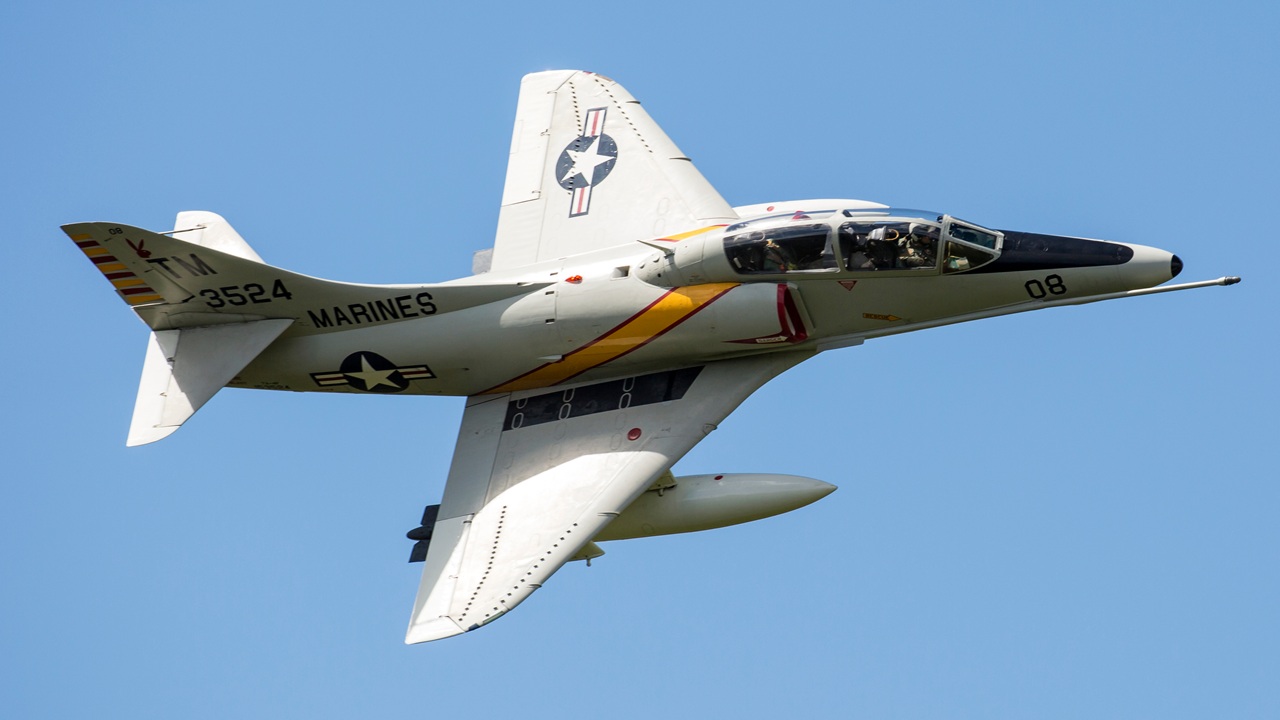
The A-4 Skyhawk was designed as a small and nimble dogfighter—the same design principles used for Soviet aircraft, making it useful as a stand-in.
The aircraft people remember from the film Top Gun is the F-14 Tomcat. This is no surprise, given that the Tomcat is the star of the show. More invested fans will likely also remember the fictional MiG-28, in reality an American F-5 dressed in black and red livery. But few remember the other aircraft displayed in the film, the A-4 Skyhawk.
While the A-4’s screen time was brief relative to the F-14 and the “MiG-28,” the A-4’s role, as an adversary trainer, was not fictional—it mirrored real US Navy training habits. In fact, the A-4 was one of the most effective adversary trainers the Navy ever flew.
The A-4 Skyhawk’s Specifications
- Year Introduced: 1956
- Number Built: ~2,960 (all variants)
- Length: 40 ft 3 in (12.3 m)
- Wingspan: 27 ft 6 in (8.38 m)
- Weight (MTOW): ~24,500 lb (11,100 kg)
- Engines: One Pratt & Whitney J52-P-8A turbojet (≈9,300 lbf / 41 kN thrust)
- Top Speed: ~670 mph (1,080 km/h) ≈ Mach 0.9
- Range: ~2,060 mi (3,315 km) ferry
- Service Ceiling: ~42,000 ft (12,800 m)
- Loadout: Two 20mm cannons; five hardpoints; up to ~9,900 lb (4,490 kg) of ordnance
- Aircrew: 1
How the A-4 Skyhawk Got a Second Lease on Life
Designed in the 1950s by Ed Heinemann at Douglas, the A-4 was nicknamed “Heinemann’s Hot Rod.” The aircraft was built specifically for use as a lightweight carrier-based attack aircraft. It was designed to be simple, cheap, and reliable.
The A-4’s defining feature was its small size. In fact, unlike most Navy airframes, the Skyhawk didn’t even need the folding wings often required to facilitate storage within the cramped confines of an aircraft carrier; it was simply so compact that it could be stored with its wings fully extended. In addition to saving space, the A-4’s design philosophy also emphasized low weight, ease of maintenance, and high agility—all features that made her valuable to the Navy.
By the 1960s and 1970s, the A-4 was no longer as cutting-edge, and was being phased out of frontline service in favor of newer jets like the F-14 However, the Navy had also come to realize that training pilots against mirror-image US aircraft was misguided, as there would not be pure symmetry in engagements with Soviet fighters. Instead, pilots needed exposure to dissimilar threats, which would more closely represent the conditions of fighting the Soviets in the air.
It so happened that the A-4 lined up well with expected Soviet fighters. Heinemann’s design philosophy had much in common with the Kremlin’s; both the A-4 and Soviet fighters had a small visual signature, a high roll rate, and good sustained turn performance. Accordingly, the A-4 could effectively stand in for the MiG-17, MiG-19, and MiG-21. And the A-4’s lack of radar or BVR weaponry forced pilots to dogfight within visual range, which is how the Navy wanted to train its pilots.
The A-4 Could Often Defeat “Better” American Aircraft
The A-4 had an excellent instantaneous turn rate. Low wing loading meant the aircraft was maneuverable at low and medium speeds, ideal for dogfighting engagements. The controls were very responsive, allowing for nimble agility. And the A-4’s modest top speed meant the aircraft couldn’t simply run away; it had to stay in the merge and fight. In a dogfight, the A-4, if flown well, could embarrass heavier frontline fighters, like the F-4 or F-14, and punish sloppy energy management, forcing US pilots to fly at their best.
The A-4 was used at the real Navy Fighter Weapons School, aka TOPGUN, and in Navy and Marine adversary squadrons, with pilots trained to fly enemy tactics. The depiction of the airframe in that role in Top Gun is accurate. Sometimes the A-4 was even painted in Soviet-style camouflage, complete with Red Star markings. And the A-4’s mechanical simplicity made it cheap to operate, which was ideal for high-sortie adversary work, with a minimal maintenance burden relative to frontline fighters.
Top Gun served as something of a swan song for the A-4; at the time the movie was filmed, the jet was near the end of its Navy career. The aging airframe had limited growth potential, and could not realistically mimic newer Soviet fourth-generation fighters or high-speed BVR combat. The jet was replaced in the adversary role, first by the F-5 (aka Top Gun’s MiG-28), and later by F-16 and F/A-18s.
About the Author: Harrison Kass
Harrison Kass is a senior defense and national security writer at The National Interest. Kass is an attorney and former political candidate who joined the US Air Force as a pilot trainee before being medically discharged. He focuses on military strategy, aerospace, and global security affairs. He holds a JD from the University of Oregon and a master’s in Global Journalism and International Relations from NYU.
Image: Shutterstock / BlueBarronPhoto.