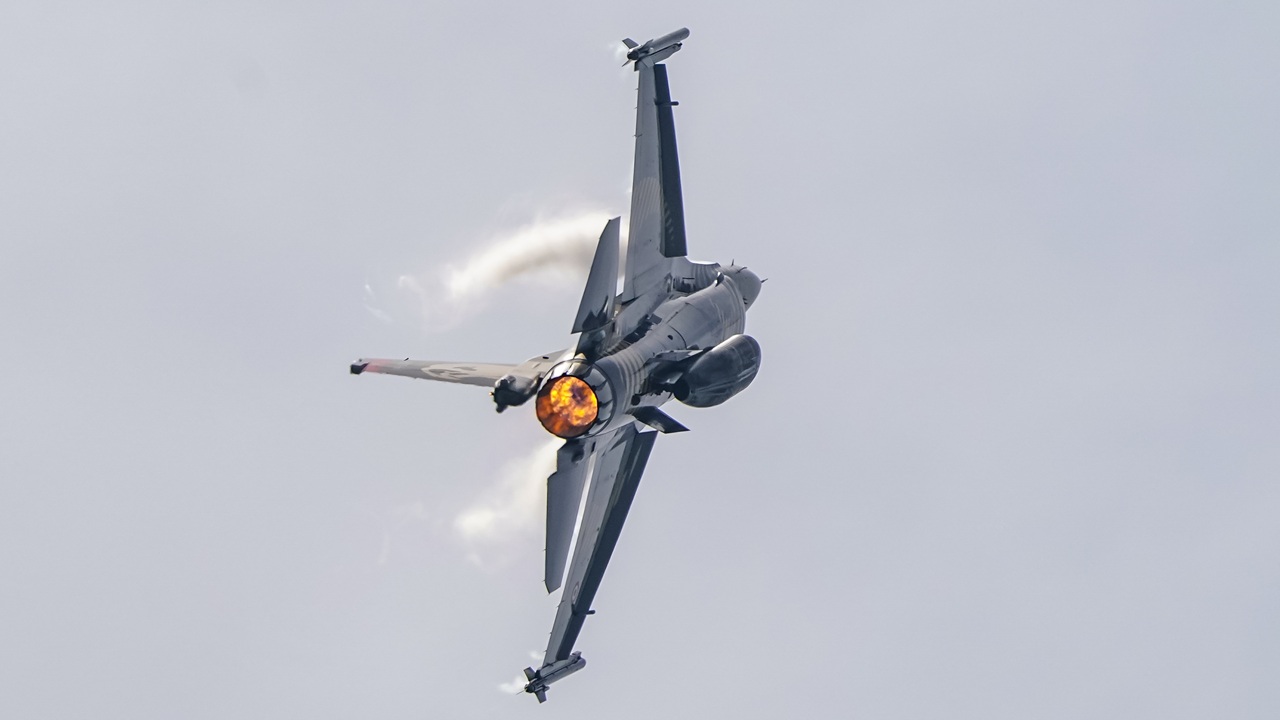
Pilots sometimes need to operate at slow speeds—during tight turns and landings, for instance—and good low-speed handling is the hallmark of a great fighter jet.
People tend to associate raw speed with the performance, indeed the success, of a fighter aircraft. But good low-speed handling remains an almost equally critical component of fighter performance. Even as combat shifts towards beyond-visual-range (BVR) fighting, sensors and data fusion, and long-range missiles, low-speed performance is still important for a variety of reasons: close-in fighting (should it happen), carrier landings, high-angle-of-attack maneuvering, and recovery from energy-depleted states.
It’s Easy to Fly a Plane Fast—but Sometimes You Need to Fly It Slow!
Low-speed handling does not simply mean the aircraft can fly slow. It means the aircraft is controllable near a stall; that the aircraft has a predictable control response; is resistant to departure and spin. The metrics dictating low speed performance are the stall margin, buffet onset, control authority, and the energy bleed rate.
Several aerodynamic factors determine low-speed performance. Wing loading is a key aerodynamic measure, in which an aircraft’s total weight is divided by its wing area, indicating how much weight each square foot of wing surface supports. Wing loading dictates performance—affecting stall speed, take/off landing distances, and turbulence sensitivity. Lower wing loading results in better lift at low speeds, improving low-speed handling, whereas higher wing loading leads to a higher stall speeds, which can make handling at low speeds more precarious. In addition to wing loading, the wing design itself can dictate low-speed performance.
Large wings with leading-edge devices improve low-speed lift; swept wings trade low-speed lift for high-speed efficiency. Lift-enhancing features, like leading-edge slats, flaps, or vortex-generating strakes (LEX), can improve low-speed performance. Thrust-to-weight ratio is a factor, too; high thrust can mask poor low-speed aerodynamics, giving the pilot a greater margin for error, a way to quickly regain lost energy.
Modern fighters feature flight computers that interact with low-speed handling performance. Fly-by-wire systems operate with flight control laws that prevent departure. The advantages here are that the aircraft is allowed to operate safely near or beyond traditional stall limits; post-stall maneuvering is even possible. But the downside is that the pilot is partially filtered out of the control process, allowing for less instinctual flying, so low-speed handling can sometimes be more artificial than purely stick-and-rudder aerodynamics.
The Many Benefits of Good Low-Speed Handling
The benefits of strong low-speed handling characteristics are many. Although “dogfighting” has become somewhat outdated, low-speed handling allows for tighter turns and better nose authority for gun/short-range missile shots. In an energy-depleted situation, adequate low-speed handling performance allows for a safer escape and recovery. In carrier operations, which require an aircraft to land at relatively low speeds, adequate performance in this envelope is obviously desirable. And in training, aircraft that are more forgiving at low speeds reduce accident rates and improve the training pipeline. Ultimately, low-speed handling allows the pilot to trust the aircraft more.
Examples of aircraft with strong low-speed handling include:
- The F-16 Fighting Falcon (low wing loading, relaxed stability);
- The F/A-18 Hornet (carrier-optimized and forgiving); and
- The A-4 Skyhawk (light with high lift).
Meanwhile, other aircraft with poor low-speed handling suffer from a high stall speed, which makes landing riskier and increases accident rates. These aircraft tend to spin more easily, and can bleed energy too quickly, become vulnerable in prolonged engagements, and force pilots to rely on speed and altitude, to rely on avoidance rather than maneuverability. Examples of aircraft with poor low-speed handling include:
Low-speed handling is far less visible than top speed or stealth performance—but no less important. As long as pilots fly fighters, controllability at the edge of the envelope will matter.
About the Author: Harrison Kass
Harrison Kass is a senior defense and national security writer at The National Interest. Kass is an attorney and former political candidate who joined the US Air Force as a pilot trainee before being medically discharged. He focuses on military strategy, aerospace, and global security affairs. He holds a JD from the University of Oregon and a master’s in Global Journalism and International Relations from NYU.
Image: Shutterstock / EvrenKalinbacak.