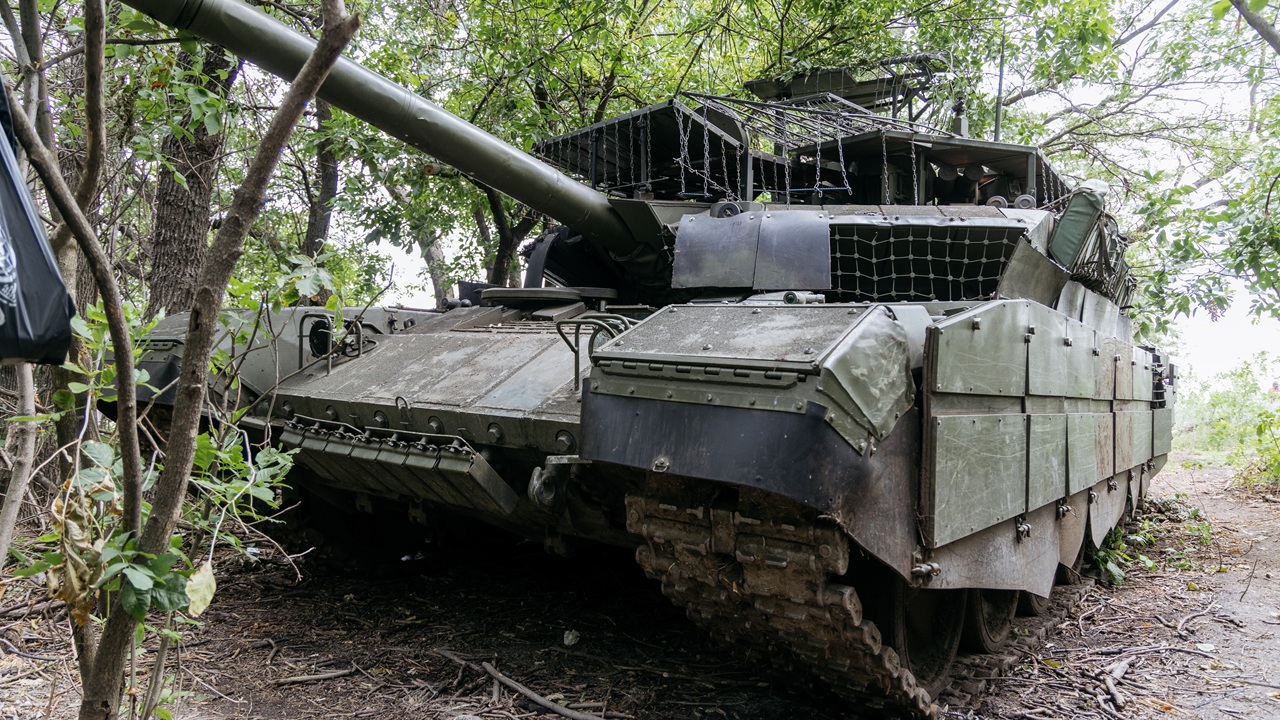
By strapping shipping containers to its tanks, Russia apparently hopes to improve protection against drones—but the resulting vehicles seem highly impractical for battlefield use.
This is the time of year when strange things might be shipped around the world just in time for the holidays. However, a video circulated on social media this past weekend that appeared to show a pair of Russian tanks not in shipping containers, but instead covered by the massive metal crates.
It was apparently part of the latest efforts to counter attacks by drones and man-portable anti-tank weapons by transforming an MBT into a “turtle tank.”
The resulting armored vehicle looks just as ridiculous as it sounds—and may be less effective than Russia’s other efforts to up-armor its tanks.
Repurposed Shipping Containers as Armor: Simple or Stupid?
As Maritime Executive reported, it isn’t uncommon for old shipping containers to find a second life after they are no longer fit for “oceangoing service.” This can include inventive uses such as “storage sheds, shop spaces, mobile offices, housing, even indoor aquaculture ponds.”
Few would have expected that at least two inventive tank crews would place a cut-up shipping container over their tanks. The armored vehicles were believed to be T-80BVMs, but this has not been confirmed.
“The expediency of the material is a clear advantage: very little fabrication is required when starting with a premade box, and the result adds just a few thousand pounds in weight,” the Maritime Executive added.
The exact location where the tanks were spotted also isn’t known, but according to the Region 22 channel on the Telegram social messaging app, it was somewhere in the eastern parts of Ukraine, now occupied by Russian forces.
The video has since made the rounds on X and other platforms, where the effectiveness has been debated. Some accounts that are linked to Russia have suggested this could be successful in stopping loitering munitions and drones from damaging a tank while in storage, and that the containers were only placed on the chassis until the tanks can move into combat.
Are Shipping Containers Effective as Armor? Probably Not
Obviously, it wouldn’t be without drawbacks. It limits the view for the commander, gunner, and even the driver, but also makes it impossible to turn the turret as long as the container is present. Although a shipping container could likely stop small-arms fire and keep a drone from damaging the tank, it dramatically increases the vehicle’s profile, making it a much larger target.
“It is worth noting that standard sea containers have relatively thin walls, typically 1.5–2 millimeters thick. They are made of corten steel, which is not designed to provide ballistic protection,” added Militarny.com.
The turret and engine compartment have some added protection, but the treads are still exposed.
Moreover, holes likely needed to be cut in the rear to provide ventilation so that the engine exhaust can escape, lest the crew asphyxiate themselves. Even a relatively small hole could present a weak spot that drone operators might seek out, rendering the entire effort futile.
The shipping containers are just the latest in a series of attempts to counter drones and protect the tanks. It followed “cope cages” that consisted of metal grids, wire mesh, and even shed-like superstructures. Other efforts have included wooden logs and sheet metal. Most of these have serious drawbacks—but probably nothing like throwing a sea container over the hull!
About the Author: Peter Suciu
Peter Suciu has contributed over 3,200 published pieces to more than four dozen magazines and websites over a 30-year career in journalism. He regularly writes about military hardware, firearms history, cybersecurity, politics, and international affairs. Peter is also a contributing writer for Forbes and Clearance Jobs. He is based in Michigan. You can follow him on Twitter: @PeterSuciu. You can email the author: [email protected].
Image: Shutterstock / Eugene Symonenko.