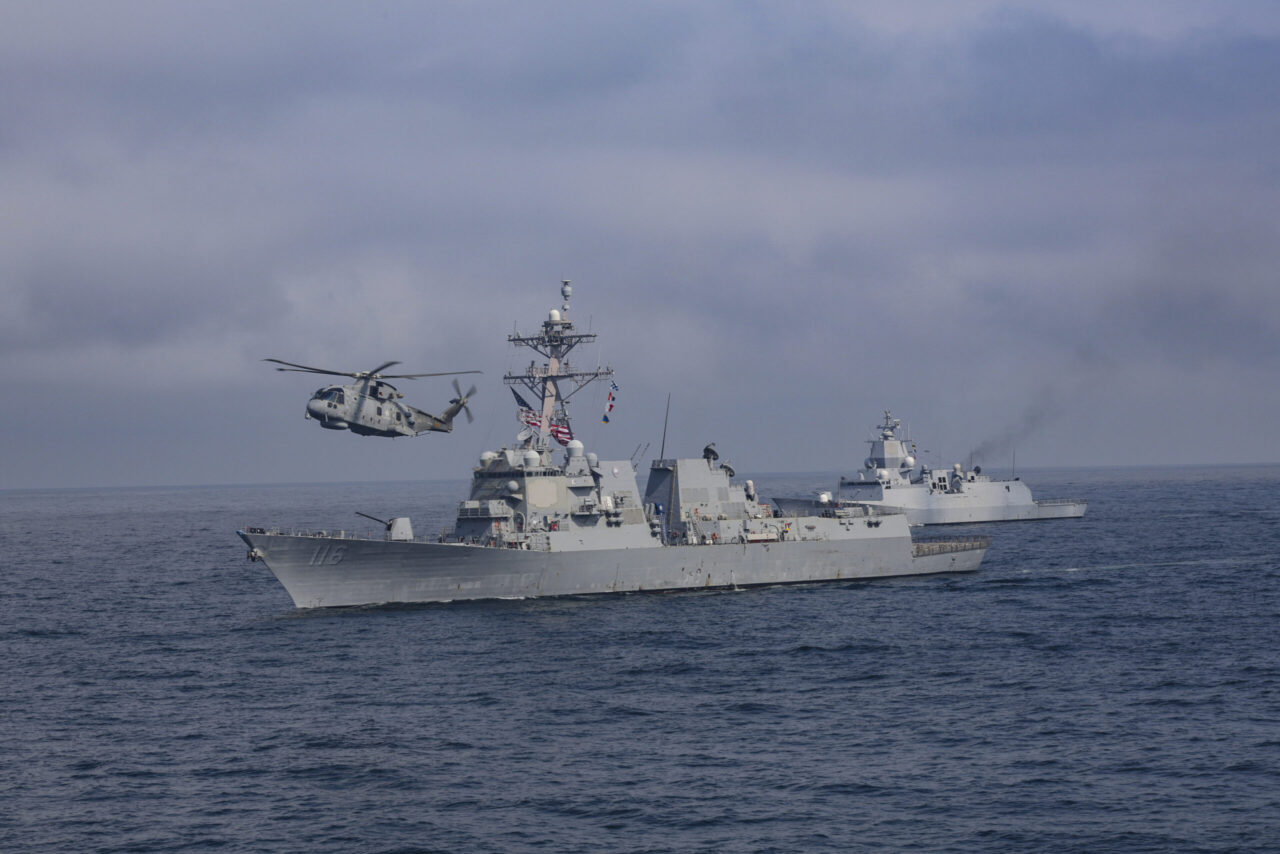
The Arleigh Burke-class destroyers, which can conduct anti-surface warfare, anti-submarine warfare, and air defense operations, are the cornerstone of the Navy’s surface combatant fleet.
In December, the US Navy began operational testing of its first Flight III Arleigh Burke-class destroyer.
The USS Jack H. Lucas is currently undergoing intensive testing and evaluation to assess its new generation of surface combatant capabilities.
Flight III Lead Ship Testing
The USS Jack H. Lucas has been designated by the chief of naval operations, the most senior officer in the Navy, as the initial operational test and evaluation campaign ship. In this role, the ship undergoes significant testing under different operational and training conditions to develop the technological requirements for the rest of the class.
“In order to rapidly transition this technology to the fleet and to get it out on the front line, Jack H. Lucas was designated as the IOT&E campaign ship, and we push on a very aggressive schedule to test underway while going through different scenarios,” Captain Andy Bucher, the ship’s commanding officer, said in a service press release.
The USS Jack H. Lucas was commissioned in 2023.
“Jack H. Lucas is tasked with taking the technology to sea, to test it, and then to rapidly and iteratively build on that so that we meet the requirements to maintain that war-fighting edge,” Bucher added.
Arleigh Burke-class destroyers are the cornerstone of the Navy’s surface combatant fleet. With approximately 73 destroyers in service and several others in order. The destroyers can conduct anti-surface warfare, anti-submarine warfare, and air defense operations.
Flight III Arleigh Burke-destroyers can carry nearly 100 missiles, including Tomahawk land-attack cruise missiles, Harpoon anti-ship missiles, air defense missiles, and torpedoes.
The Arleigh Burke Is a Warship With a Powerful Radar
One of the most advanced features of the Flight III design is its radar. The USS Jack H. Lucas packs a powerful AN/SPY-6(V)1 Air and Missile Defense Radar (AMDR), which is the most powerful radar ever fielded on a Navy surface combatant. Previous versions of Arleigh Burke-class destroyers carry the SPY-1D(V).
Chief Sonar Technician (Surface) Nicholas Cederblom provided a vivid picture of what it is like going from the older version of the SPY radar to the AN/SPY-6(V)1 AMDR.
“It’s like going from a flip phone to an iPhone,” he said. “It does the calling, it does the texting, but it does so much more. And moving from that system into the advanced capabilities build, what we have right now, definitely is a lot more. No one else has done this.”
According to the Navy, the SPY-6 provides much better sensitivity, enabling warships to detect, track, and discriminate smaller, faster, and more complex threats across longer ranges. In the age of unmanned naval and aerial weapon systems, this ability to track smaller threats in more complex environments could spell the difference between a warship being struck and taking out an incoming threat.
But installing a new radar is not such a simple proposition as it might appear on paper. Indeed, the AN/SPY-6(V)1 AMDR is larger and requires different power than its predecessor. Thus, its installation required a substantial redesign of the destroyer’s power and cooling systems, including an upgraded electrical plant, increased chilled-water capacity, and strengthened structural design to accommodate its increased power demands and larger size.
About the Author: Stavros Atlamazoglou
Stavros Atlamazoglou is a seasoned defense journalist specializing in special operations and a Hellenic Army veteran (national service with the 575th Marine Battalion and Army HQ). He holds a BA from the Johns Hopkins University and an MA from the Johns Hopkins’ School of Advanced International Studies (SAIS). His work has been featured in Business Insider, Sandboxx, and SOFREP.
Image: DVIDS.