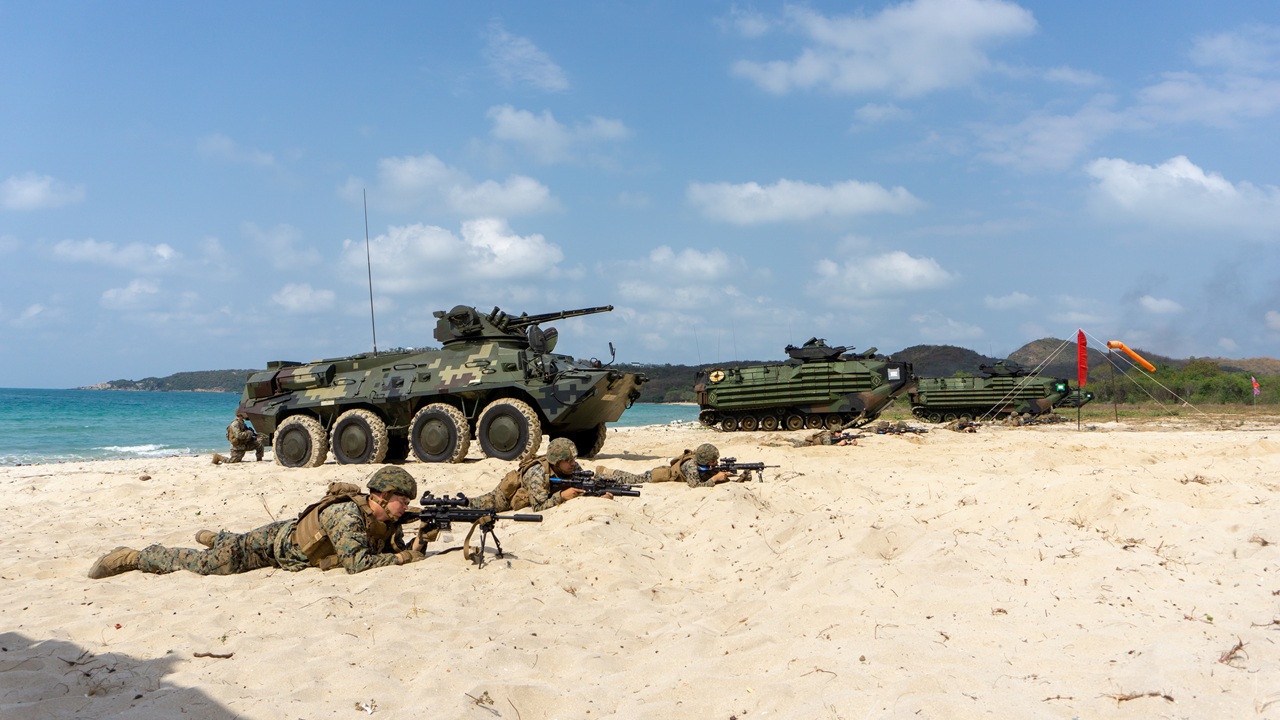
The loss of the Thai BTR-3E1 vehicle to Cambodian forces is likely to have been a fluke, as Thailand still holds the upper hand in the conflict.
Ukraine has become an arms exporter globally, despite being a nation invaded and under siege. Going back to the year 2007, the BTR-3E1 was an upgraded version of the BTR-3U from Ukraine’s Kharkiv Morozov Machine Building Design Bureau (KMDB). Ukraine’s KMDB partnered with multiple foreign companies and countries to sell the BTR-3E1 globally.
Thailand, a key nation in the Indo-Pacific, ordered at least 96 of these armored vehicles in 2007 and received that order in 2009-10. Bangkok has since ordered an additional 200 units.
Understanding the BTR-3E1 Armored Vehicle
- Year Introduced: 2007
- Number Built: 96 (with more than 200 on order)
- Length: 25.1 feet (7.65 meters)
- Total Weight, Battle Ready: 36,155 lbs (16,400 kg)
- Suspensions: Wheeled 8×8
- Engine: Deutz BF6M1015 Diesel (326 horsepower) or MTU
- Top Speed: 59 miles per hour (95 km/h) with a rear waterjet for water propulsion
- Range: Up to 528 miles (850 km) on roads
- Armament: One 30mm ZTM-1 Automatic Cannon (350 rounds), one 7.62mm PKT (2,500 rounds), Six 81mm smoke/aerosol launchers (three per side), and options of a 30mm Automatic Grenade Launcher (AGL) or ATGM launchers (like the Barrier-V)
- Crew: 3 crew (along with 6–7 troops)
The BTR-3E1 is an essential element of the Royal Thai Army (RTA). It is an armored personnel carrier (APC) on an eight-by-eight chassis. This system provides critical protection and firepower (as well as transportation) for infantry. Because of its mobility and armor, it serves in multiple combat roles including patrols.
These platforms are key elements for Thailand’s border security policies along their unstable border with neighboring Cambodia.
While the BTR-3E1’s armor is not as thick as the armor of a main battle tank (MBT), it has steel armor with Kevlar spall liner that affords decent protection for its users—notably against small arms and landmines. It includes modern sights, stabilization, and a central tire inflation system.
Because this platform is designed for use in Ukraine, it is highly interoperable with European subsystems, making the BTR-3E1 relatively easy and affordable for the RTA to maintain.
Thailand’s BTR-3E1 has a Shturm Turret, which is a remotely controlled system developed by Ukraine (and has proven most helpful for Ukraine’s Armed Forces in their war against Russia).
How Cambodia (Allegedly) Captured a BTR-3E1 from Thailand
With the Thai-Cambodia War erupting once more, the RTA has nearly every advantage over their Cambodian neighbors—and those advantages are decisive. Yet, as Michael Yon told me recently, no matter how professional and well-equipped the RTA is, because of the difficult geography their military faces, the RTA is always under the proverbial gun.
On paper, the RTA should be running circles around the Cambodians. In specific instances, however, the Cambodians are getting in some lucky shots.
This is precisely what happened recently, after the crew of a Thai Army BTR-3E1 armored vehicle had to abandon their vehicle during fighting near the Thai-Cambodian border. Cambodian forces filmed themselves claiming the vehicle and taking it back to Cambodia as a war trophy. According to Defence-Blog, this is the first confirmed loss of any major Thai military vehicle in the war.
For their part, Thai officials denied that the BTR-3E1 in question was captured by their Cambodian foes. Thailand’s military leadership argued that the vehicle in question became immobilized during combat operations along the border, and was eventually recovered by RTA forces.
Why Hasn’t Thailand Coasted to Victory over Cambodia?
Whatever happens next, it is obvious that the Royal Thai military has what’s known as “overmatch” capabilities over their Cambodian rivals. Interestingly, there is a thick layer of complex geopolitics that covers this war. While official sources claim the fight is over historic religious landmarks and business deals gone bad between the Cambodian elite and the ruling class of Thailand, independent war correspondent Michael Yon tells me that this is all meaningless.
Yon, who spent years working in Thailand and is heavily enmeshed with the Thai ruling class, says that this whole fight is about dominating energy, resource, and trade flows. China is backing Cambodia in a bid to dominate the immense energy resources of the Gulf of Thailand. For its part, Thailand is attempting to secure its position as the dominant player in the Gulf of Thailand while working to create alternative waterways to the Strait of Malacca.
In all, the great competition for dominance between states—and a proxy war between Beijing and Washington—are the causes of these events.
Thailand is winning. Let no one tell you otherwise. But they will take hits along the way. And as the fighting intensifies, it should be America’s place to stand beside Thailand as they essentially fight America’s battle in the Indo-Pacific.
About the Author: Brandon J. Weichert
Brandon J. Weichert is a senior national security editor at The National Interest. Recently, Weichert became the host of The National Security Hour on America Outloud News and iHeartRadio, where he discusses national security policy every Wednesday at 8pm Eastern. Weichert hosts a companion book talk series on Rumble entitled “National Security Talk.” He is also a contributor at Popular Mechanics and has consulted regularly with various government institutions and private organizations on geopolitical issues. Weichert’s writings have appeared in multiple publications, including The Washington Times, National Review, The American Spectator, MSN, and the Asia Times. His books include Winning Space: How America Remains a Superpower, Biohacked: China’s Race to Control Life, and The Shadow War: Iran’s Quest for Supremacy. His newest book, A Disaster of Our Own Making: How the West Lost Ukraine is available for purchase wherever books are sold. He can be followed via Twitter @WeTheBrandon.
Image: Shutterstock / The Mariner 4291.