Christmas is quickly approaching, and remembering to recognize it as a season offers an opportunity to extend its graces and lessons further into our lives.
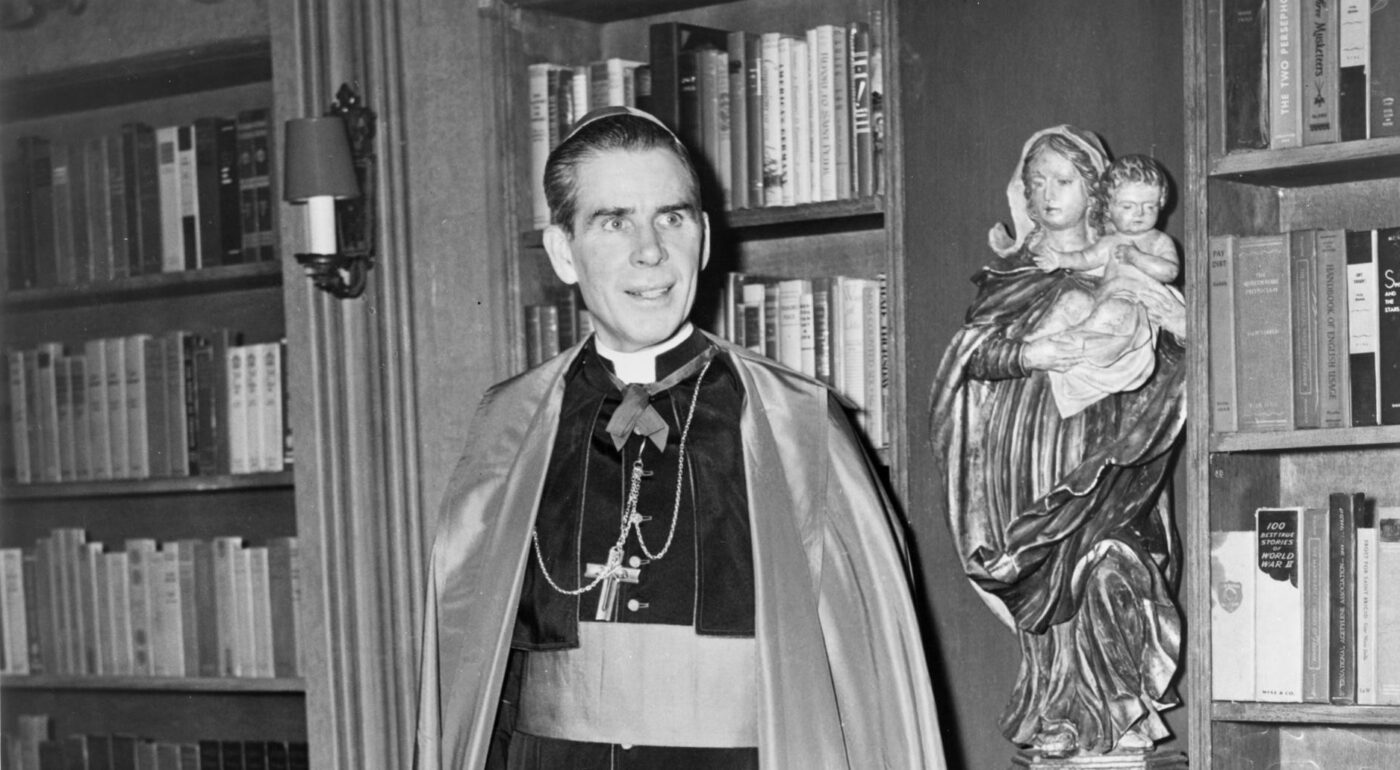
Venerable Fulton Sheen helps us to understand this reality well. Each year, in his syndicated newspaper column published close to Christmas day, he provided rich teaching, application to everyday life, and memorable turns of phrase that help deepen our insight into the Christmas mystery and apply it to our lives beyond December 25th.
Sheen’s understanding of Christmas—the reality he desired to convey to his audience—is captured by a single axiom. “Christmas,” he wrote in December 1969, “is not something that happened; it is something that is happening every day.” Nearly identical statements appear in many columns over many years. Essentially, he wanted to convey that the celebration of Christmas, every year, “means a summons to every human nature in the world to prolong the enfleshment of Christ” (column from Dec. 25, 1960).
The obvious follow-up question is how this “prolonged enfleshment” happens practically in the lives of real people living in the world. In these same Christmas columns, Sheen’s teachings point us to three ways Jesus can be—indeed, is—enfleshed in our lives and in the world. These include quiet repose, the sacraments, and virtue and mission.
The Quiet Stillness
Sheen was ever a proponent of repose, the need of the human spirit to slow down and spend quiet time listening to and reflecting on the Lord’s messages. This was a point he accentuated in his Christmas column from 1968.
He began by remarking how many modern people want to be “where the action is” or “where something is happening.” People generally have a “feverish love of excitement.” The point Sheen wanted to establish, though, was that an event, a happening, has meaning; and we should seek that meaning beyond the action.
Too often, he remarked, “we refuse to stay…long enough to find out what the Lord is telling us.” He concluded, “This is the meaning of Christmas for our day—letting the Lord reveal Himself by us standing still, being quiet, letting the winds of heaven play on the strings of our heart” (column from Dec. 22, 1968).
The Church gives us twelve days for the Christmas season: to sit in quiet, still repose, letting the Lord transform our hearts.
Jesus: Incarnate at our Baptism
Aside from prayerful repose, Sheen knew and taught that Jesus is also enfleshed in us and in the world through the sacraments.
In his 1958 Christmas column, titled “What Is Christmas?”, America’s bishop taught: “Christmas is both an event in history and an event in every human life.” We know, he continued, that Jesus’ birth in Bethlehem was an event in human history. But what of Christmas—Jesus’ birth—in every human life?
He reminded readers that just as the Divine Nature had to enter the world, so humans could not access the Divine Life unless God would “come down to us and elevate our nature to be something that it could not be of and by itself.” This birth takes place specifically through Baptism, and the other sacraments are extensions of that first sacrament.
Thus, he wrote, it is a tragedy that every human person is not baptized and granted access to the divine life. Because Baptism is Christmas—that is, Jesus’ Incarnation—in a person’s soul, we ought to have an “eager desire that every person in the world be made merry by having Christ born in his poor heart…” (column from Dec. 21, 1958).
Virtue & Mission
Once the grace of the sacraments takes root in a person’s life, virtue and mission become natural ways that Christian disciples can incarnate the love of Jesus for others. Sheen wrote this exhortation, too, as part of his Christmas messages.
Virtue is like a “second Bethlehem,” he stated. It develops in the humble circumstances of everyday life, and “[it] drives away other guests of the heart such as pride, lust, avarice, hatred, selfishness, greed” (column from Dec. 23, 1962). In another column, he taught specifically on a foundational Christian virtue: “Christmas means the exaltation and glorification of the spirit of the child, which is just another word for humility” (column from Dec. 20, 1964). Finally, the bishop employed the image of a five-pointed start, drawing from that central image in the Nativity story. The real celebration of Christmas means extending Jesus’ humility, compassion, sacrifice, and love by our lives to others (column from Dec. 22, 1957).
He announced this again, specifically, in his 1969 column, titled “Christmas Occurs Daily As God Seeks Out Man.” Sheen wrote of the one whose life has been turned around and upside down by Jesus; “Once he becomes passive in surrender, he becomes active toward others. All the good that is done to others is inspired by Him who did good to us” (column from Dec. 21, 1969). The Lord sends us on mission to the person next door or to the peoples around the world.
Sheen’s Christmas columns reveal that the reality of Christmas turns each day into a decision point—a “Kairos” moment, as he wrote in 1969. This moment is when we have an opportunity to respond to Jesus’ invitation: “I want to give you an infusion of light for your mind, a power for your will, and a joy for your heart. What does it profit Me if I am born in Bethlehem and am not reborn in your hearts?” (column from Dec. 25, 1966). So, whether on December 25th or any other day or season throughout the year, we are called to ensure Jesus becomes incarnate in us, first through repose and sacraments, and then through virtue and mission in charity.
Image from Wikimedia Commons