The Air Force’s ASM-135 missile test in 1985 was the first kinetic destruction of a satellite in orbit. It would not be the last.
In September 1985, the US Air Force used an F-15 Eagle to destroy an orbiting satellite. The event remains one of the most unusual demonstrations of air power in history—showing that space was not a sanctuary, and that the common fighter jet could be used as a space denial weapon. The test revealed the technical reach of US air power, while serving as a warning to the strategic dangers of weaponizing space in the decades to come.
Military Planners Have Always Thought About Satellites
During the Cold War, satellites began trending towards the central role they have come to occupy in the way humans live their lives. The “Space Race” began in 1957 with the launch of the Soviet Sputnik-1 satellite, the first artificial satellite in human history. The following year, Congress created NASA, which began to pursue its own satellite program.
By the 1980s, satellites had become essential for reconnaissance, early warning, and communications, causing both the US and USSR to worry about satellite vulnerability. Space had become a critical frontier, yet remained largely undefended; the US began exploring multiple anti-satellite weapon (ASAT) concepts, from ground-launched interceptors to space-based systems to air-launched weapons—the latter of which proved promising, with the offer of flexibility, surprise, and rapid deployment.
On September 13, 1985, an F-15A Eagle was outfitted with an ASM-135 ASAT missile, and tasked with destroying a defunct US research satellite, the Solwind P78-1. The mission profile was fairly straightforward; the F-15 climbed steeply to 38,000 feet, accelerated to supersonic speed, and then released the ASAT missile. The result was a kinetic (e.g. non-explosive) intercept of the satellite at 345 miles altitude, destroying it.
How the ASM-135 Missile Worked
The ASM-135 was a two-stage missile, measuring 18 feet long and weighing 2,600 pounds. After being released, a booster propelled the ASAT upward. Then, a second stage guided the payload into space. The final stage was used as a kinetic kill vehicle, relying upon precise guidance and velocity. There was no explosive charge.
The interception required extreme navigation accuracy, obviously, to collide with a satellite orbiting at 345 miles above the Earth. The timing needed to be perfect, which required sophisticated tracking data. The guidance system relied on inertial navigation, to start, and infrared homing in the terminal phase.
While the test was successful, it was also controversial. The destruction of the Solwind P78-1 created large amounts of orbital debris, raising fear of escalation or an arms race in space. Political pressure mounted, and Congress ultimately cut funding for the program in the late 1980s.
But the strategic implications were already clear. Satellites were vulnerable. Space assets could be targeted from Earth. This signaled to adversaries that the US possessed credible ASAT capabilities—but also demonstrated mutual vulnerability and debris risks that affected all space users.
In the four decades since the F-15 ASAT test, the United States has never knowingly repeated an air-launched ASAT intercept. Other nations have, however, including China, Russia, and India. The United States’ focus in space has also shifted towards electronic warfare and cyber attacks—measures with reversible effects, without the debris-causing kinetic destruction of an ASAT.
Today, the 1985 ASAT test serves as both a technical triumph and a warning, demonstrating both extreme capability and strategic risk. The fact that the test has never been repeated speaks to the profound concerns such satellite destroying capabilities raise.
About the Author: Harrison Kass
Harrison Kass is a senior defense and national security writer at The National Interest. Kass is an attorney and former political candidate who joined the US Air Force as a pilot trainee before being medically discharged. He focuses on military strategy, aerospace, and global security affairs. He holds a JD from the University of Oregon and a master’s in Global Journalism and International Relations from NYU.
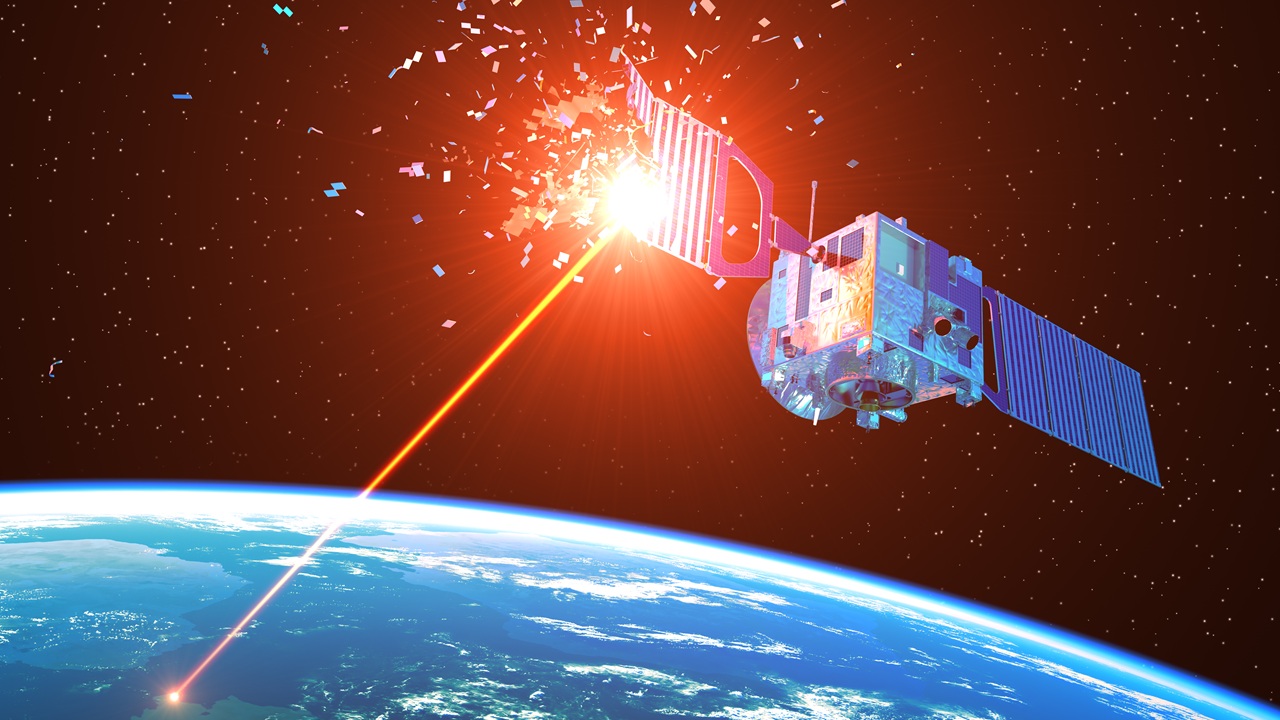
Image: Shutterstock / 3Dsculptor.