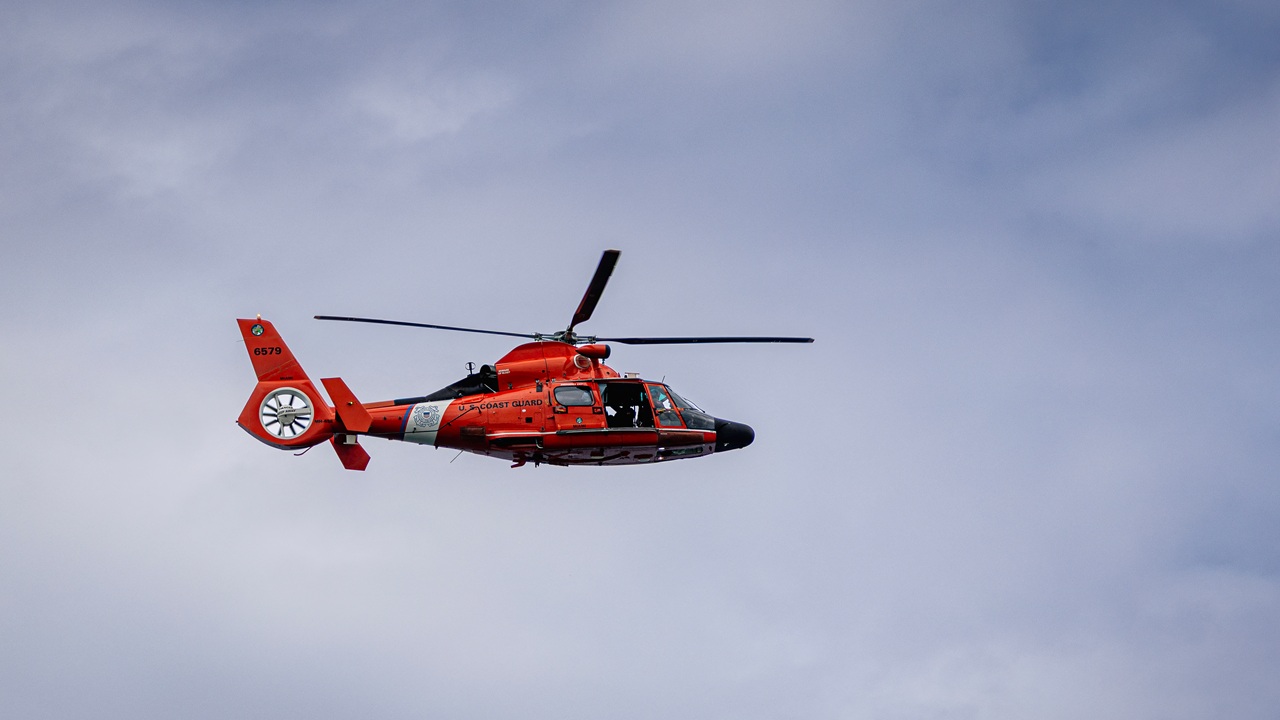
The MH-65 is used extensively by the US Coast Guard for rescue missions—and is ideally tailored for the perilous conditions the service often faces.
The MH-65 Dolphin is the US Coast Guard’s workhorse helicopter, the most recognizable platform in the service. Seen constantly in search and rescue missions, maritime patrol, and drug interdiction, the MH-65 is compact, fast, and distinctive—with its red, white, and blue livery, a sharp departure from drab color ways of other military helicopters. And while the MH-65 isn’t a glamorous machine, it is perfectly optimized for its Coast Guard mission set.
The MH-65 Dolphin’s Specifications
- Year Introduced: 1985
- Number Built: ~102 (for US Coast Guard)
- Length: 41 ft 1 in (12.5 m)
- Rotor Diameter: 39 ft 0 in (11.9 m)
- Weight (MTOW): ~9,700 lb (4,400 kg)
- Engines: Two Turbomeca Arriel 2C2-CG turboshafts (≈853 shp / 636 kW each)
- Top Speed: ~210 mph (338 km/h)
- Range: ~400 mi (645 km)
- Service Ceiling: ~18,000 ft (5,490 m)
- Loadout: Rescue hoist, sensor turret; optional light weapons for interdiction
- Aircrew: 4 (2 pilots, flight mechanic, rescue swimmer)
Why the Coast Guard Needed a New Helicopter
In the late 1970s and early 1980s, the Coast Guard needed to replace its fleet of aging HH-53 Seaguards. The new helicopter needed to perform short-range response, with shipboard compatibility, and high reliability in harsh maritime environments.
After an initial review, the Coast Guard selected a militarized version of the Eurocopter AS365 Dauphin, which entered US service in 1985 as the MH-65 Dolphin. Unlike Army or Navy helicopters, the MH-65 was never designed for combat—instead being built for speed, responsiveness, and precision.
The MH-65 features two engines—a crucial redundancy feature for an aircraft that spends so much time operating over water. The airframe’s compact footprint allows for operation from cutters, small decks, and forward operating bases. The platform is equipped with a rescue hoist, night vision compatibility, and the advanced navigation and weather radar necessary to operate in the harsh conditions the Coast Guard is often charged with entering.
For a helicopter of the MH-65’s size, she is notably fast. Moreover, she’s highly stable while hovering, which is critical for hoist operations in heavy season. The MH-65 also offers excellent low-altitude handling, which is ideal for coastal operations, offering precise maneuvering near ships, cliffs, urban environments—wherever the Coast Guard is needed. And as mentioned, the twin-engine design offers redundancy in engine-out scenarios, or during ice buildups, or in high-wind conditions. Essentially, the platform is optimized for short, intense sorties not long endurance runs.
The MH-65 Has Saved Countless Lives
The Coast Guard relies heavily upon the MH-65 for coastal surveillance, port security, and disaster response. But the primary mission is search and rescue, where the MH-65 is dispatched for sinking vessels, medevac, and distressed mariners. The platform can deploy a rescue swimmer via hoist, and can operate in poor visibility or high sea states or in severe weather conditions.
The MH-65 is also periodically used for law enforcement and interdiction, frequently paired in this role with Coast Guard cutters. Occasionally, the MH-65 is armed, and can be used to fire warning shots or disabling fire. To be clear, though, the MH-65 is not a military platform, and would fare poorly if its targets were able to fire back.
Since entering service 40 years ago, the MH-65 fleet has undergone multiple upgrades. The engines have been improved; avionics modernized; flight control systems updated. These upgrades have extended the platform’s service life while improving reliability and reducing the maintenance burden. And the upgrades, emphasizing sustainment over replacement, hint at the Coast Guard’s constrained fiscal reality.
The MH-65 is not flashy—but it is amongst the most utilitarian and successful aircraft in US service. More than 40 years after its introduction, it is still in use, not because of technological sophistication, but for compatibility with its mission: saving lives and keeping America’s shores safe.
About the Author: Harrison Kass
Harrison Kass is a senior defense and national security writer at The National Interest. Kass is an attorney and former political candidate who joined the US Air Force as a pilot trainee before being medically discharged. He focuses on military strategy, aerospace, and global security affairs. He holds a JD from the University of Oregon and a master’s in Global Journalism and International Relations from NYU.
Image: Shutterstock / Wize Pixels.