
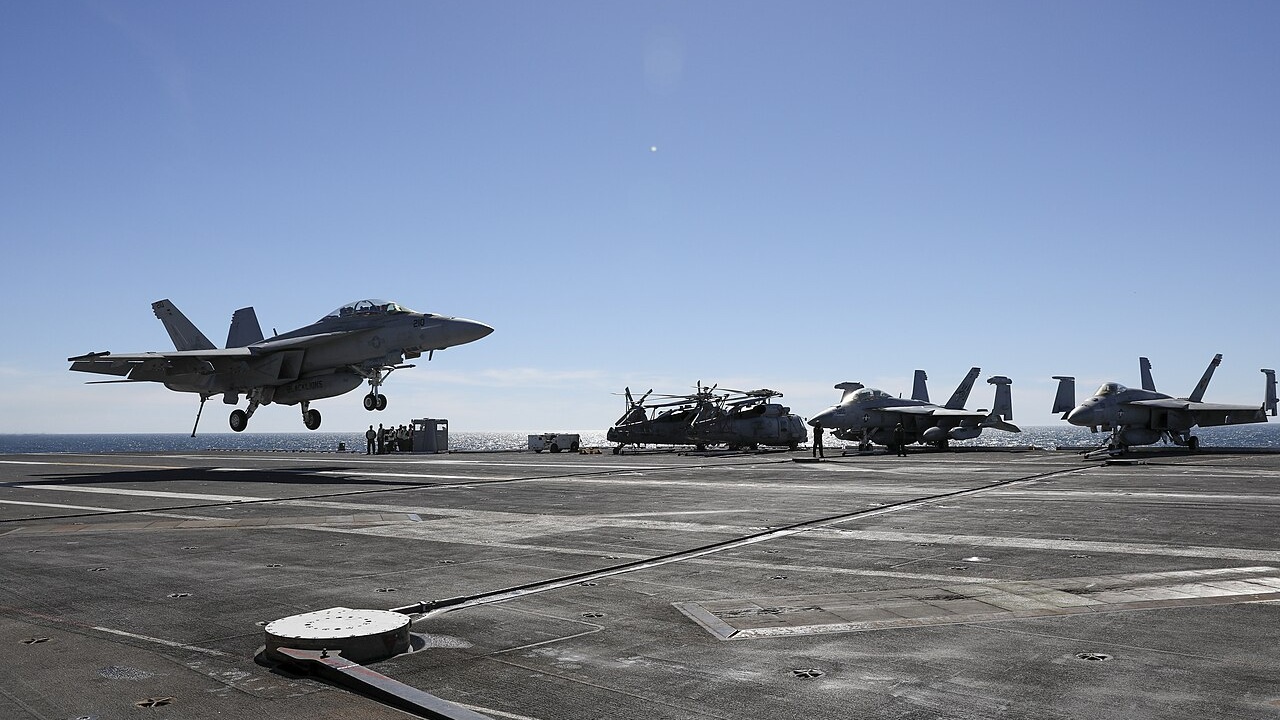
The Ford-class aircraft carrier’s AAG system is far better than the old steam-based hydraulic catapults—but the Navy has struggled with technical issues in its implementation.
For over 70 years, America’s aircraft carriers relied on hydraulic arresting gear for the recovery of aircraft. The system was reliable and proven—but mechanically outdated. So, with the cutting-edge Gerald R. Ford-class, the Navy introduced the Advanced Arresting Gear (AAG), a fundamental redesign of how carrier aircraft are recovered. Like the EMALS, AAG has faced technical hurdles, raising questions about whether the tech transition was worthwhile.
Why the Navy Built the Advanced Arresting Gear
The AAG replaces the Mk 7 hydraulic arresting system used on the Nimitz-class carriers. Developed by General Atomics, AAG was designed to recover heavier aircraft, like the F/A-18 and the F-35C, as well as lighter aircraft, like UAVs and future platforms—ultimately accommodating the full spectrum of carrier-capable aircraft as future fleets diversify.
The core idea, from a technical perspective, is to replace analog hydraulic braking with digitally controlled energy absorption. With traditional arresting gear, the aircraft snags a cable, which is attached to hydraulic pistons, offering fixed resistance. This resulted in a resistance that changed mechanically and slowly. In that sense, the hydraulic system was basically a one-size-fits all braking scheme. It was difficult to tune for lighter aircraft, and also required a heavy maintenance burden—limiting its upside for the Navy.
The AAG meanwhile uses electric motors, water turbines, and digital control systems, converting energy from a landing aircraft into rotational energy. The resistance is computer-controlled and adjusts in real time based on the weight and speed of the airframe. Basically, the AAG is smarter and more perceptive, more nuanced, and more capable of handling different types of aircraft. The AAG features a closed-loop digital control that responds instantly during landing. The water twisters absorb energy smoothly. And electric motors replace massive hydraulic systems while software determines the optimal deceleration profile for each aircraft. The result: more precise, smoother, and adaptable aircraft recovery.
In spite of its expense and technical hurdles, the advantages of this system are myriad. AAG offers adjustable energy absorption and reduced stress on aircraft airframes. This leads to lower long-term maintenance and manpower requirements. Also, UAVs and future light platforms, which were for the most part incompatible with the Mk 7, are recoverable with AAG. In sum, AAG offers not an incremental upgrade, but a generational shift.
Why Can’t the Navy Get the AAG to Work?
Of course, like most generational shifts, AAG has had persistent implementation challenges. The system suffered from reliability issues and software instability and a lower-than-required Mean Cycles Between Failure (MCBF). The root cause was immature software and overly ambitious first-of-class integration. These issues delayed carrier certifications and drew Congressional criticism. The Navy and General Atomics have since worked to improve reliability through software refinement and component redesign.
So, was the hassle worth it? In principle, the AAG should allow for higher sortie rates, thanks to a faster reset time between recoveries. The Ford-class goal is to have a 33 percent higher sortie generation rate (SGR) than the Nimitz-class. This would be profound, as a carrier essentially exists to launch and recover aircraft; the AAG allows the Ford to launch and recover more aircraft. And over time, AAG, with its more controlled deceleration, should reduce the wear and tear on aircraft landing gear, arresting cables, and carrier deck systems. This reduces lifecycle costs thanks to fewer mechanical parts, less hydraulic fluid, and reduced crew requirements.
So, while the transition has been difficult at time, the AAG is an emblem of the Navy’s modernization efforts, set to define the next era of carrier aviation.
About the Author: Harrison Kass
Harrison Kass is a senior defense and national security writer at The National Interest. Kass is an attorney and former political candidate who joined the US Air Force as a pilot trainee before being medically discharged. He focuses on military strategy, aerospace, and global security affairs. He holds a JD from the University of Oregon and a master’s in Global Journalism and International Relations from NYU.
Image: Wikimedia Commons.














_underway_in_the_Atlantic_Ocean_on_March_4,_2023_-_3.jpg)