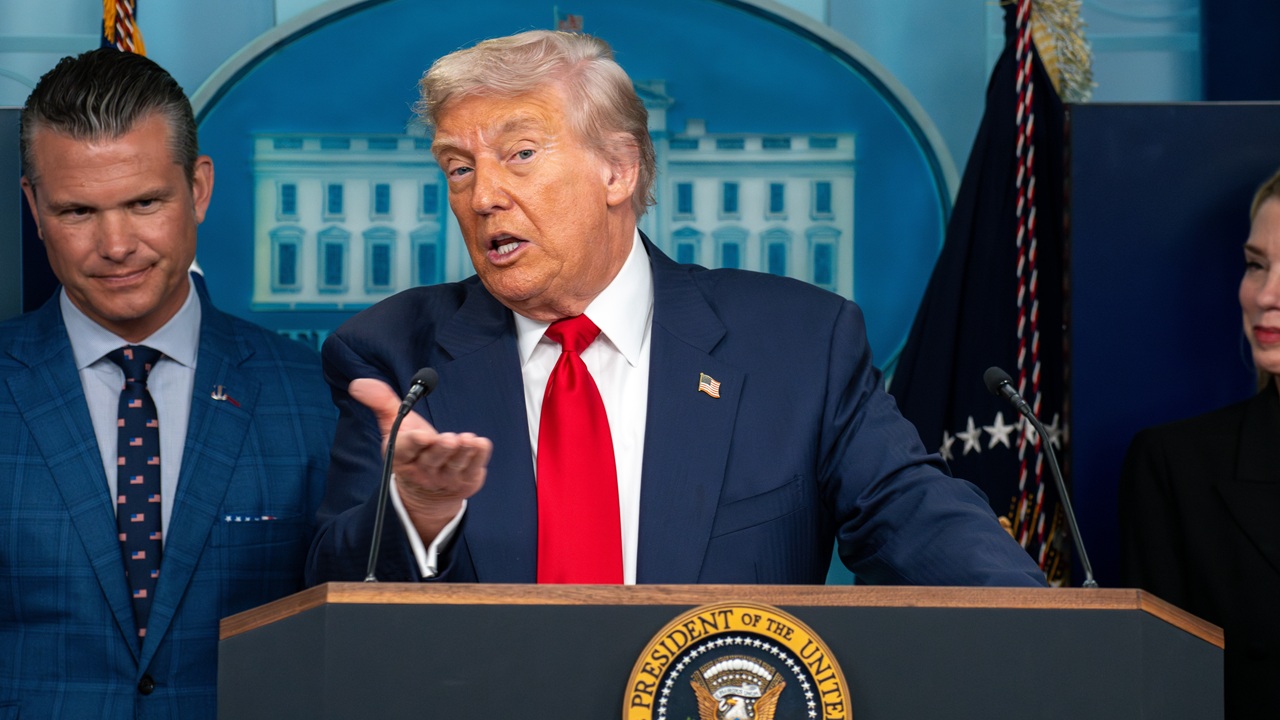
Trump’s national security strategy outlines a broad rethinking of American defense priorities—starting from the Western Hemisphere and branching outward.
The United States Army has activated Western Hemisphere Command, which is the fusion of the Army’s North and South commands. It is, what I have been told, the beginning of a much larger reorganization underway by President Donald Trump’s Pentagon to reprioritize certain strategic commands and to deprioritize commands that have been deemed important for far too long.
The creation of Western Hemispheric Command for the Army can—and should—be seen as a bureaucratic trial balloon floated by the Trump administration.
The National Security Strategy Memo
This all comes on the heels of the new National Security Strategy (NSS) memo that explains how—and why—the Trump administration will no longer emphasize defense of Eurasia, the Middle East, and even Africa at the expense of its own hemisphere.
That document was ready for publication months ago. Yet the Trump team kept it on ice and ultimately changed the language in some parts to be less caustic for the audience of DC insiders who were already dyspeptic over Trump’s policies.
But the NSS was just the start of the major reorganization underway—a reorganization that began with a simple (though apparently remarkably expensive) name change of the Department of Defense to the Department of War (this has yet to be made official by Congress and it is unlikely to be). That, too, was a trial balloon put forward by President Trump’s team.
Trump Wants to Rearrange the Pentagon Bureaucracy—Fast
It sounds to me like there is a real shift that will occur not at once, but it will be dragged out across the next 35 months until Donald Trump is no longer the president. For his plan to work, Trump must move faster.
Not only is the Western Hemisphere Command smart for the Army, so too are the calls to fuse US Northern Command (USNORTHCOM) and SOUTHCOM into one, cohesive entity. So are the original plans to restore US Africa Command (USAFRICOM) to the control of US European Command (EUCOM), all while diminishing the importance of Central Command (CENTCOM), which governs the Middle East and Central Asia.
Meanwhile, the Indo-Pacific Command (INDOPACOM), while very important, is not to be given the same priority as the proposed Western Hemispheric command structure.
And, because of Trump’s justified focus on space-based national missile defense, give Strategic Command (STRATCOM), which oversees the integration of space with the other strategic domains. The two most important commands going forward should be the one tasked with Western Hemispheric Defense along with STRATCOM for integrated national space-based missile defense. All others are a luxury the United States cannot afford at this time.
Trump Must Prioritize the Western Hemisphere, Then Work His Way Outward
Once the US can reassert its dominance in its hemisphere and do an adequate job of degrading the threats that ballistic missiles, hypersonic weapons, and drones pose to the homeland via space-based missile defense, then Washington can start to reassert itself in the Indo-Pacific—while leaving Europe to the Europeans, Africa to the Africans, and the Middle East to the denizens of that region.
If Trump maintains his commitment to Western Hemispheric Command, then, this is not the end but instead the beginning of a truly seismic strategic and bureaucratic shift toward a new world order—an order of at least three poles (the United States, China, and Russia), with other medium-sized powers coming online behind them. It is the strategy of spheres of influence and balance rather than hegemony and compellence.
Should the Trump administration fail to fully reorient America’s command structures to better comport with the realities of this new world order, the United States will surely collapse as a great power due to overextension.
About the Author: Brandon J. Weichert
Brandon J. Weichert is a senior national security editor at The National Interest. Recently, Weichert became the host of The National Security Hour on America Outloud News and iHeartRadio, where he discusses national security policy every Wednesday at 8pm Eastern. Weichert hosts a companion book talk series on Rumble entitled “National Security Talk.” He is also a contributor at Popular Mechanics and has consulted regularly with various government institutions and private organizations on geopolitical issues. Weichert’s writings have appeared in multiple publications, including The Washington Times, National Review, The American Spectator, MSN, and the Asia Times. His books include Winning Space: How America Remains a Superpower, Biohacked: China’s Race to Control Life, and The Shadow War: Iran’s Quest for Supremacy. His newest book, A Disaster of Our Own Making: How the West Lost Ukraine is available for purchase wherever books are sold. He can be followed via Twitter @WeTheBrandon.
Image: Shutterstock / Joey Sussman.