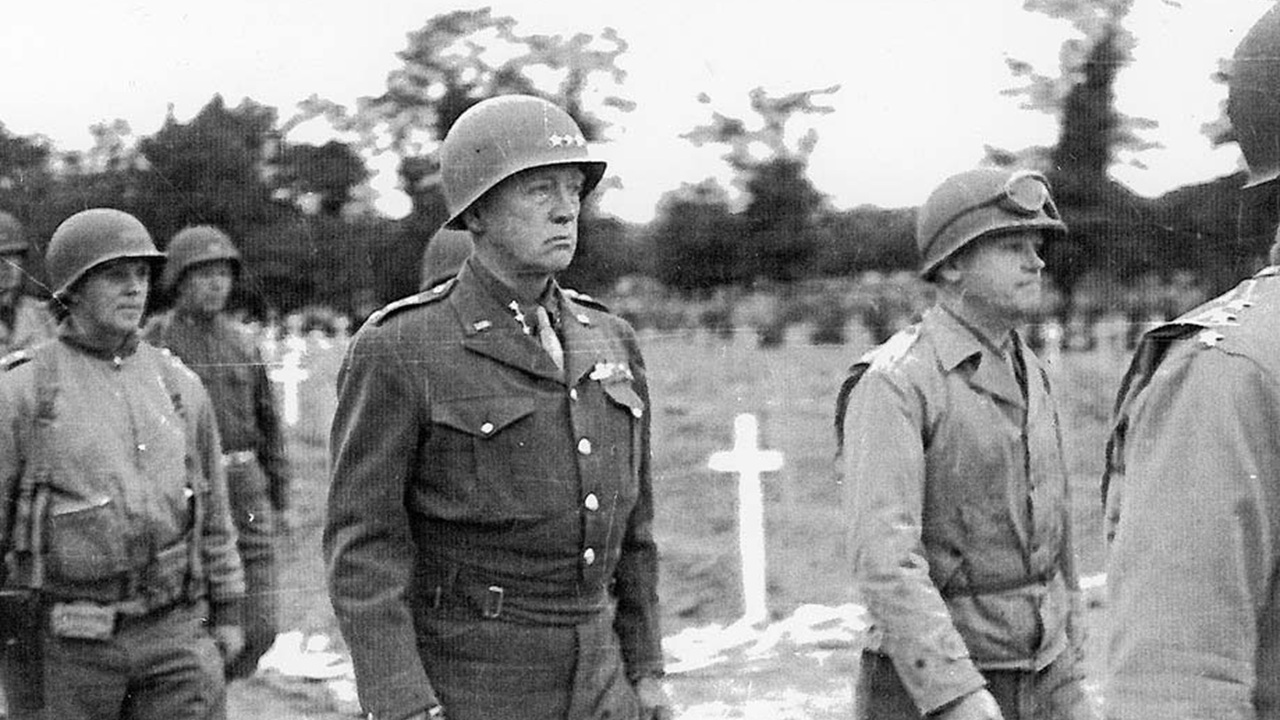
Patton was not an ideal commander. But his fighting spirit was second to none—and continues to inspire military leaders in the United States today.
The year 1945 is, in many respects, the year that the modern world began—for America, the existing world order, and modernity itself. It was the year that World War II ended in a victory for the Allied Powers.
Sadly, 1945—specifically December 21—was the day and year that one of America’s most iconic war heroes would die an ignominious death.
Remembering General George S. Patton
United States Army General George S. Patton is widely viewed as a visionary, albeit controversial, American tank commander who led his legendary Third Army in a mad dash across Europe.
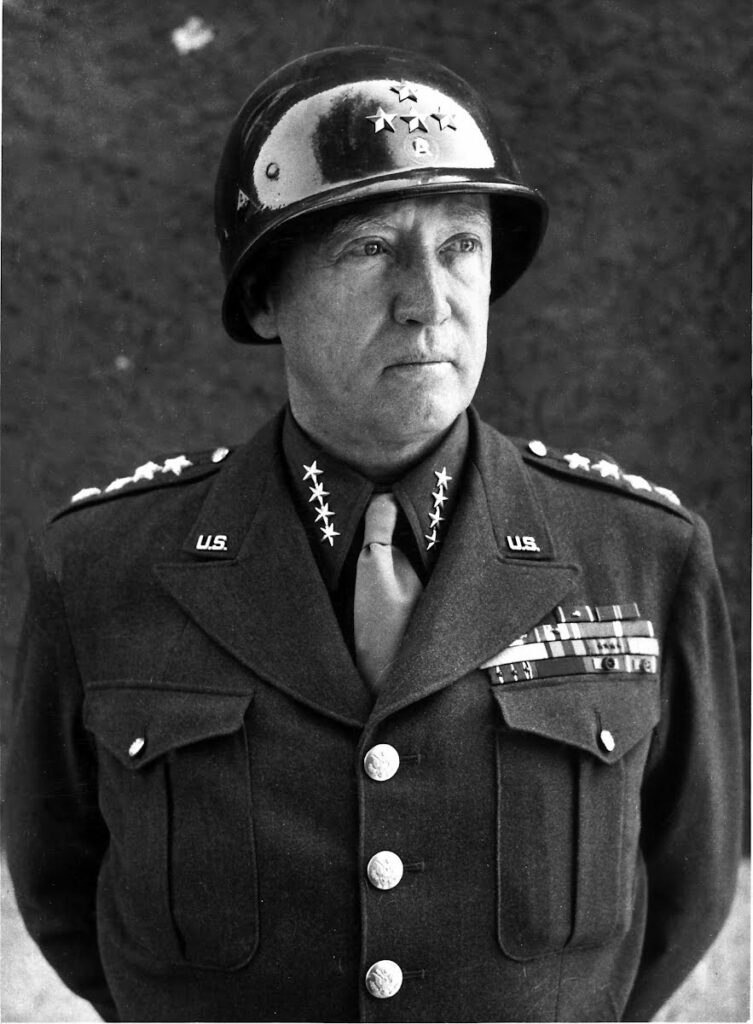
His objective was simple: to break the Nazi war machine in the West—and, secretly, he yearned to beat the Soviet Red Army to Berlin. Widely viewed as a prima donna by his colleagues, feared by his enemies, and glorified after his death, Patton was an incandescent personality who was responsible for some of the greatest victories enjoyed by the Allies in Europe.
Despite having taken grave personal risks during the war, Patton survived all that… only to be bitterly disappointed at the end of the war, and overcome with a sense of ennui at the postwar settlement that gutted Germany and empowered the Soviet Union in Europe.
A Car Accident Wasn’t a Proper End for Patton’s Life
On December 9, 1945, the general was being transported in the back of a Cadillac limousine that collided with a US Army truck near Mannheim, Germany. Patton struck his head on the partition, causing spinal cord damage leading to his paralysis from the neck-down.
Although Patton survived the initial crash for 12 days, spending those days in traction, he apparently suffered a pulmonary embolus resulting from the paralysis, killing him in his sleep on December 21 of that year.
Many rumors and conspiracy theories abound about Patton’s death. Some have speculated that he was murdered by vengeful Soviet intelligence operatives who were fearful of his very public calls to rearm the disbanded German Wehrmacht and to redeploy them to fight the Soviet Union—and finish the Reds off before they could recover from their war with Germany. Others theorize he was killed by his own government for being too uncontrollable and impolitic.
Whatever happened to him on December 9, the fact remains that he was killed as a result of a freak car accident. His death is such a point of controversy among people simply because it was such a small, even pointless death. When compared with his flamboyant life, his anticlimactic death hardly seems fitting for such a giant of a man.
What made this man a giant?
Understanding Patton’s Philosophy
Well, for starters, it was philosophy. One biographer of the Patton family—because Patton’s forbearers, and his heirs, were iconic military men, too—said a common trait of all the Patton men was that they “didn’t know how to quit.”
Not only did Patton not know how to quit, even when the chips in World War II were down, Patton entered the war with a fundamentally different philosophy. Retreat was never an option, and Patton believed it was always better to be on the attack than to be waiting around for the enemy.
More to the point, Patton was always training and conditioning his troops. He was constantly refining tactics and studying his enemy. It is worth remembering that scene in the eponymously named feature film written by Francis Ford Coppola and starring the great George C. Scott, in which Patton yells, “Rommel, you magnificent bastard, I read your book!”
For Patton, war was more than just studying and preparation, though. It was a lifestyle. Patton, like the old tribal war chiefs of foreign lands, was over-the-top. He was pugnacious and irreverent.
Many have unfavorably compared Patton to the likes of his contemporary, General Omar Bradley. Whereas Patton was unique and innovative, Bradley was reserved and methodical. Patton came from wealth and had the tastes of someone fitting that life, whereas Bradley was viewed as the “GI’s General.” Bradley was more well-liked by his peers, and rose higher in the ranks than did Patton as a result of these differences.
To be clear, Bradley was a good general, too. He contributed mightily to the American victory in the European Theater. But Patton brought a certain distinct fighting spirit with him and imposed it upon all around him. And he had a very unique view of warfare—especially the relatively new form of warfare involving tanks and mobility.
All that was lost when Patton unceremoniously perished in 1945.
How Does Patton’s Memory Help Us Today?
Today, however, that Patton-like ethos is back in vogue among the Pentagon’s brass. You see it in the way that the Trump administration’s secretary of defense, Pete Hegseth—who clearly styles himself roughly along Patton’s iconography—is trying to restore that martial balance to the Pentagon.
New Pentagon leaders, like Patton, have a new view of warfare at odds with those of their immediate predecessors. As Patton would appreciate, readiness in the new Pentagon bureaucracy must trump all else. And appealing to the warrior ethos of new and potential recruits to the military trumps standard operating procedure or political ideology.
Still, just like Patton, these changes imposed by the new Trump team might not always pan out. They might try to go too far, too quickly, requiring recalibration. Patton certainly experienced this. Nevertheless, the mentality is key. And you see that with some of these newer leaders in the Pentagon.
Ultimately, Patton’s death stunted whatever reforms he was pushing for the US military going into the Cold War.
A similar dilution of whatever Hegseth is trying to do at the Pentagon may occur, notably if Hegseth is either forced out of his job or if he simply quits. Clearly, the over-the-top “cult of the offensive” that defined Patton’s time as a top US military leader remains at the forefront of the current Pentagon leadership.
That is both useful for the US as well as risky. Regardless, the current shaping of the US Armed Forces as conducted by Hegseth and his team is much closer to Patton’s management of the Third Army in World War II than anything else.
About the Author: Brandon J. Weichert
Brandon J. Weichert is a senior national security editor at The National Interest. Recently, Weichert became the host of The National Security Hour on America Outloud News and iHeartRadio, where he discusses national security policy every Wednesday at 8pm Eastern. Weichert hosts a companion book talk series on Rumble entitled “National Security Talk.” He is also a contributor at Popular Mechanics and has consulted regularly with various government institutions and private organizations on geopolitical issues. Weichert’s writings have appeared in multiple publications, including The Washington Times, National Review, The American Spectator, MSN, and the Asia Times. His books include Winning Space: How America Remains a Superpower, Biohacked: China’s Race to Control Life, and The Shadow War: Iran’s Quest for Supremacy. His newest book, A Disaster of Our Own Making: How the West Lost Ukraine is available for purchase wherever books are sold. He can be followed via Twitter @WeTheBrandon.
Image: Wikimedia Commons.