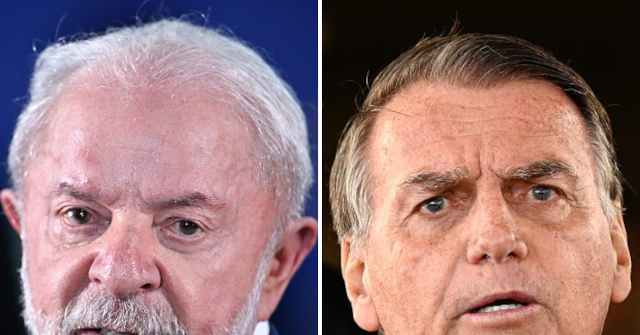
Socialist President Luiz Inácio Lula da Silva of Brazil confirmed on Thursday he will veto a bill passing both chambers of the Brazilian Congress that reduces the sentence of conservative former President Jair Bolsonaro, currently serving 27 years in prison on dubious “coup” charges.
The bill in question passed the Brazilian Senate this week after successfully passing the lower house, the Chamber of Deputies, earlier in December. The text of the document would significantly reduce prison sentences for those implicated in the January 8, 2023, riot in Brasilia, in which Bolsonaro supporters stormed the Congress, the presidential palace, and the headquarters of the Supreme Federal Tribunal (STF).
While the riot resulted in no deaths and minimal injuries, the government offices sustained substantial material damage. Jair Bolsonaro was in the United States at the time, visiting after his loss to Lula in the 2022 presidential election. Despite his absence from Brazil at the time of the riot, Bolsonaro has faced a litany of criminal charges for allegedly attempting to stage a “coup” to prevent Lula from taking office for a third time.
The news of Lula’s decision to block any attempt to give amnesty to Bolsonaro preceded a decision on Friday by the Brazilian Chamber of Deputies to oust Bolsonaro’s son, Eduardo Bolsonaro, who represented Sao Paulo in the Chamber. He was reportedly removed from Congress as a result of his prolonged absence from the Congress during his stay in America. At the time of his election in 2018, he received more votes for his seat than any other Congressional candidate in his cohort.
The younger Bolsonaro left Brazil in February and announced a month later that he would be seeking political asylum in the United States in the face of growing persecution of conservatives under Lula’s government, emboldened by renegade STF Justice Alexandre de Moraes. In July, the administration of President Donald Trump declared Brazil a “national security threat” over Lula’s persecution of conservative voices. The United States also imposed sanctions personally on Alexandre de Moraes under the Global Magnitsky Act, used to sanction individuals who violate human rights around the world.
Bolsonaro and Lula competed in one of the world’s most heated presidential elections in 2022. Lula had been disqualified from holding public office and imprisoned as part of the corruption probe known as “Operation Car Wash,” but the STF released him on a technicality and allowed him to run. The STF’s election arm, the Superior Electoral Tribunal (TSE), then banned journalists and Bolsonaro campaign members from referring to Lula as “corrupt” or a criminal, while allowing Lula to spuriously brand Bolsonaro a “cannibal” and “pedophile.”
Following Bolsonaro’s loss in the 2022 election, conservatives protested that the election was not held fairly, given the censorship, and questioned Lula’s eligibility to run for office. The protests led to the January 8 riot, which in turn the STF used to prosecute Bolsonaro for allegedly trying to stage a coup. In September, the STF sentenced Bolsonaro to 27 years in prison, accusing him of organizing a conspiratorial coup and attempting to poison Lula, among other allegations. Bolsonaro is 70 years old and in poor health, so the conviction effectively ends his political career. Alongside Bolsonaro, others arrested in relation to the January 8 riot received extensive prison sentences for alleged crimes against democracy.
Conservatives in the Brazilian Congress responded to the news by drafting a bill to adjust the sentences for Bolsonaro and the accused January 8 rioters. Under the new bill, Bolsonaro would not be exempt from serving time in prison, but his sentence would be reduced to just two years. The bill passed the Chamber of Deputies on December 10 and the Senate on Wednesday.
Speaking to reporters on Thursday, Lula said that he had not negotiated any arrangement to accept amnesty for those involved and some had not even completed their judicial processes.
“If there was an agreement with the government, I wasn’t told. So, if the president wasn’t informed, there is no agreement,” Lula asserted. “I’m told that the people who commit crimes against Brazilian democracy should pay for the acts committed against this country.”
“The trial hasn’t even finished yet and they already decided to reduce sentences,” he complained. “With all respect to the Congress, the moment that it [the amnesty bill] arrives at my desk, I will veto it.”
The Brazilian president has the constitutional power to veto bills, but Congress can override a veto with an absolute majority, or 50 percent of the votes plus one. This is a lower bar than in the United States, where two-thirds of both Houses of Congress must vote to override a veto. Unlike America’s two-party system, however, Brazil has a long list of many parties, representing various parts of the political spectrum, in its politics, making the creation of a united front to override the president a challenge.
Conservatives lost one more conservative vote in the Chamber of Deputies on Friday, when Eduardo Bolsonaro was formally removed from his seat. Bolsonaro lost his position for missing too many votes and did not challenge the decision; because he lost his seat over absenteeism, he would be eligible to run for office again and restore his position if he returns to Brazil.
In a message to his constituents on Friday, Bolsonaro emphasized that no legal wrongdoing had led to his removal and that fighting for Brazilian rights in the United States was “worth it.”
“They just ended my mandate — not for corruption… or drug trafficking. On the contrary, they took away my mandate for doing exactly what my voters expected of me,” he said in a video posted to social media. “I am very grateful for all of you who not only voted for me… but always supported me courageously.”
“I have certainty that this story has not ended,” he concluded. “I will keep being the same person because you follow me… with 41 years of age, we have many chapters left to write together.”
The younger Bolsonaro explained his departure to the United States in March.
“Brazil is no longer a democracy. It’s not possible for a parliamentarian to lose his passport for what he says. Where is parliamentary immunity?” he explained. “I’m not going to subject myself to this and remain under the thumb of Alexandre de Moraes. I’m taking my leave to represent the interests of my constituents, those who voted for me.”