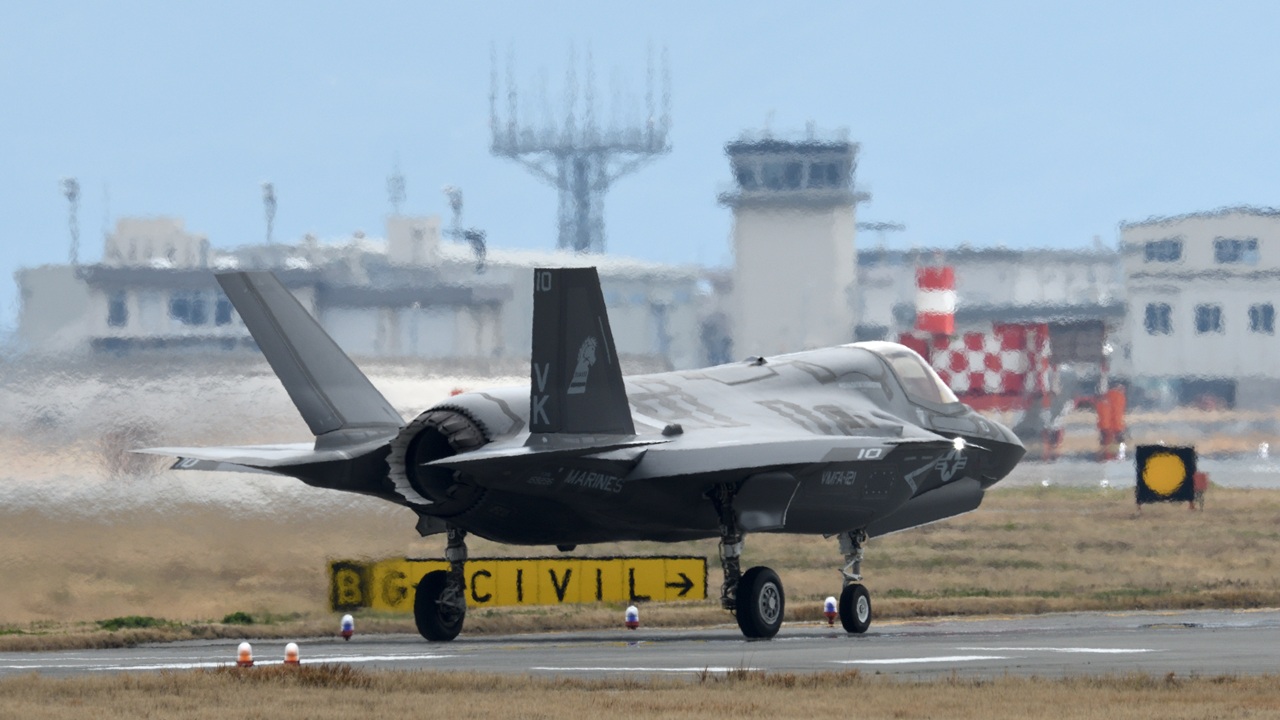
Japan now operates dozens of advanced F-35 stealth fighters—including the F-35B STOVL variant, based on its two quasi-aircraft carriers.
Eighty years ago, following its defeat in World War II, Japan was in ruins. Its most capable warships, notably its super battleships and most of its aircraft carriers, were at the bottom of the ocean. Its cities were destroyed—two by nuclear bombs, the only time such weapons of mass destruction have ever been employed in an armed conflict. Tokyo’s efforts to engage in an offensive war for territorial gain and regional influence brought the nation perilously close to annihilation.
After the war, Japanese society underwent a sea change. Its postwar constitution emphasized pacifism and renounced the right to declare war, and Japan significantly reduced its military capabilities. The goal was to ensure that the Land of the Rising Sun would never again be a significant military power.
In the decades that followed, Japan emerged as an industrial powerhouse and became a respected friend and ally of the United States and the West. As its economic and political clout grew, it also gradually began to rebuild its military strength. Today, Tokyo is becoming one of the nations preparing to stand up to Chinese aggression—resembling in some respects its efforts to expand its power that began a century ago.
Japan Is Now the Largest Operator of the F-35 in Asia
Japan is the largest operator of the Lockheed Martin F-35 Lightning II fifth-generation stealth fighter. There are currently 105 F-35As, the conventional takeoff and landing (CTOL) variants, and 42 F-35Bs, the short takeoff and vertical landing (STOVL) models now in service.
Three squadrons operate the F-35A at Misawa and Komatsu air bases, and as additional aircraft are received, each base will host two squadrons.
This month, the Japanese Ministry of Defense (MoD) announced that it has plans to base another Lightning II squadron at Chitose Air Base in Hokkaido. That base was selected following a comprehensive review that determined it had ” sufficient space to host the necessary facilities and support infrastructure, good training conditions … and efficient aircraft replacement,” The Aviationist reported.
Located in northern Japan, Chitose Air Base is adjacent to the civilian New Chitose Airport. From the base, the Japan Self-Defense Force (JSDF) monitors Russia and hosts an Air Rescue Wing. Chitose will begin to receive the F-35A in 2030.
The 201st and 203rd Tactical Fighter Squadrons are currently based at Chitose, each operating the F-15 Eagle. The Japan Air Self-Defense Force (JASDF) continues to replace its aging jet fighters with more advanced aircraft in response to threats from China, Russia, and North Korea.
“Countries surrounding Japan are rapidly modernizing their air forces by introducing new aircraft, including fighter jets believed to have stealth capabilities, and upgrading existing models,” the Japanese MoD explained in its review document.
Both Russia and China currently operate fifth-generation stealth fighters: the Sukhoi Su-57 (NATO reporting name “Felon”) and the Chengdu J-20 Mighty Dragon and Shenyang J-35. Moscow and Beijing have conducted additional joint bomber patrols, and F-35s operating from Hokkaido would be able to respond more quickly than those based at Misawa or Komatsu, both on the main island of Honshu.
“The Ministry of Defense and the Self-Defense Forces intend to steadily introduce F-35A fighter jets, which possess high network capabilities and stealth performance, in order to refine further and strengthen the quality and quantity of Japan’s air power, and to ensure the complete defense of our country,” the MoD added.
Japan’s F-35Bs Will Have ‘Aircraft Carriers’ (Sort Of)
In addition to the F-35As that will be deployed to the three bases, the JSDF has begun acquiring the F-35B, which will operate from the Japan Maritime Self-Defense Force’s (JMSDF) two Izumo-class multipurpose destroyers. Originally designed to deploy helicopters in an anti-submarine role, the JS Izumo and JS Kaga are being modified to operate with the STOVL F-35B, enabling the warships to serve as de facto carriers—the first such warships in service with Japan since 1945.
Although smaller than the People’s Liberation Army Navy’s (PLAN’s) three aircraft carriers, only the newest, the Type 003 CNS Fujian, can embark a stealth aircraft, as it is equipped with electromagnetic catapults. The Type 001 CNS Liaoning and Type 002 CNS Shandong each employ a ski-jump ramp, which limits the capabilities of carrier-based aircraft.
Japan’s F-35Bs are now temporarily deployed at Nyutabaru Air Base on Kyushu, the southernmost home island, while a new facility on Mageshima Island is being built. This future deployment is intended to support the defense of the southwestern islands near Taiwan and to enable the aircraft to be embarked on the modified Izumo-class flattops.
F-35A vs. F-35B: A Head-to-Head Comparison
| Aircraft | F-35A (Japan) | F-35B (Japan) |
| Year Introduced | 2016 | 2019 |
| Number Built | ~750 | ~150 (production ongoing) |
| Length | 51.4 ft (15.7 m) | 51.5 ft (15.7 m) |
| Wingspan | 35 ft (10.7 m) | 35 ft (10.7 m) |
| Weight (MTOW) | ~70,000 lb | ~60,000 b (27,200 kg) |
| Engine | One Pratt & Whitney F135-PW-100 afterburning turbofan (40,000 lbf thrust) | One Pratt & Whitney F135-PW-600 afterburning turbofan (41,000–43,000 lbf thrust); has rear nozzle swivels for STOVL capability |
| Top Speed | 1,200+ mph (1,930 km/h) / Mach 1.6 | 1,200+ mph (1,930 km/h) / Mach 1.6 |
| Range | ~1,200 mi (1,380 mi / 2,222 km) | ~900 nmi (1,035 mi / 1,670 km) |
| Service Ceiling | 50,000+ ft (15,240 m) | 50,000 ft (15,240 m) |
| Loadout | Internal 25 mm GAU-22/A cannon, two AIM-120 AMRAAMs, two GBU-31 JDAMs | Internal bays (up to 15,000 lbs ordinance), 6 external hardpoints for missiles / bombs |
| Aircrew | 1 | 1 |
About the Author: Peter Suciu
Peter Suciu has contributed over 3,200 published pieces to more than four dozen magazines and websites over a 30-year career in journalism. He regularly writes about military hardware, firearms history, cybersecurity, politics, and international affairs. Peter is also a contributing writer for Forbes and Clearance Jobs. He is based in Michigan. You can follow him on Twitter: @PeterSuciu. You can email the author: [email protected].
Image: Shutterstock / viper-zero.