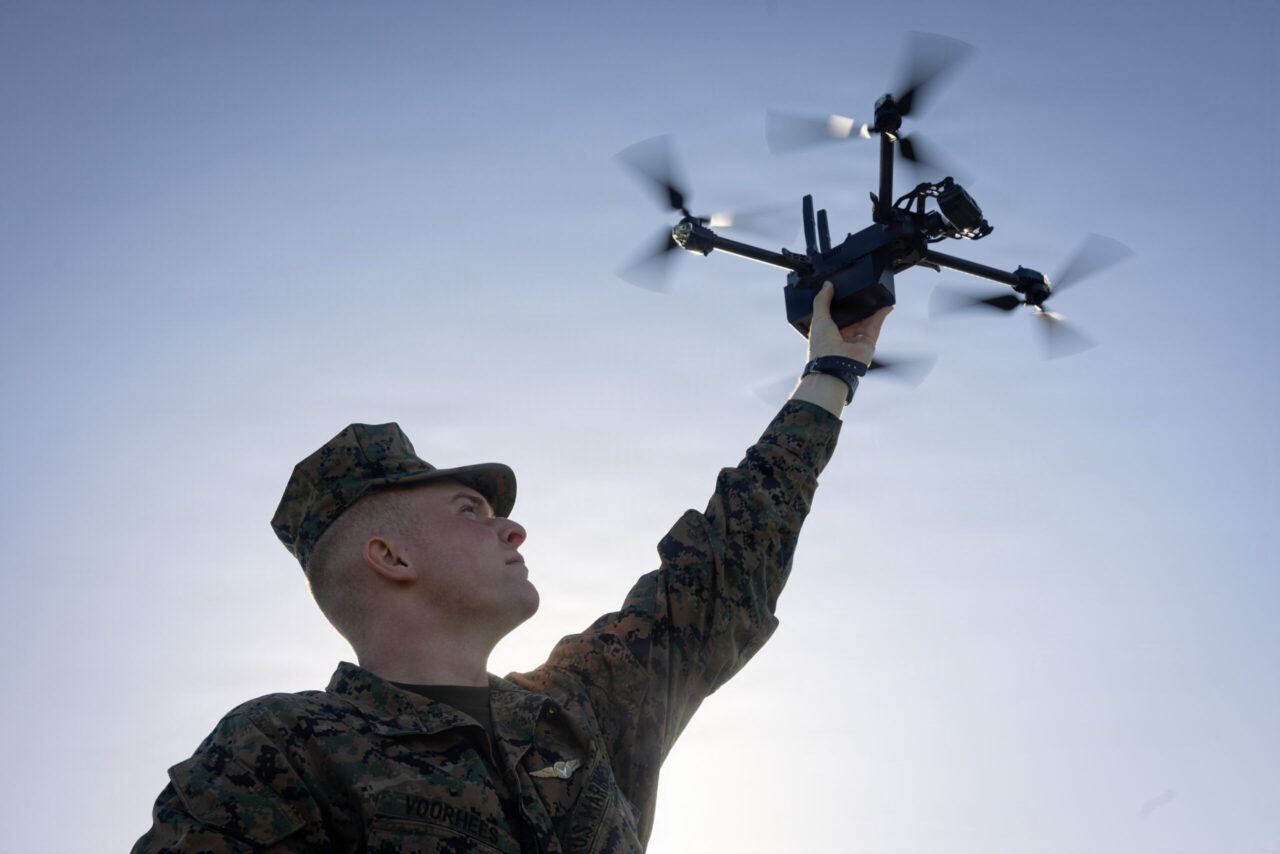
The competition trained and certified Marines as drone operators, giving them the ability to employ one-way attack unmanned aerial systems in training and operations.
Earlier in December, the US Marine Corps held a large-scale suicide drone competition in the Indo-Pacific.
The competition brought together Marines and troops from other services to compete on who is the best suicide drone operator.
The Marines Host a Suicide Drone Competition
In the first two weeks of December, the 3rd Marine Division, III Marine Expeditionary Force, held the Marine Corps Attack Drone Competition at Camps Hansen and Schwab, Okinawa, Japan.
The goal of the competition was to put Marines through the rigors of suicide drone operations and hone their capabilities.
“The Marine Corps Attack Drone Competition allows Marines to test and improve their drone skills alongside the top operators in the Marine Corps, enhancing their confidence and capabilities on the battlefield,” Marine Corps sgt. Grant Doran, an attack drone instructor with the Marine Corps Attack Drone Team in Quantico, said in a service press release.
The competitors used Neros Archer, a one-way attack unmanned aerial system. The Neros Archer is a small suicide drone that can carry a 4.5 lb payload over 12 miles. The unmanned aerial system is designed for close engagements in a tactical setting.
Troops from other services also took part in the competition, thus encouraging interoperability across the US military.
“I believe that with [any potential] crisis, small Unmanned Aerial Systems development and integration within small unit formations is going to be super relevant given its longer reach,” a Marine Corps non-commissioned officer added.
The event trained and certified Marines as attack drone operators, attack drone instructors, and payload specialist instructors, qualifying them as drone operators and giving them the ability to employ one-way attack unmanned aerial systems in training and operations. The competition qualified 12 Marines as attack drone operators.
The Marine Corps has been investing in suicide drone technology in anticipation of a near-peer conflict with China.
A Changing Drone Environment
Alongside the US Intelligence Community, the US military has pioneered unmanned aerial systems technology beginning in the 1990s. During the Global War on Terror operations in Afghanistan and Iraq, the US forces became increasingly reliant on drones. Although the US Intelligence Community used drones for kinetic strikes against high-value targets, the US military mainly relied on unmanned aerial systems for intelligence, surveillance, and reconnaissance of the battlefield, providing troops on the ground and tactical commanders with real-time information on the battlefield situation.
However, the war in Ukraine has introduced significant developments in unmanned aerial system technology, tactics, techniques, and procedures. In Ukraine, the daily life in the trenches and behind the frontlines consists of frequent glimpses of enemy drones in the sky. The buzzing of death, as many call it, is the last thing many Russian and Ukrainian soldiers hear before an impact with a suicide drone. Indeed, drone usage by both sides is so prevalent that many urban centers near the frontlines have miles of anti-drone netting across major roads and hubs to catch incoming one-way attack unmanned aerial systems.
Interservice and intraservice competitions like the one held by the Marine Corps are the right path to bringing up the US military current with drone warfare and ensuring that it will not lose precious time learning in the event of a conflict with China or Russia.
About the Author: Stavros Atlamazoglou
Stavros Atlamazoglou is a seasoned defense journalist specializing in special operations and a Hellenic Army veteran (national service with the 575th Marine Battalion and Army HQ). He holds a BA from the Johns Hopkins University and an MA from the Johns Hopkins’ School of Advanced International Studies (SAIS). His work has been featured in Business Insider, Sandboxx, and SOFREP.
Image: DVIDS.