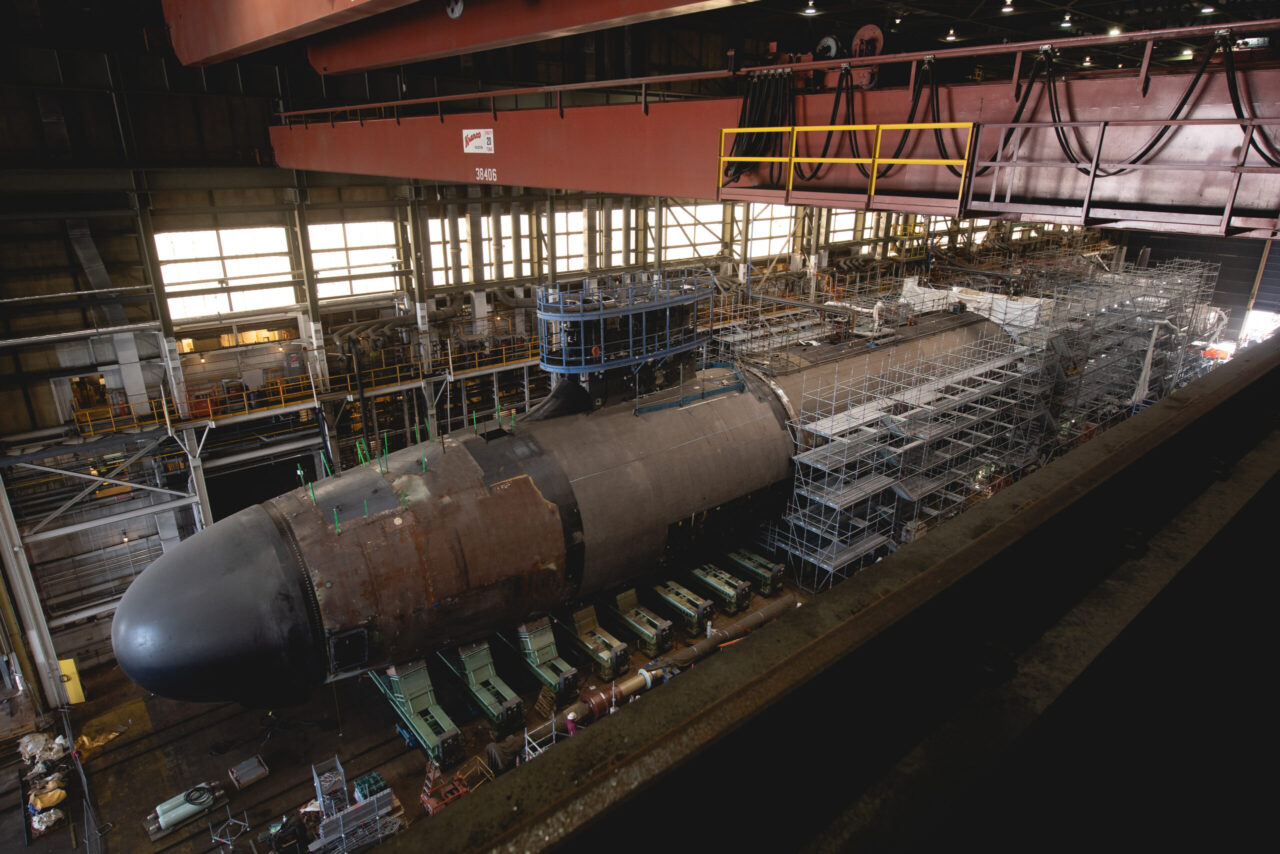
Once USS Barb reaches operational capacity with the Navy, the fast-attack sub will undoubtedly play a role in its sea power.
In light of growing escalations between Washington and Beijing in the South China Sea, the US Navy is continuing to field advanced warships in order to retain its power projection strategy. Earlier this month, the keel for the service’s future 31st Virginia-class nuclear-powered attack submarine was laid. The upcoming USS Barb will represent the Navy’s latest effort to steer away from older, Cold War-era-designed Los Angeles-class submarines to newer and technically superior variants.
During the submarine’s keel-laying ceremony, Huntington Ingalls Newport News Shipbuilding President Kari Wilkinson said, “It marks the beginning of a construction journey, and while it is a journey measured in inches of weld, amount of pipe, and amount of cable pulled, it is fueled by the strength and determination of shipbuilders and our partners working together toward a common objective.” Like her Virginia-class sister ships, USS Barb is being designed to carry out a litany of responsibilities, including the capability of operating in anti-submarine warfare, anti-surface warfare, strike missions, and intelligence and reconnaissance tasks.
The Virginia-Class Submarine’s Specifications
- Year Introduced: 2004
- Number Built: 24 (69 planned)
- Length: 377 ft (115 m)
- Beam (Width): 34 ft (10.4 m)
- Displacement: 7,800 tons
- Engines: S9G nuclear reactor; auxiliary diesel engine
- Top Speed: 25 knots (28.8 mph, 46 km/h)
- Range: Unlimited
- Armaments: 12 VLS tubes, four 21-inch (530mm) torpedo tubes for Mk-48 torpedoes; BGM-109 Tomahawk missiles
- Crew: 135 (15 officers, 120 enlisted)
The Navy’s Virginia-class platform was conceptualized at the height of the Cold War under the codename “Centurion Study.” While the service’s Seawolf-class warships were initially designed to fulfill its requirement for a new and improved nuclear-powered submarine platform, these vessels proved to be far too expensive to produce. In fact, only three Seawolf submarines were ultimately completed before the program’s cancellation, costing the Navy a staggering $3 billion per boat. The Virginia-class surpassed the Seawolf-class primarily due to its lower production cost and smaller frame.
To date, 24 Virginia-class submarines have been commissioned with the Navy. The first boats in the Virginia-class to enter service were the Virginia (SSN 774) and Texas (SSN 775). Subsequently, Hawaii (SSN 776), New Hampshire (SSN 778), Missouri (SSN 780), Mississippi (SSN 782), and John Warner (SSN 785) were commissioned, followed by North Carolina (SSN 777), New Mexico (SSN 779), California (SSN 781), Minnesota (SSN 783) and North Dakota (SSN 784). In June 2008, the Navy christened its first-ever Block II submarine: USS New Hampshire. USS Iowa was the latest IV Virginia boat commissioned.
While all the Virginia-class variants are cutting-edge, the latest Block IV contingent is especially lethal and advanced. These submarines host new fly-by-wire control systems that enable better shallow-water ship handling. Additionally, these submarines feature design changes to their torpedo room that allow special operation forces, including NAVY SEALs, to deploy from them. Once USS Barb reaches operational capacity with the service, the fast-attack sub will undoubtedly play a role in its sea power.
About the Author: Maya Carlin
Maya Carlin, national security writer with The National Interest, is an analyst with the Center for Security Policy and a former Anna Sobol Levy Fellow at IDC Herzliya in Israel. She has over 1,000 articles published over the last several years on various defense issues. Carlin has bylines in many publications, including The National Interest, Jerusalem Post, and Times of Israel. You can follow her on Twitter: @MayaCarlin.
Image: By Huntington Ingalls Industries, CC BY-SA 4.0, Wikimedia Commons.