
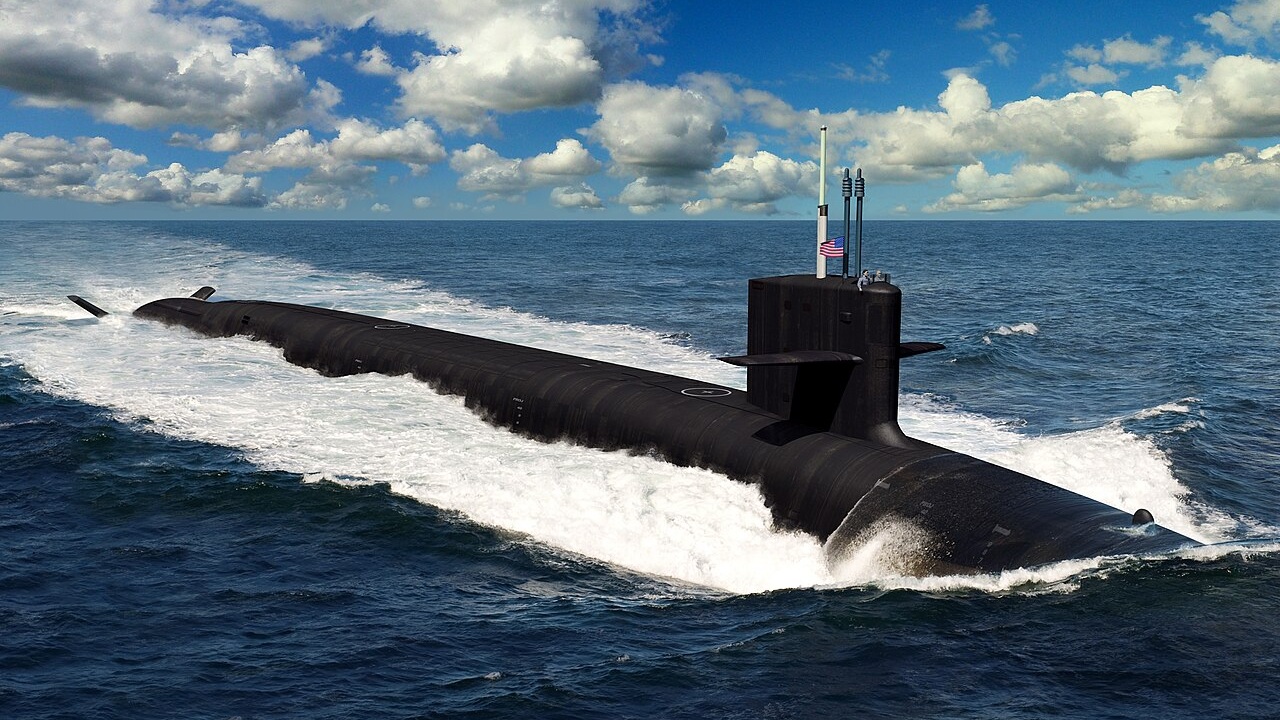
The Columbia class is slated to enter service in 2031—with very little room for error, as its predecessor, the Ohio-class SSBN, will be retired starting in 2017.
The United States Navy is desperately working to replace the aging Ohio-class ballistic missile submarines that have plumbed the depths of the world’s oceans, ready to initiate a second strike with nuclear weapons if the United States were ever attacked first.
The Columbia-class ballistic missile submarines are to be the advanced replacements for the aging Ohio-class submarines. The Navy intends to produce 12 vessels to be the vanguard of America’s sea-based nuclear weapons capability.
Thus far, the first ship in the series, the USS District of Columbia (SSBN 826), is projected to enter service by 2031. After that, the USS Wisconsin (SSBN 827) has already had its keel laid and is slated for commissioning later the same year.
All Columbia-class nuclear submarines will run off the S1B nuclear reactor. These new SSBNs are believed to be stealthier than their Ohio-class predecessors, and possess a superior sensor suite.
The Columbia-Class Submarine’s Specifications
- Year Introduced: Not yet introduced (projected 2031)
- Number Built: 0 (2 under construction, 12 projected)
- Length: 560 feet (170.7 m)
- Beam: 43 feet (13.1 m)
- Displacement: 20,810 long tons
- Propulsion: S1B nuclear reactor, turbo-electric drive with pump-jet
- Top Speed: ~20 knots (23 mph, 37 km/h)
- Range: Unlimited
- Armaments: 16 Trident D5 SLBM nuclear missiles; torpedo tubes
- Crew: 155
How the Columbia-Class Submarine Improves on the Ohio Class
The Columbia-class SSBN’s electric drive is believed to reduce its cost and acoustic signature when compared to the older Ohio-class” Boomers.” The submarine’s LAB sonar system is itself a bigger version of the LAB sonar installed on the newer Virginia-class submarines.
Columbia-class submarines will each have a 42-year service life, or a minimum of 124 deterrent patrols during its service life. Unlike the Ohio-class submarines, which require mid-life nuclear refueling, the Columbia-class submarines will not need such mid-life refueling, and are expected to remain in one piece until their retirement.
Each of the Columbia-class submarines will have X-shaped hydroplanes, sail-mounted dive planes, and Integrated Power System (IPS), anechoic coating, and a stern area system (SAS). The Columbia-class, like the British Royal Navy’s Dreadnought-class SSBN will have a common missile compartment (CMC) that will hold four missile tubes—or a “Quad-Pack.” Columbia-class subs will hold four Quad-Packs.
Why Does America Need New Submarines, Anyway?
General Dynamics Electric Boat, a subsidiary of General Dynamics, was awarded a $2.28 billion contract to move forward with procurement and construction of five Columbia-class fleet ballistic missile submarines. Work on the five hulls in question will be carried out at the company’s shipyard in Groton, Conn., with support from facilities in Virginia and Rhode Island.
America entering the third decade of the twenty-first century is finding itself in uncharted geopolitical waters. No longer the only major power in the world and, of the three major powers (the US, China, and Russia), the US is in decline (at least for the time being). One of its greatest defenses is its nuclear deterrent. That, now, is also declining. And it is declining at a moment in which both Russia and China—America’s chief competitors on the world stage—are expanding their arsenals relative to that of the United States.
The US Navy’s submarine-based nuclear deterrent constitutes a key second-strike capability and has since the earliest phases of the Cold War in the previous century. In fact, Washington has fixated on enhancing their sea-based nuclear deterrent so much that, unofficially, those submarine-launched ballistic missiles have become more of a first-strike weapon (especially when dealing with nuclear-arming rogue states, such as Iran and North Korea).
Understanding America’s Submarine Crisis
Still, the Americans are facing an unprecedented submarine crisis. The US Navy needs new submarines. Its existing fleet is deteriorating and being retired at a rate that current US naval shipyards simply cannot replace. Whether the Americans ever acquire the 12 proposed Columbia-class SSBNs on time and within budget is yet to be seen. What can be deciphered now, though, is that if the Columbia-class SSBN development slips even slightly, there will be key gaps formed in America’s undersea nuclear deterrent. The Ohio-class SSBNs are slated to be retired at the rate of one per year starting in 2027. Under current conditions, the Columbia-class subs will enter service in 2031.
At the end of November, the US Navy announced it might extend the operational life of the five oldest Ohio-class submarines as a result of the slow production of the Columbia-class. Yet these aging subs will struggle to remain combat-effective simply because of their age and the increased demands placed upon them. Remember when the post-Soviet navy in Russia tried to extend the lives of many of its aging Soviet-era submarines?
So, the US Navy will have to make do with less for some time—at a time when both Russia and China are expanding their own submarine fleets as well as their nuclear arsenals (and developing other first-strike weapons). In other words, the numerical imbalance that is set to take place in America’s Boomer fleet will occur at the most inopportune time imaginable.
Unless the US military starts fundamentally changing the way it operates, the US could very well lose a war simply because of the imbalance in our own forces.
About the Author: Brandon J. Weichert
Brandon J. Weichert is a senior national security editor at The National Interest. Recently, Weichert became the host of The National Security Hour on America Outloud News and iHeartRadio, where he discusses national security policy every Wednesday at 8pm Eastern. Weichert hosts a companion book talk series on Rumble entitled “National Security Talk.” He is also a contributor at Popular Mechanics and has consulted regularly with various government institutions and private organizations on geopolitical issues. Weichert’s writings have appeared in multiple publications, including The Washington Times, National Review, The American Spectator, MSN, and the Asia Times. His books include Winning Space: How America Remains a Superpower, Biohacked: China’s Race to Control Life, and The Shadow War: Iran’s Quest for Supremacy. His newest book, A Disaster of Our Own Making: How the West Lost Ukraine is available for purchase wherever books are sold. He can be followed via Twitter @WeTheBrandon.
Image: Wikimedia Commons.














.jpg)