The Huey’s designated successor, the MH-139A Grey Wolf, has suffered from delays and cost overruns and is not yet prepared to replace it.
America’s Huey helicopter is probably the most iconic military rotorcraft in history. Specifically designed to operate in the jungle canopy of Asia, variants of this bird have operated in service to the US military for more than 40 years.
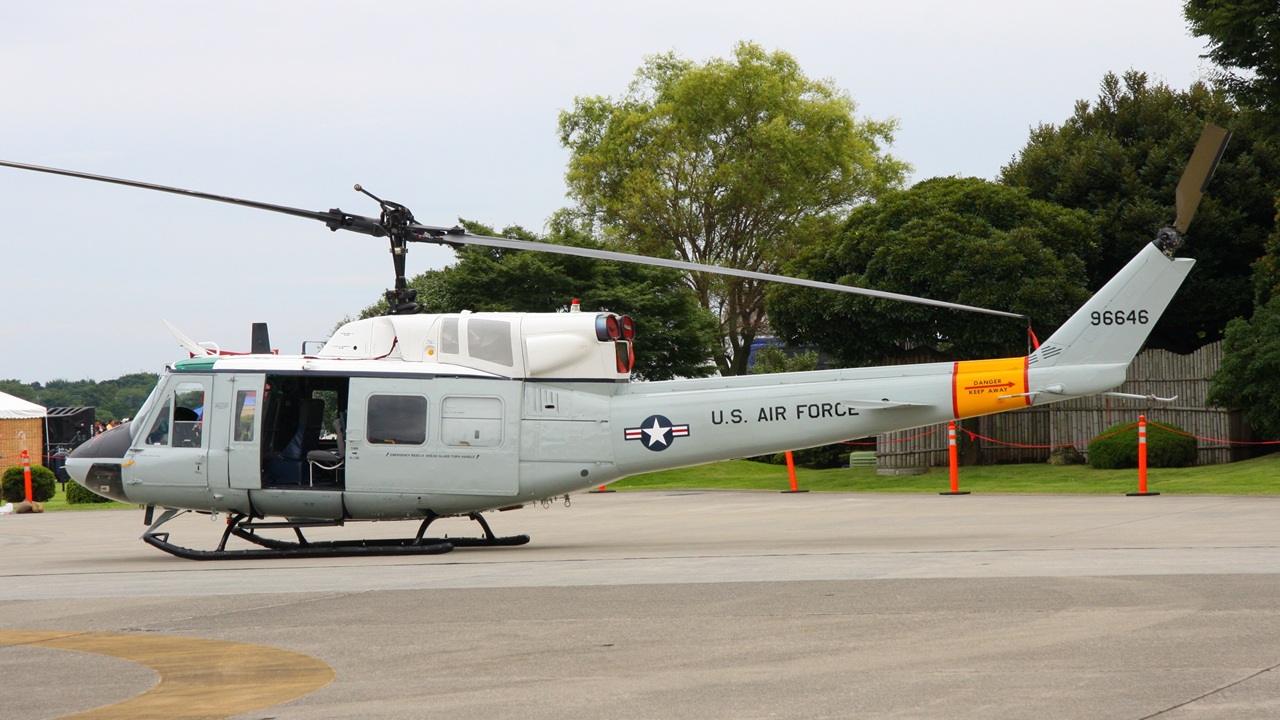
For the United States Air Force, the final UH-1N Huey departed Yokota Air Base after 45 years of continuous service there. This marks the end of an era for the Air Force, which has now retired their final Huey as part of a larger modernization effort. But the helicopter is far from the end of its useful life; variants are still active in other branches of the US military, and it continues to serve in the inventories of dozens of other air forces around the world.
The Bell UH-1 Iroquois’ Specifications
- Year Introduced: 1959
- Number Built: 16,000+
- Length: 57 ft 9 in (17.6 m)
- Rotor Diameter: 48 ft (14.6 m)
- Weight: 9,500 lb (4,300 kg)
- Engines: Two Pratt & Whitney T400-CP-400 turboshaft engines
- Top Speed: 149 mph (240 km/h)
- Range: 300+ mi (483 km)
- Service Ceiling: 15,000 feet and 10,000 feet for gross weights above 10,000 pounds
- Loadout: 7.62mm machine guns; 70mm rocket pods; other armaments depending on mission / configuration
- Aircrew: Typically 3 (pilot, co-pilot, flight engineer)
The History of the “Huey” Helicopter
The United States military was looking for a new helicopter to conduct battlefield medical evacuation (“medevac”) missions. On February 23, 1955, Bell Helicopters won the contract from the United States Army. It would be redesigned and given the designation of “HU-1,” giving rise to the nickname “Huey.” The designation was ultimately changed to “UH-1,” but the nickname stuck.
The Bell UH-1 Iroquois helicopter debuted on October 20, 1956, under the prototype designation of the “XH-40.” It entered US Army service three years later, in 1959. It soon became the primary helicopter used throughout America’s war in Vietnam—perfect for an assortment of mission sets in the dense canopy jungle of Indochina, from troop transport to medical evacuation to surveillance to assault roles.
Huey helicopters were the first turbine-powered helicopters to enter mass production for the US military. The United States built more than 16,000 during its production run, ensuring its legacy as possibly America’s most successful helicopter.
At its height, the UH-1N not only served in Air Force Special Forces but it served within the Air Force Global Strike Command and was located at bases like Warren Air Force Base, the 341st Missile Wing at Malmstrom AFB in Montana, and the 91st Missile Wing in Minot AFB. This bird served in the First Helicopter Squadron at Andrews AFB and with the 36th Rescue Flight at Fairchild AFB, along with the 459th Airlift Squadron in Yokota AB, the 40th Flight Test Squadron at Eglin AFB, and the 512th Rescue Squadron at Kirtland AFB.
Last year, at Kirtland Air Force Base, a 58th Operations Group, Det 2, UH-1N helicopter broke a major record. It logged a whopping 20,000 flight hours, “giving it one of the highest numbers of flight hours for Huey’s across the Department of Defense.” This 20,000 flight hours is a testament to durability of the Huey which has operated for decades. In fact, two other UH-1Ns that crossed the 20,000-flight hour threshold were also part of the 58th Operations Group.
How the Huey Became a Pop Culture Icon
Not only did the helicopter define America’s role in the Vietnam War, but it also became a cultural icon. For many decades thereafter, even people who didn’t pay close attention to military technology development could identify the Huey helicopter because of its outstanding role in American pop culture from Vietnam onward. (If a movie buff hears the opening of Wagner’s “Ride of the Valkyries,” he will most likely instantly remember Robert Duvall in Apocalypse Now, commanding an attack from a Huey laden with surfboards—screaming that “Charlie don’t surf!”)
That is why the retirement of the Air Force’s final Huey is such a memorable day. In 2016, the US Army retired its final HU-1 Huey from active service to be replaced by the UH-60 Black Hawk helicopter. The US Marine Corps still operates the UH-1Y Venom—in large part because the Marine Corps are proficient at making any technology last, as they did with the Harrier jumpjets and the M60 Patton Main Battle Tank.
The Air Force intends to continue operating a small contingent of Hueys, the TH-1H Trainer, for training missions. But, its days in forward deployed missions are over.
The Huey’s Successor Isn’t Ready Yet
While these birds were clearly getting up there in age, and the modern threat environment has fundamentally changed the demands for American military helicopters, the retirement of the remaining active UH-1N Hueys is a sober moment. It reflects the end of an era for combat aviation, the end of the most successful helicopter in American military history. It also creates a period of uncertainty. Even as MH-139A Grey Wolf is supposed to replace the UH-1N for support roles in the Air Force, there have been major delays and massive cost overruns with that platform—meaning that the Air Force could potentially be facing shortages of their important helicopter capability.
The passing of the Huey and the replacement of it with what might be an insufficient, albeit newer, helicopter is a symptom of a larger problem: a US military in decline. Unless that is addressed more fully, the loss of an iconic helo will be the least of America’s problems.
About the Author: Brandon J. Weichert
Brandon J. Weichert is a senior national security editor at The National Interest. Recently, Weichert became the host of The National Security Hour on America Outloud News and iHeartRadio, where he discusses national security policy every Wednesday at 8pm Eastern. Weichert hosts a companion book talk series on Rumble entitled “National Security Talk.” He is also a contributor at Popular Mechanics and has consulted regularly with various government institutions and private organizations on geopolitical issues. Weichert’s writings have appeared in multiple publications, including The Washington Times, National Review, The American Spectator, MSN, and the Asia Times. His books include Winning Space: How America Remains a Superpower, Biohacked: China’s Race to Control Life, and The Shadow War: Iran’s Quest for Supremacy. His newest book, A Disaster of Our Own Making: How the West Lost Ukraine is available for purchase wherever books are sold. He can be followed via Twitter @WeTheBrandon.
Image: Shutterstock / yanchi1984.