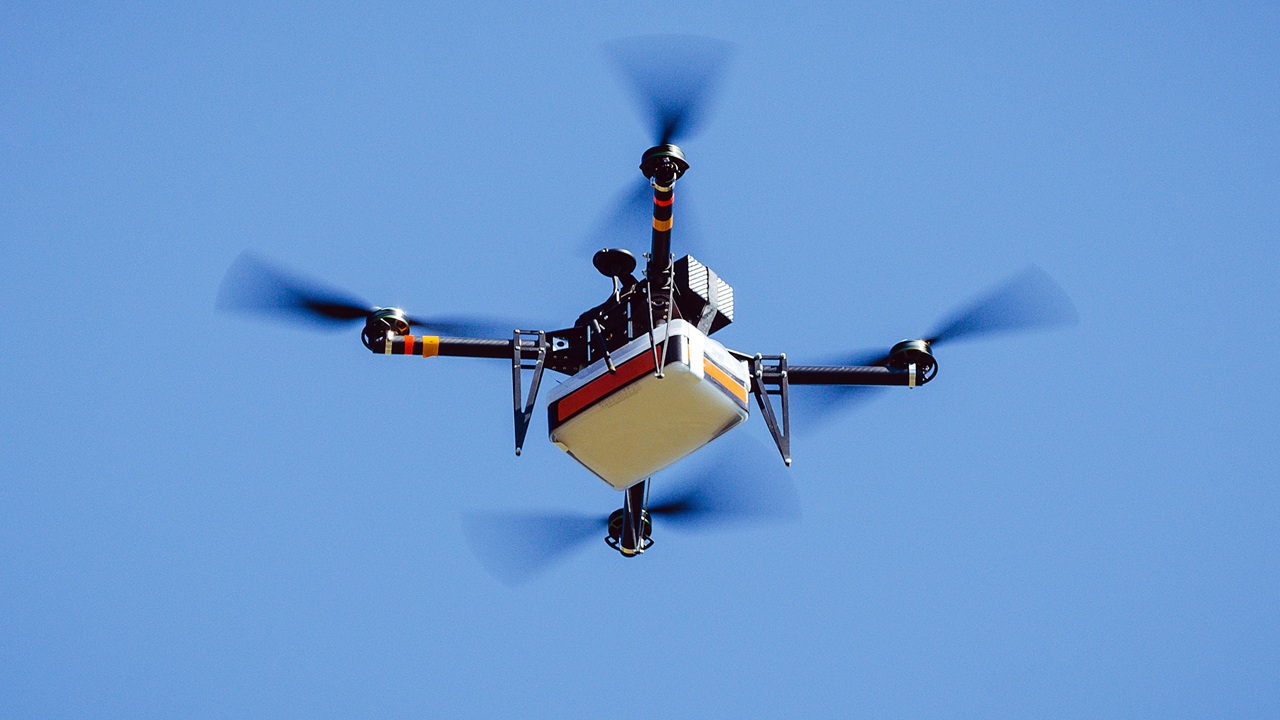
Drones have been used in a wide range of battlefield roles, including both reconnaissance and direct strikes. An Israeli startup believes they could also be used for logistics.
“Mobility is firepower.” That’s what Rani Plaut, CEO of Israeli aerospace startup AIR, wants the world to know. In an era of increasingly contested battlespaces, wherein conventional forms of mobility and firepower simply don’t pass the smell test anymore, Plaut is trying to find workarounds.
This is where AIR’s uncrewed aerial system (UAS) comes into play.
The Ukraine War Has Changed Everything
The Ukraine War, as well as other modern battlefields, such as those in the Middle East, have shown the world that drones are decisive playmakers. Even before Russia’s invasion in February 2022, drones had already made their mark in the Middle East and Central Asia, where the US military had used them in a range of roles—everything from reconnaissance to targeted assassinations—against insurgent threats during its two-decade wars there. But Ukraine marked the first full-scale war in which two strong militaries could produce their own drones and use them against each other, to devastating results.
In the morass of eastern Ukraine, the battlefield has become not just a contested environment, but a degraded one, wherein manned systems—notably helicopters and conventional airplanes—are simply too vulnerable to the disruptive actions of drones.
Rather than abandon the notion that the modern battlefield simply denies reliable contacts between logistics hubs and remote end points, Rani Plaut’s team at AIR believes they have a workaround. Drones have become ubiquitous on today’s battlefields. In fact, they’ve defined the modern battlefield.
These unmanned systems serve in a variety of roles, from surveillance to attack roles. Plaut’s firm is evaluating how drones could take up the slack in logistical roles, too. Great firms find their niche in increasingly crowded industries, such as the military drone industry. In this case, AIR has identified that most existing vertical takeoff/landing (VTOL) drones “are limited to payloads under 100 pounds and operational ranges under ten miles,” according to Defence Blog, an industry publication.
The AIR Drones Help to Fill (Unmanned) Needs
Plaut’s firm wants to enhance this carrying capacity for drones and fill in the lost reliability of battlefield logistics, since remote end points can no longer rely upon consistent resupply from logistics hubs in modern warfare, if those logistical chains are relying upon manned aircraft to fill the logistics requirements of the forces operating at those endpoints.
AIR is designing drones that can conduct heavy-lift missions without the need for any humans on the aircraft. Plaut stated that, “Decision makers will soon face a choice: acquire one heavy-lift UAS such as a Black Hawk, or 20-30 smaller, medium-lift, medium-range logistics eVTOLs operating collaboratively.” For the folks at AIR, they want to remove the human equation entirely from battlefield and emergency logistics missions.
The upcoming AIR Cargo platform will allow for battlefield logistics missions, disaster relief, and other commercial logistics needs to be met autonomously. Not only will this ensure connectivity between logistics hubs and military forces fighting on distant, isolated battlefields, but it will ensure that such missions can be accomplished with less risk involved and at a far cheaper level than what they are currently being conducted at.
Plaut doesn’t just want these systems relegated to combat (although this is likely where they will be most useful). The example he used was in the case of naval support scenarios. Under current conditions, if the US Navy needs certain heavy equipment for ship repairs, US Navy commanders will send out a Seahawk helicopter with at least two crewmembers onboard, all to deliver a 200-pound tool for the repairs.
AIR Is Paving the Way Toward the Logistics of the Future
If AIR has its way, his cargo UAS drones will accomplish similar mission sets without ever involving the human element or requiring the large Seahawk helicopter, with all the fuel needs, and the costs associated with putting wear-and-tear on such a helicopter. Instead, an AIR cargo drone could deliver the payload quickly, efficiently, safely, and cheaply—more than a manned system ever could.
The future of logistics belongs to the firm or firms that can most quickly embrace the revolution of unmanned systems—and figure out how best to enhance these unmanned systems to better carry heavier payloads to distant locations. AIR is one firm that is already doing that.
About the Author: Brandon J. Weichert
Brandon J. Weichert is a senior national security editor at The National Interest. Recently, Weichert became the host of The National Security Hour on America Outloud News and iHeartRadio, where he discusses national security policy every Wednesday at 8pm Eastern. Weichert hosts a companion book talk series on Rumble entitled “National Security Talk.” He is also a contributor at Popular Mechanics and has consulted regularly with various government institutions and private organizations on geopolitical issues. Weichert’s writings have appeared in multiple publications, including The Washington Times, National Review, The American Spectator, MSN, and the Asia Times. His books include Winning Space: How America Remains a Superpower, Biohacked: China’s Race to Control Life, and The Shadow War: Iran’s Quest for Supremacy. His newest book, A Disaster of Our Own Making: How the West Lost Ukraine is available for purchase wherever books are sold. He can be followed via Twitter @WeTheBrandon.
Image: Shutterstock / Mark Agnor.